Watching mixed-species foraging flocks
Look for coordinated movement rather than mere proximity, identify persistent or leading species, map feeding height and sequence, and record arrivals, departures, calls, direction, and predator responses without chasing the flock.
Last updated
Test whether the gathering travels together
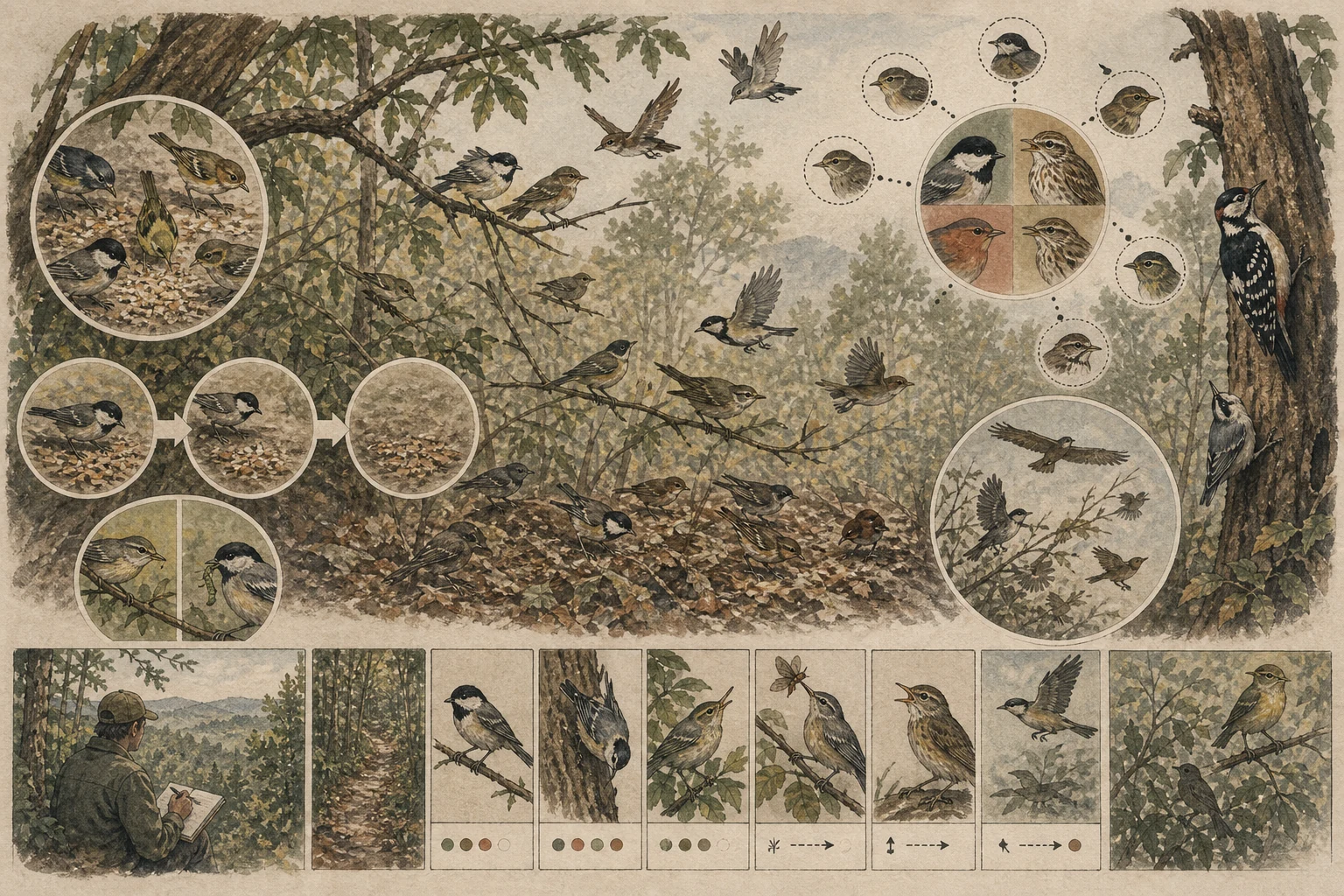
A winter woodlot can seem dead silent for half an hour and then suddenly fill with chickadees, titmice, nuthatches, kinglets, creepers, and downy woodpeckers working through the branches together. Before logging a mixed-species foraging flock, verify that the participants are genuinely moving as a cohesive social unit rather than independently converging on the same fruiting shrub, sap well, or bird feeder. Watch what happens when part of the group crosses a gap or trail: in a true mixed flock, multiple species travel in the same direction for at least several minutes, maintain loose spatial cohesion, and adjust their pace to stay with the moving wave. [1][2]
- Watch a canopy gap or trail crossing to see whether multiple species cross together along the same travel vector.
- Separate mobile foraging waves from stationary aggregations gathered around a single fruiting tree, puddle, or feeder.
- Record the clock time, habitat layer, travel bearing, and total duration over which the species remain associated.
Nuclear species are tendencies, not titles
Within many mixed flocks, species play noticeably unequal organizational roles. Persistent core or nuclear members—such as parids (chickadees and tits) in temperate forests or certain antwrens and tanagers in tropical canopies—call frequently, move steadily along the travel axis, and attract satellite or attendant species that join as the wave passes through their territories and drop out at a boundary. Yet leadership and nuclear status are behavioral tendencies rather than fixed badges: flock composition and influence shift across seasons, elevations, and forest types, and experimental work shows that species richness and parid numbers can shape how rapidly members locate new food patches. [2][3]
- Note which species give continuous contact calls at the front of the wave and which join silently for short stretches.
- Track whether attendant species drop back when the flock crosses a territorial boundary or habitat edge.
- Avoid assuming one species is always the leader; log actual movement order and calling rates in each encounter.
Benefits and costs occur together
Joining a mixed-species group alters both predation risk and foraging efficiency at the same time. Multiple species scanning different canopy layers and giving shared or eavesdropped alarm calls can spot approaching accipiters earlier, allowing individual birds to spend less time scanning and more time probing bark or foliage; insectivores may also snatch moths and cicadas flushed by larger companions. Simultaneously, traveling with heterospecifics brings real costs, including kleptoparasitism, interference, and local prey depletion. Co-occurring flock members frequently reduce direct conflict by partitioning microhabitats—with nuthatches working main trunks, creepers spiraling upward, kinglets hovering at outer twigs, and woodpeckers excavating subsurface wood. [1][4]
- Map each participant's vertical stratum, substrate (trunk, bough, outer twigs), and foraging technique within the same tree.
- Watch for flushed-prey capture or social copying when one bird locates a rich cluster of caterpillars or seeds.
- Log aggressive displacements and supplanting chases alongside cooperative alarm responses to capture both costs and benefits.
Follow with notes, not footsteps
Because a mixed foraging wave often moves through woodland at a brisk walk, observers are easily tempted to crash through brush or broadcast pishing and owl calls to hold the birds in view. Both habits distort the exact social dynamics you are trying to study: pishing and predator imitations trigger anti-predator mobbing rather than foraging behavior, and pushing off-trail scatters edge members. Instead, stay on an established path or pick a clear vantage point, scan systematically from canopy crown to understory to tally a minimum species and head count, and note joiners, dropouts, and natural alarm freezes as the wave flows past. [3][4]
- Scan vertically from upper canopy to shrub layer so quiet bark-foragers and ground-followers are not missed behind vocal leaders.
- Record head counts in dense foliage as explicit minimums rather than guessing how many birds are hidden in the leaves.
- Stay on trails and avoid pishing or playback, which switches a foraging flock into defensive mobbing behavior.
Related guides
Get Fauna and identify it in the field.
Where this guide comes from
Source-checked editorial guide. Last updated . This guide teaches identification and field skills; it is not a substitute for expert verification when it matters.
- Philosophical transactions of the Royal Society of London. Series B, Biological sciences — A classification scheme for mixed-species bird flocks ↗
- Biological reviews of the Cambridge Philosophical Society — Mixed company: a framework for understanding the composition and organization of mixed-species animal groups ↗
- PloS one — Mixed-species flock sizes and compositions influence flock members' success in three field experiments with novel feeders ↗
- Ecology and evolution — Seasonal changes in mixed-species bird flocks and antipredator information ↗