How plants defend against herbivores
Thorns, hairs, waxes, tough tissue, toxins, digestibility reducers, wound sealing, regrowth, and herbivore-induced chemistry form layered defenses. Volatiles and extrafloral nectar can alter predator or parasitoid behavior. Herbivores in turn avoid, detoxify, sequester, or suppress plant defenses, making outcomes specific to each interaction.
Last updated
Physical and chemical defenses act directly
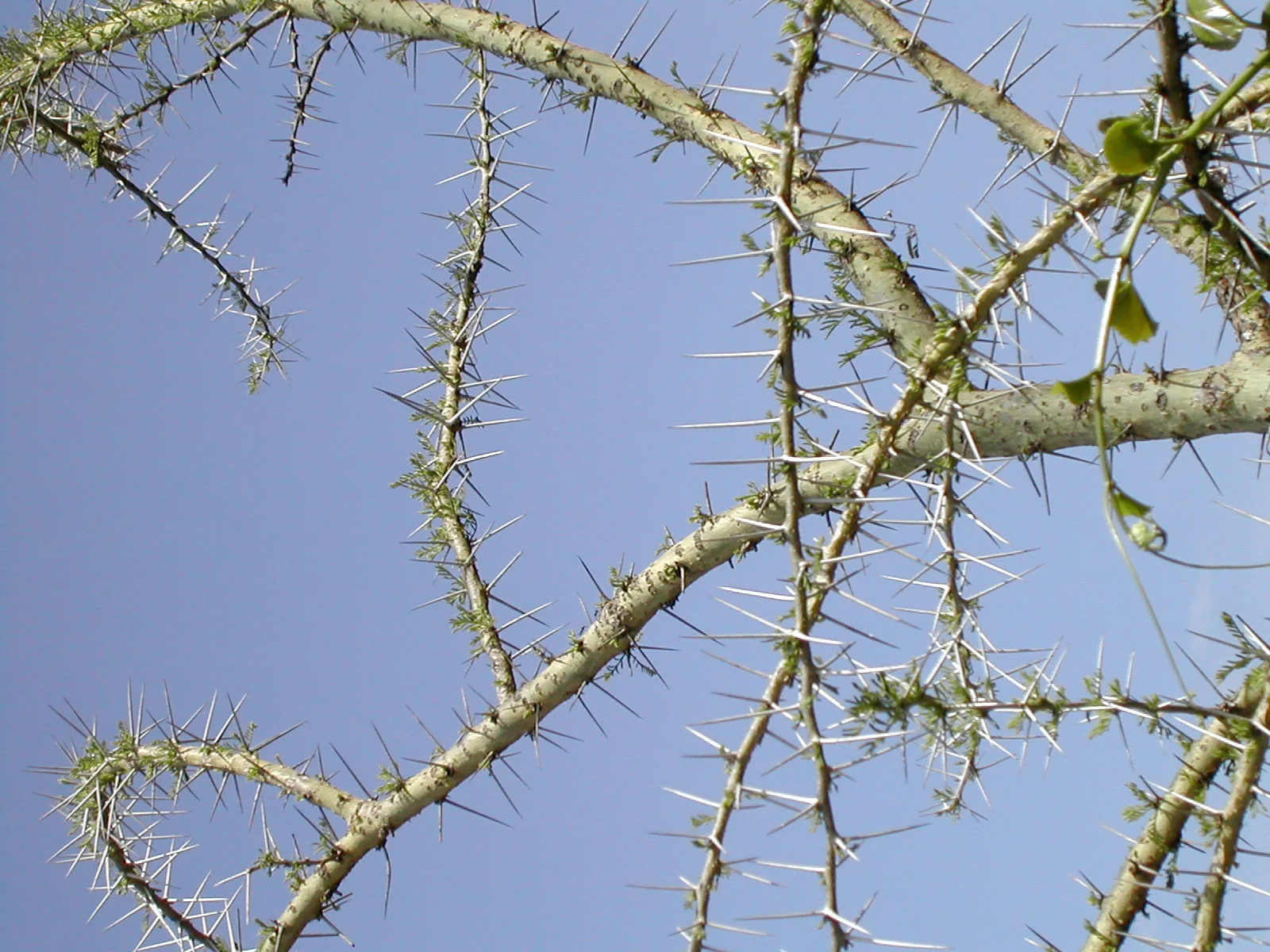
Rooted in place, plants confront browsing mammals, scraping snails, and leaf-chewing or sap-sucking insects with a first line of constitutive physical and chemical barriers. Long stipular spines and thorns on African fever trees (Vachellia xanthophloea) and honey locusts restrict bite size for large ungulates, while microscopic hooked or glandular trichomes impale caterpillars, abrasive silica phytoliths wear down insect mandibles, and pressurized latex or resin canals gum up mouthparts. Alongside structural armor, plants store vast repertoires of secondary metabolites—alkaloids, cyanogenic glycosides, glucosinolates, cardenolides, terpenoids, and proteinase inhibitors—that poison nervous systems or block protein digestion in non-adapted feeders. [1][2]
- Structural defenses range from vertebrate-deterring thorns and spines to microscopic leaf trichomes, waxy cuticles, and abrasive silica crystals.
- Chemical defenses include both direct toxins like alkaloids and cardenolides and digestibility reducers like proteinase inhibitors and tannins.
- Many defensive structures also serve non-defensive roles such as shading leaf surfaces, reducing water loss, or deterring fungal pathogens.
Damage can activate targeted responses
Maintaining maximum toxin levels in every leaf all season is metabolically expensive, so many plants pair baseline constitutive armor with inducible defenses that ramp up only after an attack begins. Plant cells distinguish mechanical wind tearing from true herbivory by detecting shattered cell-wall fragments alongside specific chemical elicitors—such as fatty-acid–amino-acid conjugates in caterpillar oral secretions or compounds in insect egg cement. Those cues trigger rapid calcium waves, reactive oxygen species, and phytohormone cascades: chewing insects typically activate the jasmonic acid pathway, whereas phloem-tapping aphids and whiteflies often trigger salicylic acid signaling. Some herbivores fight back by injecting salivary effectors that suppress host jasmonate responses. [1][4]
- Plants recognize specific elicitors in insect saliva and egg fluids, allowing them to distinguish herbivore feeding from wind or hail damage.
- Chewing caterpillars typically activate jasmonic acid defense pathways, while sap-feeding aphids often trigger salicylic acid pathways.
- Some specialist insects secrete salivary enzymes that actively mute or misdirect the host plant's induced chemical defenses.
Indirect defenses recruit ecological interactions
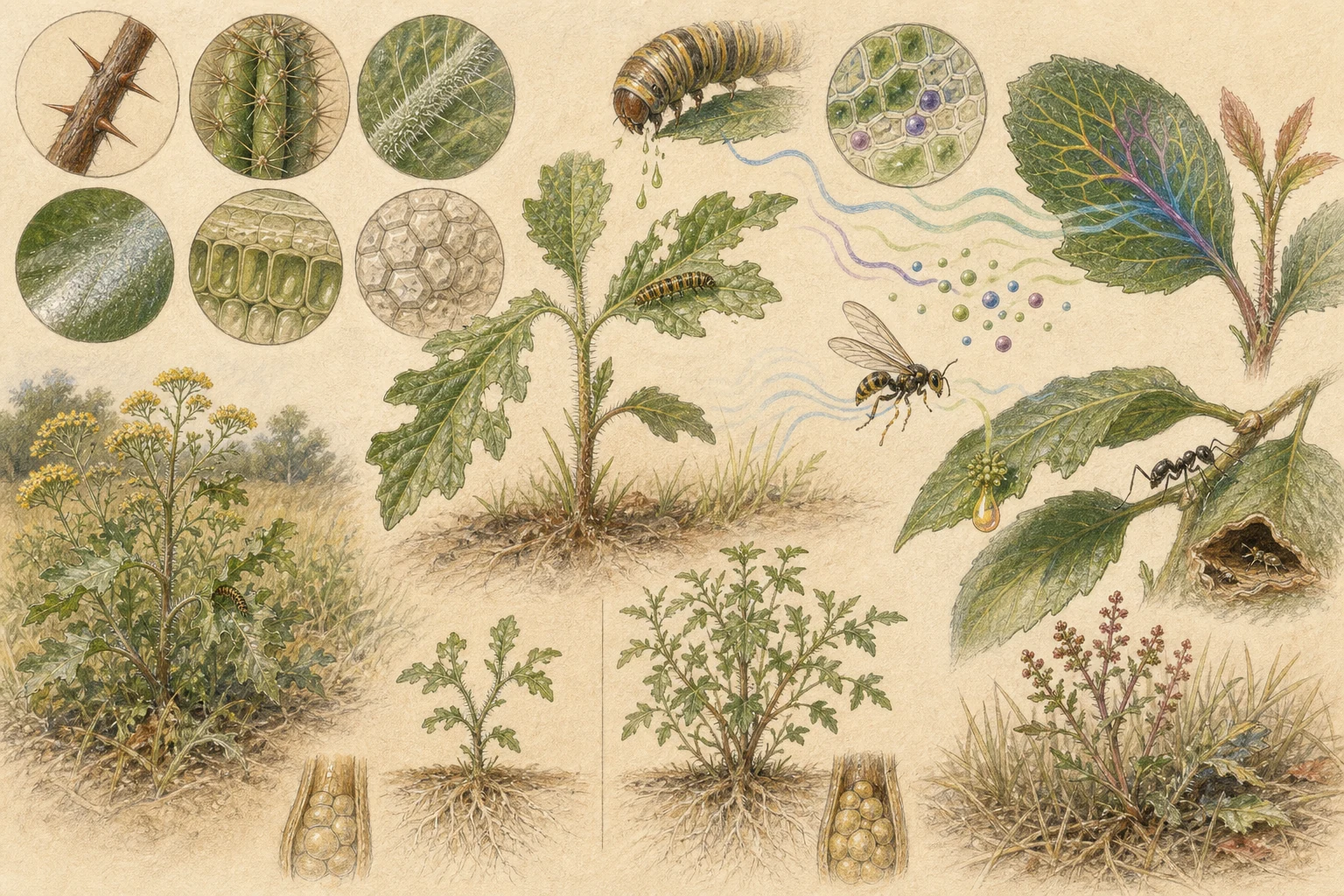
Beyond poisoning or impaling herbivores directly, damaged plants often alter interactions with the third trophic level—predators and parasitoids that attack the herbivores. Seconds to hours after a caterpillar chews a leaf, membranes release green leaf volatiles and synthesize terpenoid blends that predatory bugs, foraging birds, and parasitic braconid or ichneumonid wasps use as directional odor plumes to locate hosts. Many acacias, passionflowers, and cotton relatives also secrete extrafloral nectar or protein-rich food bodies and grow hollow domatia that house aggressive ants or predatory mites. Describing volatile release as an intentional ‘cry for help’ is misleading shorthand: volatiles also prime neighboring branches on the same plant, deter oviposition, and can attract specialist herbivores. [2][3]
- Herbivore-induced plant volatiles (HIPVs) provide chemical foraging cues that parasitic wasps and predators use to locate feeding caterpillars.
- Extrafloral nectaries, food bodies, and hollow domatia reward ants and predatory mites that patrol stems and remove herbivores.
- Induced leaf volatiles serve multiple physiological roles—including priming nearby branches on the same plant—and can also be eavesdropped on by pests.
Resistance and tolerance are different strategies
Plant defense ecology separates resistance—traits that prevent or reduce herbivore damage—from tolerance, the capacity to maintain growth, survival, and seed production after tissue is eaten. Grazing-adapted prairie grasses and browsed willows tolerate heavy defoliation by storing carbohydrates and nitrogen in underground roots or rhizomes, activating dormant axillary buds, and boosting photosynthetic rates in surviving leaves. Meanwhile, specialist herbivores continually evolve counter-adaptations to resistance: monarch caterpillars sequester milkweed cardenolides for their own defense, cabbage white larvae disarm mustard-oil bombs with nitrile-specifier proteins, and vein-cutting beetles drain pressurized latex canals before feeding beyond the cut. [3][4]
- Resistance reduces how much tissue herbivores consume, whereas tolerance sustains plant fitness and seed set after damage occurs.
- Grassland and browse-tolerant plants rely on underground carbohydrate reserves and dormant meristems to regrow rapidly after grazing.
- Specialist insects counter plant defenses by trenching leaf veins to drain latex, detoxifying metabolites, or sequestering plant toxins.
Related guides
Get Fauna and identify it in the field.
Where this guide comes from
Source-checked editorial guide. Last updated . This guide teaches identification and field skills; it is not a substitute for expert verification when it matters.
- Plant signaling & behavior — Mechanisms of plant defense against insect herbivores ↗
- International journal of molecular sciences — Plant defense against insect herbivores ↗
- International journal of molecular sciences — Green leaf volatiles: a plant's multifunctional weapon against herbivores and pathogens ↗
- Annals of botany — Mechanisms and ecological consequences of plant defence induction and suppression in herbivore communities ↗