How kelp forests support animals
Holdfasts, stipes, blades, and floating canopies add surfaces and shelter from seafloor to sea surface. Grazers consume kelp and epiphytes, detritus feeds animals inside and beyond the forest, and fish and invertebrates use the structure as nursery, feeding, and refuge habitat. Predators can indirectly protect kelp by limiting grazers in some regions.
Last updated
Kelp turns reef into layered habitat
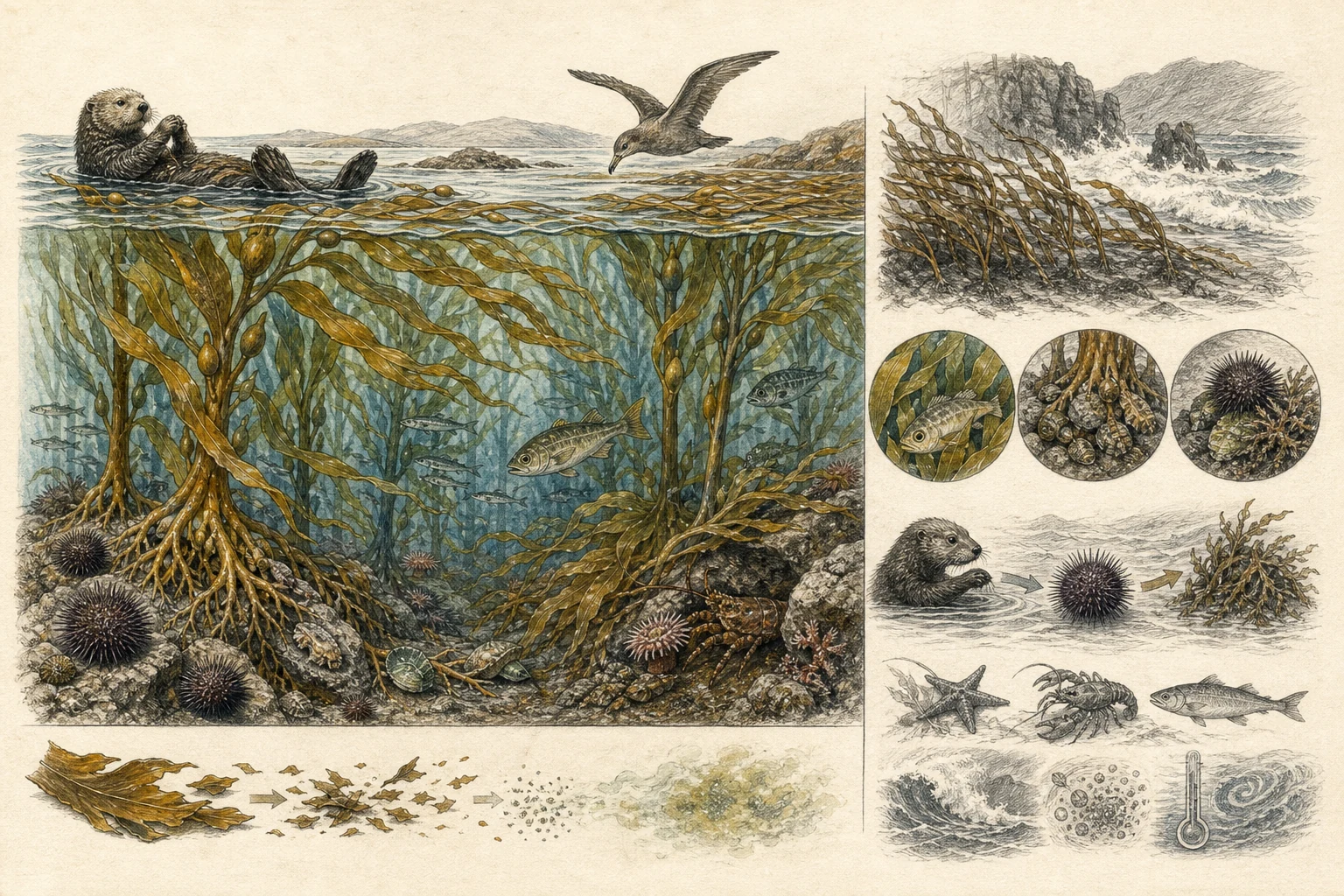
True kelps (order Laminariales) are giant brown macroalgae (ochrophytes) rather than vascular plants, yet they transform flat rocky reefs into multi-story underwater forests. Instead of soil-absorbing roots, a tangled cone of haptera called a holdfast grips bedrock and houses hundreds of brittle stars, polychaete worms, amphipods, and small crabs in its crevices. Flexible stipes rise toward the light like trunks, while broad blades and gas-filled bladders (pneumatocysts) in canopy-forming species such as giant kelp (Macrocystis pyrifera) and bull kelp (Nereocystis luetkeana) suspend a floating surface mat, allowing rockfish, kelp bass, nudibranchs, and marine mammals to partition the water column from benthic turf to sunlit canopy. [1][2]
- Kelps are large brown algae (Laminariales) that absorb nutrients directly across their blades rather than through their anchoring holdfasts.
- Tangled holdfast crevices shelter dense communities of brittle stars, worms, crustaceans, and juvenile invertebrates on the seafloor.
- Gas-filled pneumatocysts buoy giant and bull kelp fronds toward the surface, creating distinct benthic, midwater, and canopy habitat layers.
Production feeds more than direct grazers
In cool, nutrient-rich coastal upwelling zones, giant kelp is among the fastest-growing primary producers on Earth, extending up to half a meter per day under peak spring and summer conditions. Only a fraction of that biomass is eaten while still attached by direct herbivores such as sea urchins, abalone, turban snails, kelp crabs, and halfmoon fish. Much more enters the food web as dissolved organic matter and wave-torn drift kelp: sunken fronds feed sea cucumbers, passive-grazing urchins, and brittle stars on the reef floor, while ocean currents export detached kelp rafts onto sandy beaches—where beach hoppers and shorebirds feast—and down into deep submarine canyons that lack sunlight of their own. [1][3]
- Only a portion of living kelp is grazed directly on the stalk; wave-detached drift kelp and detritus fuel a much wider food web.
- Passive-feeding sea urchins and abalone remain in reef crevices when drift kelp fragments rain down abundantly onto the bottom.
- Winter storms and currents export torn kelp wrack to sandy beaches and deep submarine canyons, subsidizing food webs far beyond the reef.
Structure changes risk and opportunity
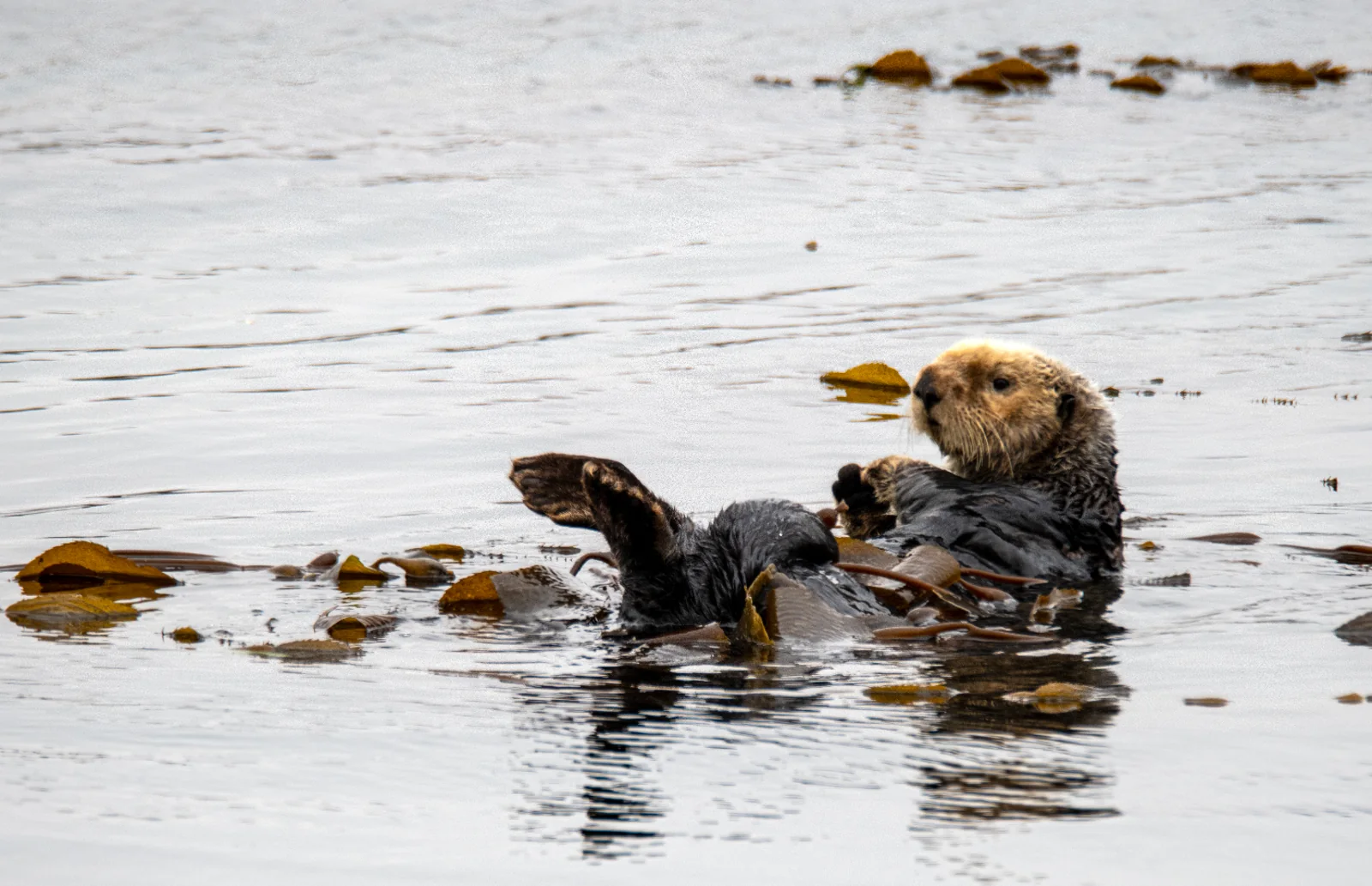
A dense stand of kelp alters the physical environment of a coastal reef just as a forest canopy modifies a hillside. Fronds dampen wave surge and slow alongshore currents, helping retain planktonic larvae close to the reef while shading the rock floor enough to let red and coralline understory algae compete with fast-growing turf. Juvenile rockfishes, cabezon, and perch use the mottled light and vertical blades as visual cover from pelagic predators, bryozoans and hydroids encrust the fronds, herons and gulls hunt small fishes from the floating surface mat, and sea otters drape kelp over their bodies to avoid drifting in the swell while resting or tending pups. [1][2]
- Dense kelp stands slow coastal currents and dampen wave surge, influencing larval retention and sediment movement on the reef.
- Canopy shading suppresses some fast-growing filamentous turfs and allows shade-adapted red and coralline algae to persist on the rock below.
- Juvenile rockfishes and invertebrates use midwater blades and holdfasts as refuge from larger visual predators.
Predators can protect the habitat indirectly
When drift kelp becomes scarce or grazer populations boom, hungry sea urchins can emerge from reef crevices in roaming fronts that chew through kelp holdfasts and turn a lush three-dimensional forest into an open crustose-coralline ‘urchin barren.’ Along parts of the northeast Pacific coast, sea otters act as keystone predators that limit urchin density and behavior, indirectly preserving kelp canopies in a classic trophic cascade. Across California and global kelp regions, however, food-web control involves a wider cast—including sunflower sea stars (Pycnopodia), spiny lobsters, California sheephead, wolf eels, and urchin viral or bacterial epidemics—interacting with marine heatwaves, El Niño nutrient drops, and winter storm waves. [3][4]
- When drift food runs short and predators are scarce, roaming sea urchins can graze through holdfasts and shift reefs into urchin barrens.
- In parts of the North Pacific, sea otters suppress urchin grazing, while spiny lobsters, sheephead, and predatory sea stars fill key roles elsewhere.
- Marine heatwaves, nutrient-poor warm water, and storm swell interact with grazing pressure to govern kelp collapse and recovery.
Related guides
Get Fauna and identify it in the field.
Where this guide comes from
Source-checked editorial guide. Last updated . This guide teaches identification and field skills; it is not a substitute for expert verification when it matters.