How carnivorous plants trap prey
Sticky flypaper, slippery pitchers, snap traps, suction bladders, and inward-pointing passage traps evolved independently in nutrient-poor habitats. Glands and trap communities break prey into soluble compounds that plant tissues absorb, especially nitrogen and phosphorus; sunlight still supplies the energy and carbon for growth.
Last updated
Different traps solve capture differently
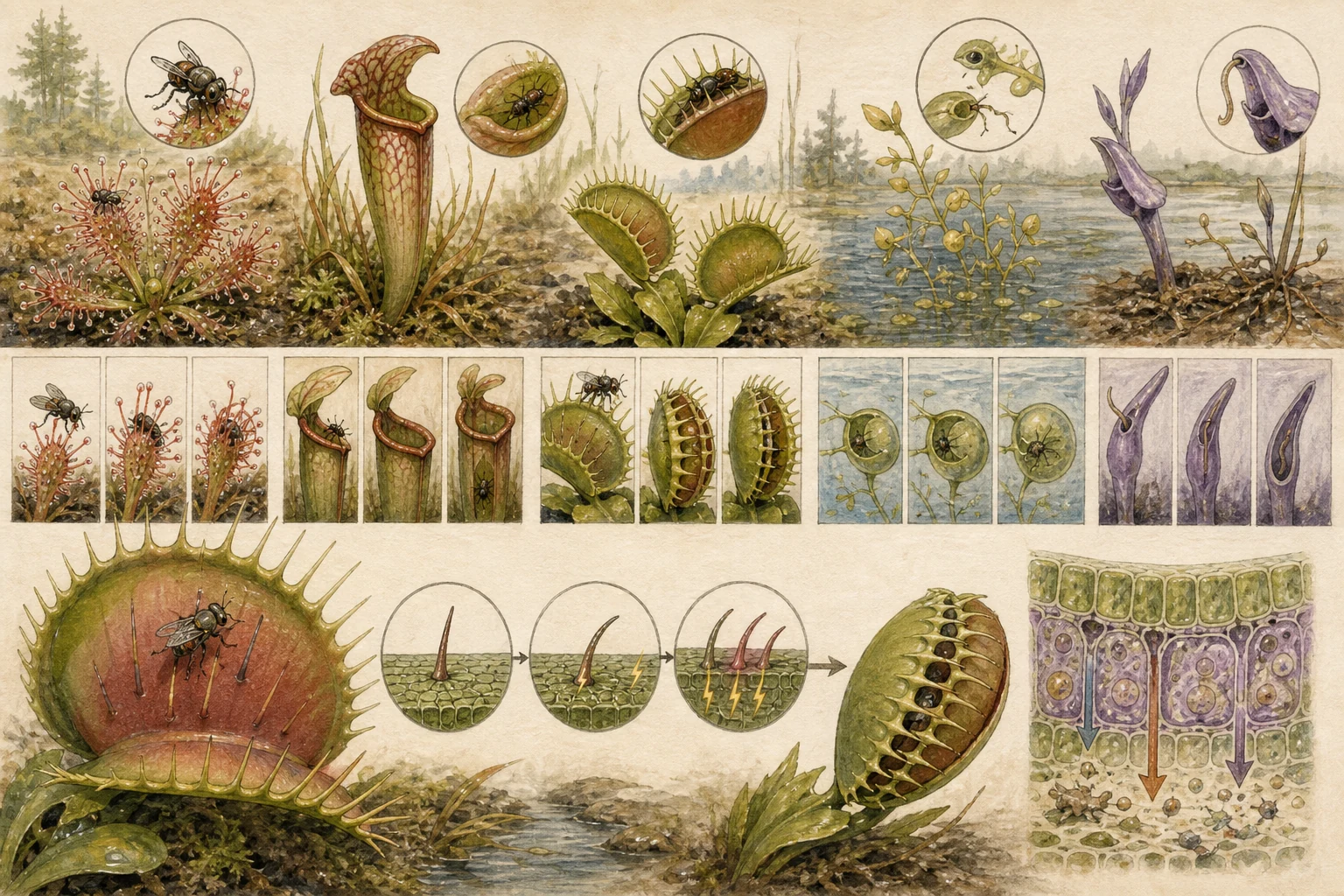
True plant carnivory has evolved independently at least a dozen times across flowering plants, producing five major trap architectures built from modified leaves. Sundews (Drosera) and butterworts (Pinguicula) snare insects on glistening drops of viscoelastic mucilage; pitcher plants (Nepenthes, Sarracenia, Cephalotus, and Heliamphora) lure visitors onto nectar-slick peristomes and waxy walls that send them plunging into fluid wells; Venus flytraps (Dionaea) and waterwheel plants (Aldrovanda) snap shut bilobed blades; bladderworts (Utricularia) fire underwater suction bladders in milliseconds when prey brush trigger bristles; and corkscrew plants (Genlisea) guide soil protozoans and microcrustaceans through inward-pointing hairs that prevent backing out. [1][2]
- Carnivorous plants use five main trap mechanics: adhesive flypaper, pitfall pitchers, snap traps, suction bladders, and lobster-pot passages.
- Carnivory evolved independently across multiple plant orders in response to nutrient-starved habitats.
- Calling a trap active or passive refers only to whether capture involves rapid leaf movement, not whether glands physiologically respond after capture.
The flytrap filters repeated stimulation
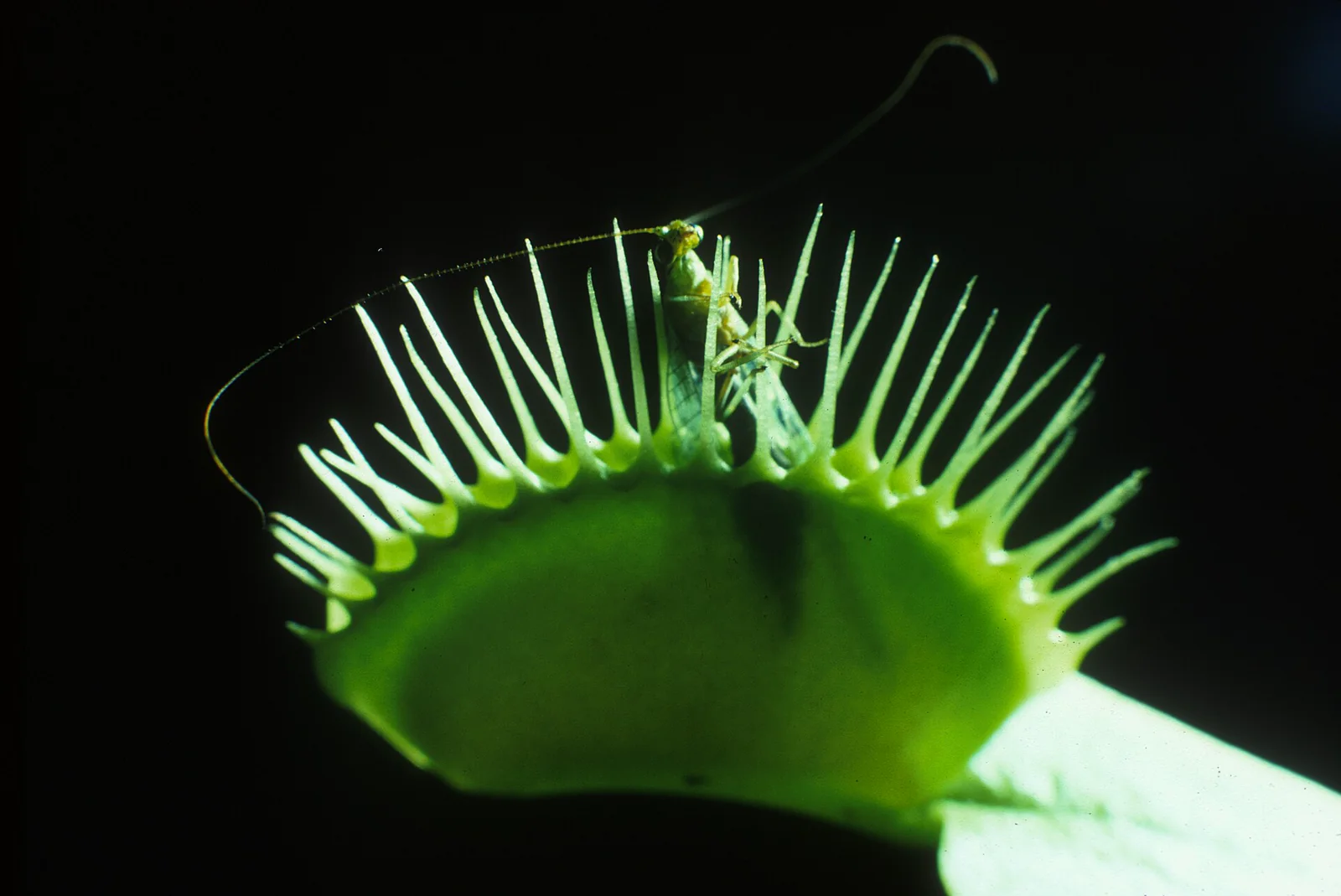
In the coastal bogs of the Carolinas, a Venus flytrap avoids wasting energy on windblown pine needles or falling raindrops by filtering mechanical touches through an electrical threshold. Each inner trap lobe bears sensitive trigger hairs; bending one hair opens mechanosensitive ion channels and fires a calcium-mediated action potential across the blade without closing the trap. Only if a second touch arrives within roughly 20 to 30 seconds does cytosolic calcium cross the threshold that releases elastic curvature stored in the lobes, snapping the marginal teeth shut in a fraction of a second. Continued struggling by the trapped lacewing or beetle fires further action potentials that trigger jasmonate signaling, hermetically seal the rim, and flood the chamber with digestive fluid. [2][4]
- Two touches to trigger hairs within roughly 20 to 30 seconds are normally required to fire the action potentials that snap a Venus flytrap shut.
- This two-step electrical threshold prevents costly false closures from a single raindrop or windblown speck of debris.
- Repeated mechanical and chemical stimulation from struggling prey triggers jasmonate hormones that seal the trap and start enzyme secretion.
Digestion and absorption complete carnivory
Catching and killing insects is not enough to make a plant carnivorous in the strict botanical sense: many sticky wildflowers and glandular stems trap midges solely as a defense against crawling herbivores. True carnivory requires that nutrients liberated from dead prey be absorbed into plant tissues and contribute measurably to growth or seed set. In flytraps, sundews, and many pitchers, specialized digestive glands pump protons to acidify the trap fluid and secrete proteases, phosphatases, chitinases, and nucleases—enzymes evolutionarily repurposed from pathogen-defense proteins—before membrane transporters take up ammonium, amino acids, peptides, and phosphate. In several Sarracenia and bromeliad pitchers, symbiotic bacteria and midge larvae perform much of the initial shredding and mineralization. [1][3]
- Many non-carnivorous plants trap insects on sticky defensive hairs without digesting or absorbing nutrients from the carcasses.
- Carnivorous plant glands repurpose ancestral pathogen-defense enzymes like chitinases and proteases to dissolve insect exoskeletons and tissues.
- Some pitcher traps rely heavily on resident bacteria, protozoa, and insect larvae to break down prey and release soluble nutrients.
Prey supplies fertilizer, not photosynthetic energy
Even the most voracious sundew, pitcher plant, or flytrap still relies on chlorophyll, sunlight, and atmospheric carbon dioxide to manufacture its sugars. Carnivorous plants are concentrated in sunny, waterlogged bogs, acidic seepage slopes, and leached quartz sands where anoxic conditions and acidity lock up mineral nitrogen, phosphorus, potassium, and sulfur. Digesting arthropod prey acts as a foliar fertilizer supplement that boosts rubisco investment and photosynthetic capacity in newly formed leaves. Because traps themselves have high construction costs and lower photosynthetic rates than flat green leaves, carnivory pays off evolutionarily only where light and water are plentiful while soil minerals are severely limiting: add fertilizer or heavy shade, and many carnivorous plants reduce trap production altogether. [3][4]
- Carnivorous plants obtain energy and carbon from sunlight via photosynthesis; insect prey supplies mineral fertilizer like nitrogen and phosphorus.
- Traps are photosynthetically inefficient to build and maintain, so carnivory is favored mainly in sunny, wet, nutrient-impoverished soils.
- When shaded or grown in nitrogen-rich soil, many pitcher plants and sundews shift investment from traps back to ordinary flat leaves.
Related guides
Get Fauna and identify it in the field.
Where this guide comes from
Source-checked editorial guide. Last updated . This guide teaches identification and field skills; it is not a substitute for expert verification when it matters.
- Plant physiology — The digestive systems of carnivorous plants ↗
- AoB PLANTS — Fastest predators in the plant kingdom: functional morphology and biomechanics of suction traps found in the largest genus of carnivorous plants ↗
- Annals of botany — Recent ecophysiological, biochemical and evolutional insights into plant carnivory ↗
- Plant physiology — Signaling and transport processes related to the carnivorous lifestyle of plants living on nutrient-poor soil ↗