How mangroves handle salt
Salt makes water harder to extract and excess sodium and chloride can disrupt cells. Mangrove roots restrict much ion movement into xylem, tissues isolate ions in vacuoles, and organic solutes protect the cytoplasm. Some species add leaf salt glands or discard salt-rich leaves; strategies and tolerances vary across lineages.
Last updated
Salinity creates a water problem first
Rooted in intertidal seawater where dissolved salts reach roughly 35 parts per thousand—and even higher in sun-baked hypersaline mudflats—mangroves face a severe physiological drought right in the middle of standing water. Because dissolved sodium and chloride ions strongly lower the osmotic water potential of tidal porewater, ordinary plant roots would lose water outward rather than pulling it in. Mangroves overcome that gradient by maintaining even more negative internal water potentials: their cells pump inorganic ions into membrane-bound central vacuoles while synthesizing organic compatible solutes such as proline, glycine betaine, and polyols in the cytoplasm to balance osmotic pressure without poisoning delicate enzymes. [1][4]
- Seawater has a low osmotic potential, forcing mangroves to maintain even more negative internal water potentials to draw water into roots.
- Cells lock excess sodium and chloride inside vacuoles while accumulating harmless organic solutes like proline in the cytoplasm.
- Thick waxy leaves, sunken stomata, and conservative water use help mangroves minimize how much saline water they must process each day.
Roots exclude much, but not all, salt
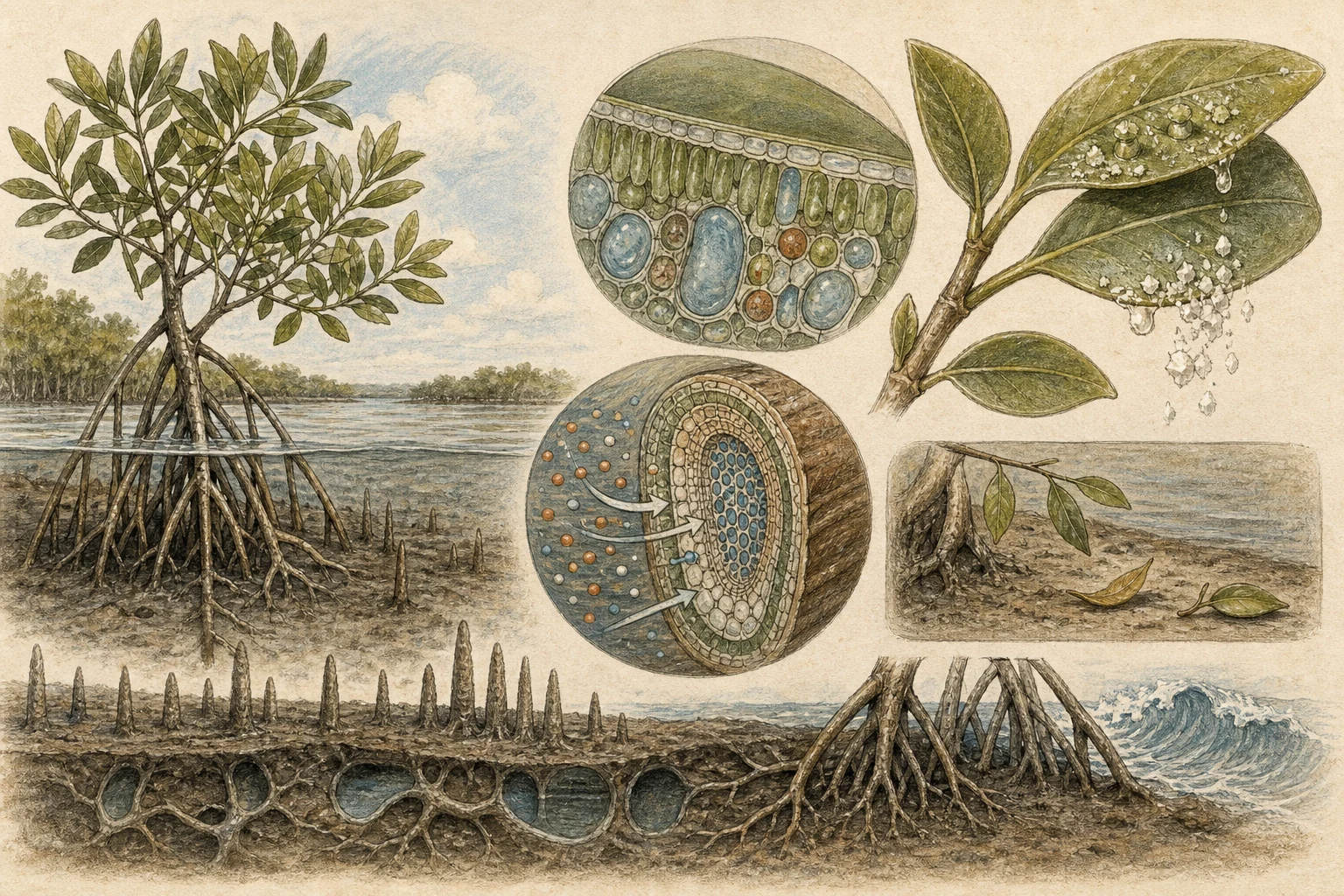
As tidal water is pulled toward the root xylem by transpiration tension, mangrove roots filter out roughly 80 to 99 percent of the dissolved salt at the root epidermis and endodermis. Hydrophobic suberin and lignin depositions in the Casparian strip block apoplastic water and ions from slipping unchecked between cell walls, forcing water to pass across selectively permeable cell membranes and aquaporins while sodium–proton antiporters pump excess sodium back out. Even in classic ‘salt-excluding’ red mangroves (Rhizophora), however, xylem sap is still significantly saltier than in terrestrial trees, so root filtration works alongside internal ion compartmentalization rather than acting as a 100 percent desalination membrane. [1][2]
- Suberized Casparian strips in young roots block passive salt flow between cells and force water through selective cell membranes.
- Red mangroves (Rhizophora) exclude a very high fraction of seawater salt at the root surface, though some ions still enter the xylem sap.
- Root exclusion efficiency varies by species, salinity level, root age, and sediment oxygen availability.
Leaves manage the salt that arrives
The sodium and chloride ions that do travel up the xylem into the canopy are handled differently across the roughly 70 mangrove species from nearly 20 plant families. Salt-secreting genera—such as black and grey mangroves (Avicennia), white mangroves (Laguncularia), and river mangroves (Aegiceras)—use specialized multicellular salt glands on their leaf surfaces to actively pump out concentrated brine, which dries into glittering cubic salt crystals until rain or wind clears the blade. Non-secreting mangroves such as Rhizophora and Bruguiera instead store incoming ions inside expanding water-storage tissues and vacuoles, producing succulent leaves and eventually shedding old, senescent yellow leaves along with their accumulated salt load. [2][4]
- Black, grey, and white mangroves (Avicennia and Laguncularia) actively excrete brine through microscopic leaf salt glands.
- Red mangroves (Rhizophora) lack salt glands and instead sequester ions inside leaf vacuoles and succulent water-storage tissues.
- Seeing salt crystals on a mangrove leaf identifies a salt-secreting lineage rather than a universal trait of all mangrove trees.
Tides add oxygen and stability challenges
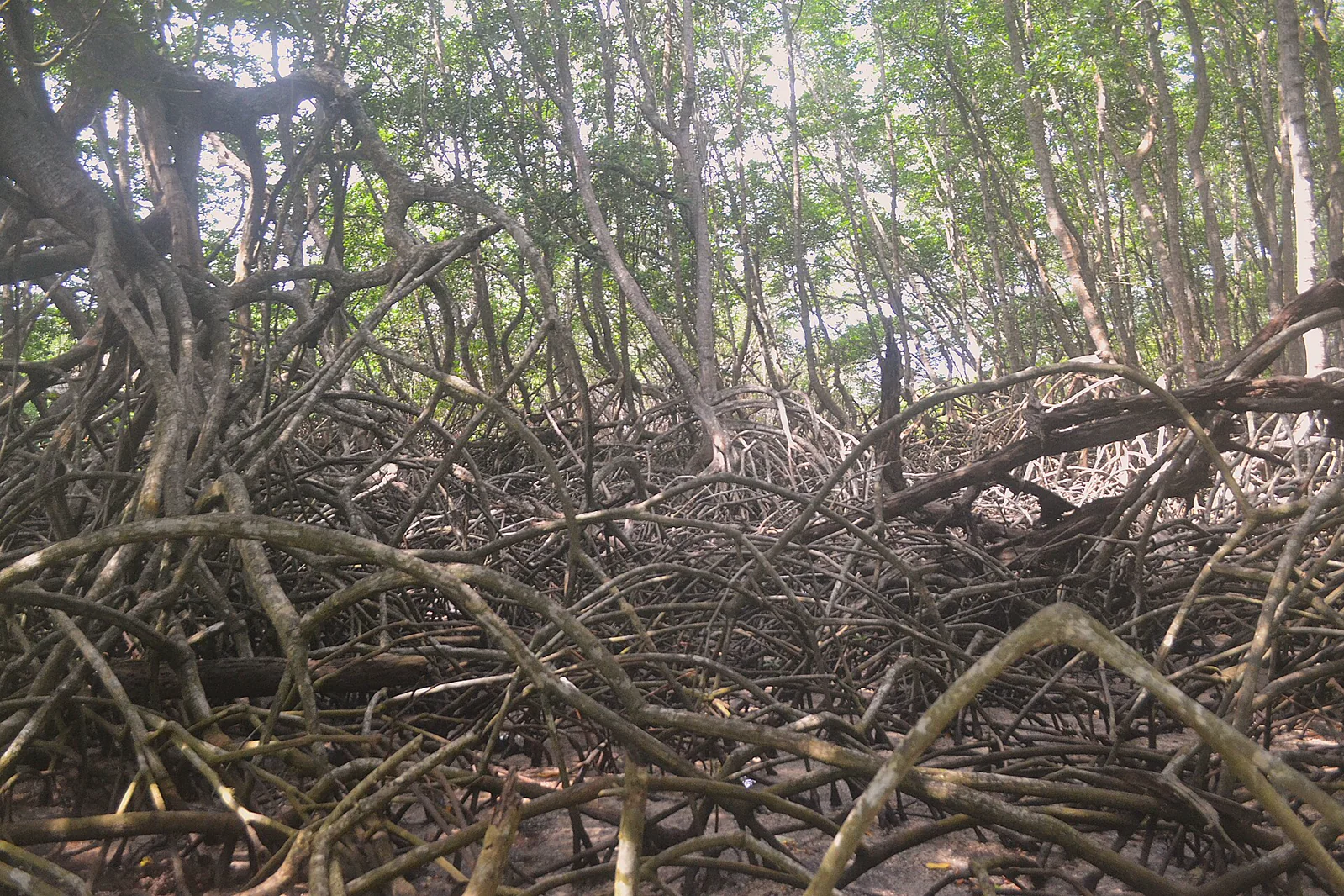
Walking along a mangrove shoreline, the most striking structures in view—arching stilt and prop roots in Rhizophora, pencil-like upward-growing pneumatophores in Avicennia and Sonneratia, and ribbon-like plank buttresses—are primarily adaptations for anchoring in shifting tidal mud and breathing in anoxic, waterlogged sediment rather than filtering salt. Covered in spongy lenticels and filled with internal air channels called aerenchyma, these aerial roots pipe atmospheric oxygen down to buried absorbing roots that would otherwise suffocate in sulfide-rich mud. Most mangroves can actually grow well in freshwater when planted alone, showing that their coastal dominance reflects tolerance of combined salt and flooding where terrestrial competitors fail. [2][3]
- Arching prop roots and vertical pneumatophores supply oxygen to buried roots via aerenchyma and anchor trees in soft tidal mud.
- Surface lenticels on aerial roots allow gas exchange at low tide while blocking water entry when submerged at high tide.
- Most mangroves are facultative halophytes that can grow in freshwater, but dominate salty tidal flats where inland trees cannot survive.
Related guides
Get Fauna and identify it in the field.
Where this guide comes from
Source-checked editorial guide. Last updated . This guide teaches identification and field skills; it is not a substitute for expert verification when it matters.