How caterpillars defend themselves
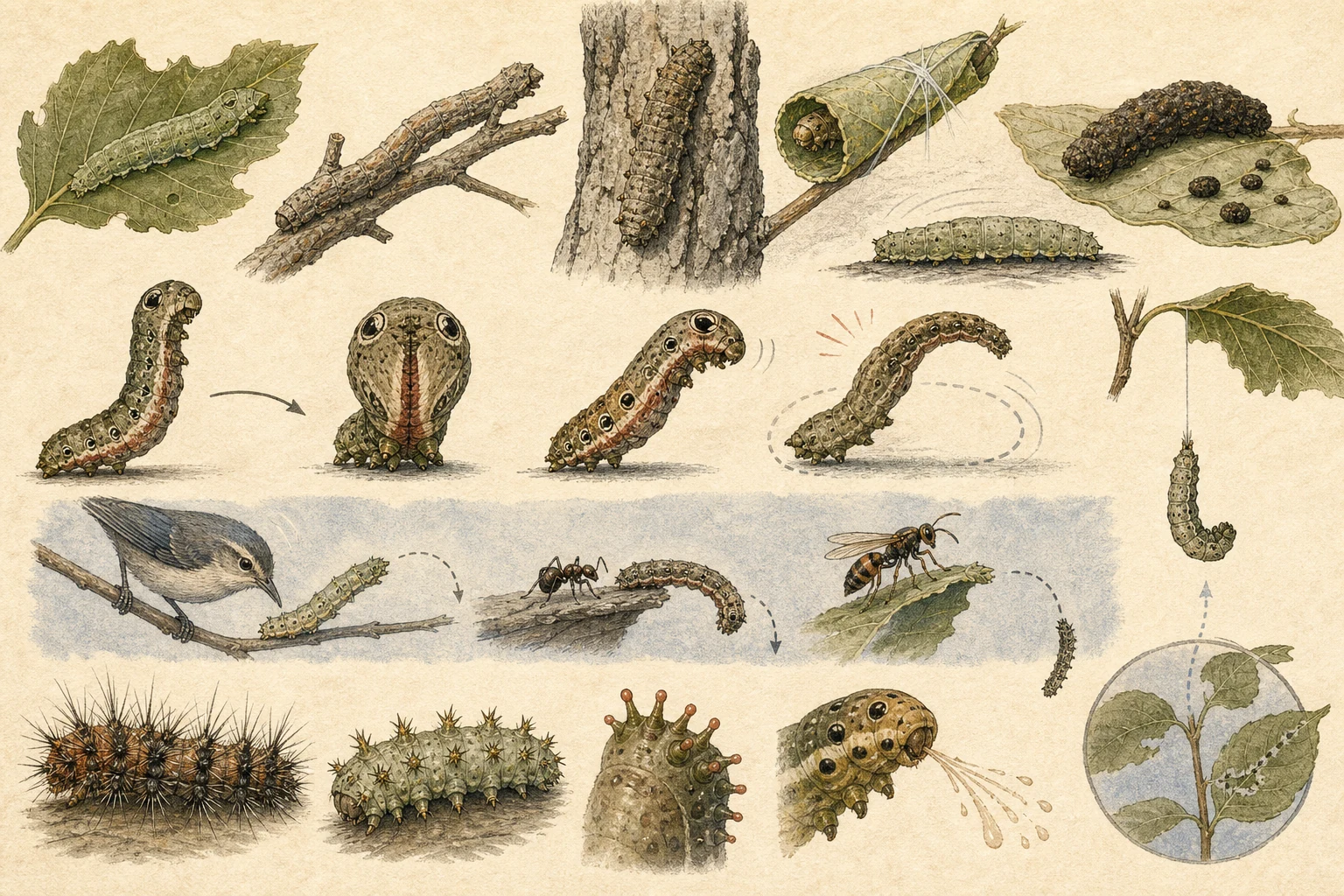
A caterpillar's defense is often layered. Avoiding detection comes first; after discovery it may posture, flee, drop, expose spines, click, regurgitate, or advertise chemicals acquired from its host plant.
Last updated
Avoid being found
For a slow, soft-bodied larva surrounded by foraging birds, wasps, and spiders, the cheapest defense is never triggering an attack in the first place. Geometrid inchworms hold their bodies rigid at a forty-five-degree angle to masquerade as woody twigs, early-instar swallowtails resemble glossy bird droppings on upper leaf surfaces, and many green caterpillars pair countershaded bellies with leaf-vein stripes. Other species stitch or roll leaves with silk into enclosed shelters and emerge only after dark, while boldly banded larvae such as the cinnabar moth (Tyria jacobaeae) blend surprisingly well into dappled yellow-and-black ragwort inflorescences at a distance yet read as warning-colored up close. [1][3]
- Twig masquerade, bird-dropping mimicry, and countershading prevent predators from recognizing a caterpillar as prey
- Leaf-rolling and silk-tying larvae feed inside concealed shelters and often clip chewed leaves free to hide damage cues
- Distance-dependent patterns can blend into flowers or foliage from afar while acting as warning signals at close range
Startle or redirect an attacker
Once a bird or lizard spots a caterpillar, sudden deimatic (startle) displays can make the predator hesitate long enough for the attack to abort. Swallowtail and hawkmoth larvae retract the head into an inflated thoracic hood emblazoned with paired, vertebrate-like eyespots, while some silk-moth and hornworm caterpillars click their mandibles, hiss by forcing air through spiracles, or flick eversible scent glands. Field experiments placing artificial caterpillars of different body sizes out for wild birds showed that eyespots are size-dependent: large eyespots on large caterpillar models deterred avian strikes effectively, whereas adding eyespots to tiny larvae actually increased predation by making small prey more conspicuous. [1][4]
- Rearing the thorax and inflating vertebrate-like eyespots can startle insectivorous birds into aborting a strike
- Field experiments show eyespots protect large caterpillars best, whereas small larvae do better remaining cryptic
- Sudden mandible clicking or thrashing often accompanies visual startle displays when a larva is prodded
Drop, thrash, or hang by silk
When an ant, hunting wasp, or parasitoid touches a caterpillar on a stem, the larva's immediate post-contact options are vigorous thrashing, rapid crawling, or abseiling off the leaf on a silk lifeline spun from its labial spinneret. Hanging in midair by a single thread pulls the caterpillar out of reach of walking invertebrate predators on the branch while sparing it a costly fall into ground-foraging ants below; once vibrations subside, the caterpillar haul-climbs its silk line back to the host leaf. Because dangling costs feeding time and can expose the larva to hanging-prey specialists, species adjust how readily they drop according to instar size, temperature, and attacker identity. [1]
- Bungee-dropping on a labial silk thread removes the larva from hunting ants and wasps walking on the leaf
- After danger passes, the caterpillar climbs back up its silk lifeline by wrapping thread around its thoracic legs
- Younger instars drop on silk more readily than heavy late instars, which often thrash or regurgitate instead
Make contact unpleasant
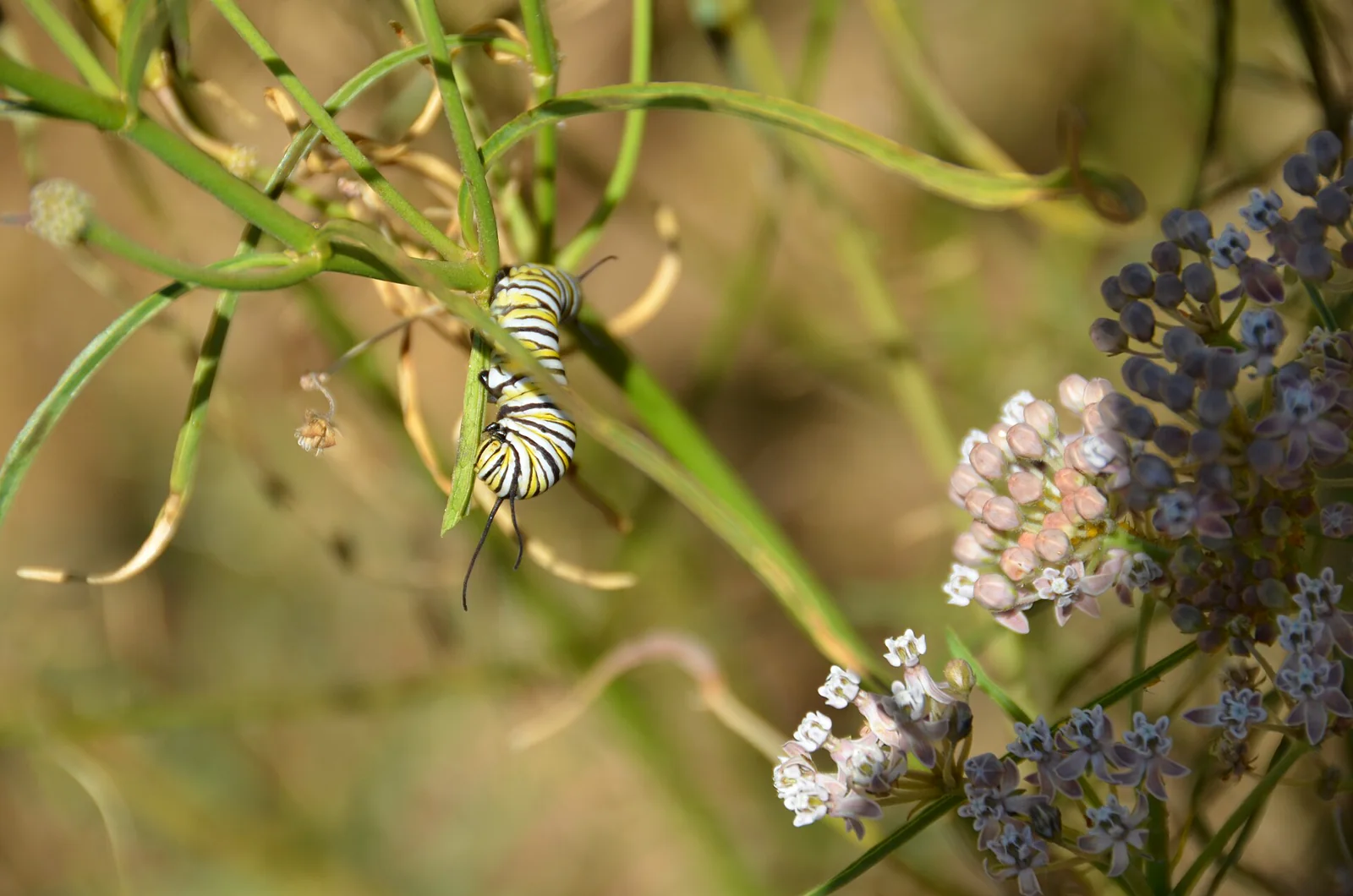
If an attacker presses home its bite or ovipositor strike, mechanical and chemical defenses come into play. Dense tufts of setae, barbed hairs that detach on contact, or hollow venomous spines can block small invertebrates or sting vertebrate mouths, though many fuzzy caterpillars—such as wooly bears—are non-venomous and rely primarily on mechanical bristle barriers. Internally or orally, larvae such as monarch caterpillars sequester cardenolides from milkweed, swallowtails evert foul-smelling osmeteria, and many species regurgitate a dark droplet of foregut fluid; experiments show that the potency of that defensive regurgitant against parasitoids depends directly on the secondary chemistry of the host plant the caterpillar has been eating. [1][2][3]
- Defensive oral regurgitation coats attackers in sticky gut fluid enriched with host-plant secondary compounds
- Host-plant diet directly changes how well a caterpillar's regurgitant or body tissues repel predators and parasitoids
- Never handle unfamiliar spined or brightly tufted caterpillars bare-handed, as urticating hairs and venom spines vary by group
Related guides
Get Fauna and identify it in the field.
Where this guide comes from
Source-checked editorial guide. Last updated . This guide teaches identification and field skills; it is not a substitute for expert verification when it matters.
- Journal of Asia-Pacific Entomology — Hanging by a Thread: Post-Attack Defense of Caterpillars ↗
- Ecology and evolution — The spitting image of plant defenses: Effects of plant secondary chemistry on the efficacy of caterpillar regurgitant as an anti-predator defense ↗
- University of Bristol — Caterpillar Warning System Also Helps It Disappear ↗
- Proceedings of the National Academy of Sciences of the United States of America — Body size affects the evolution of eyespots in caterpillars ↗