How penguins stay warm
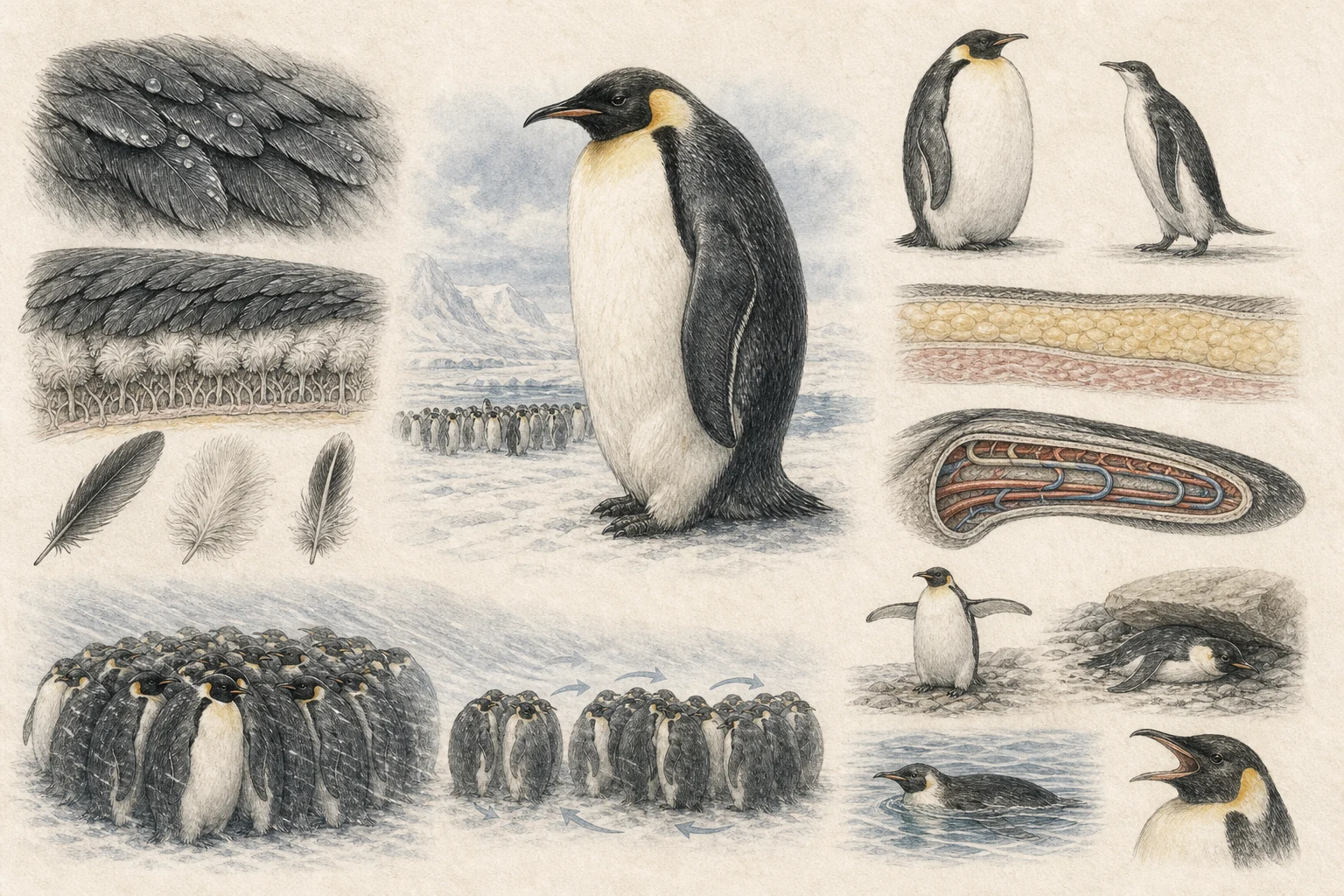
A penguin's waterproof outer feather surface and downy afterfeathers hold insulating air near the skin. Fat and compact shape add resistance, while countercurrent blood vessels recover heat from flippers and feet; behavior adjusts exposure, and emperor penguins share warmth in moving huddles.
Last updated
A dense feather coat traps air
More than 80 percent of a penguin's thermal insulation on land comes from its remarkable plumage rather than subcutaneous blubber alone. Detailed morphological mapping of emperor penguins (Aptenodytes forsteri) revealed four distinct feather types—stiff contour feathers, large downy afterfeathers attached to the main shaft, separate plumules, and hair-like filoplumes—arranged in an overlapping, shingle-like shell over a dense mat of tangled down. On Antarctic sea ice, this dual layer holds a warm boundary blanket of trapped air next to the skin that is so effective the outer plumage surface actually radiatively cools below the surrounding subzero air temperature without chilling the bird's 38°C core. [1][2]
- Emperor penguin plumage combines stiff outer contour feathers with downy afterfeathers and plumules that trap a deep insulating air layer.
- Thermal imaging on Antarctic ice shows a penguin's outer feather surface can drop colder than the surrounding air while the core stays near 38°C.
- During annual catastrophic molt, penguins must fast ashore because losing their waterproof feather seal would cause rapid hypothermia in water.
Shape, fat, and blood flow retain core heat
Beneath the skin, a thick layer of subcutaneous blubber provides both metabolic fuel for multi-week breeding fasts and backup thermal resistance when water pressure squeezes air out of the feathers during deep dives. To keep unfeathered feet and thinly covered flippers from draining core warmth into sea ice or freezing seawater, penguins rely on vascular countercurrent heat exchangers (the humeral and tibial retia mirabilia). Warm arterial blood leaving the trunk runs through bundles of vessels closely intertwined with cold venous blood returning from the feet and flippers, transferring heat back to the core so the soles of the feet stay just a few degrees above freezing—warm enough to prevent frostbite while losing minimal energy. [2][4]
- Countercurrent vascular bundles in the shoulders and legs transfer heat from outgoing arteries to returning veins before blood reaches the extremities.
- Keeping foot temperature just above tissue freezing minimizes conductive heat loss into sea ice.
- Rocking back onto the heels with the toes lifted and braced against the stiff tail reduces ice contact area by an order of magnitude.
Emperor huddles behave like moving heat systems
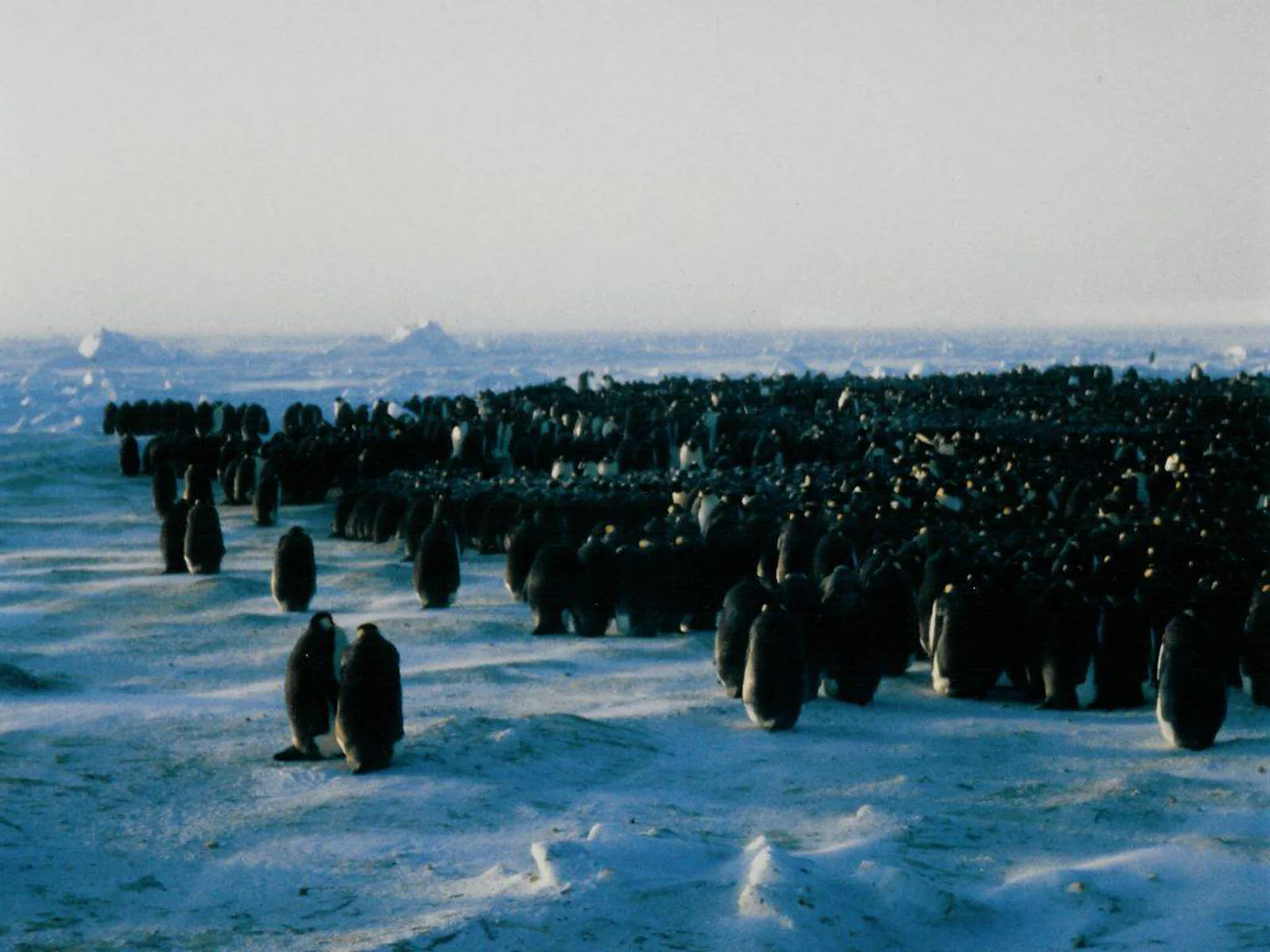
Male emperor penguins (Aptenodytes forsteri) are the only birds that incubate an egg balanced on their feet through the dark Antarctic winter, fasting for up to four months in winds exceeding 100 kilometers per hour and temperatures below -40°C. To cut metabolic heat loss in half, hundreds or thousands of males pack together at up to ten birds per square meter. Time-lapse tracking shows that a huddle is not a static pile: every 30 to 60 seconds, small coordinated 5- to 10-centimeter steps propagate through the packed flock like a slow traveling wave, continuously cycling wind-chilled birds from the windward flank into the warm interior—where ambient temperatures among feathers can pass 20°C to 35°C—before the center overheats. [3][4]
- Wintering male emperor penguins pack at densities around 8 to 10 birds per square meter while balancing single eggs on their feet.
- Coordinated small steps propagate through the huddle every 30 to 60 seconds, reorganizing packing and rotating exposed edge birds inward.
- Huddles routinely break apart when interior temperatures climb too high or winds subside, allowing birds to shed excess heat.
Penguins must sometimes shed heat too
Because penguin plumage and blubber are engineered to resist rapid heat loss in cold water—which conducts heat roughly 25 times faster than air—penguins standing in calm sunshine or exercising ashore can easily overheat. Even Antarctic Adélie and emperor penguins hold their flippers out from their flanks, ruffle their contour feathers to vent trapped air, pant with open bills, or eat snow on sunny summer days. Temperate and tropical species such as Humboldt, Magellanic, African, and Galápagos penguins (Spheniscus mendiculus) go further: they flush warm blood through patches of bare pink skin around the eyes and bill base, stand in sea breezes with flippers extended, and nest inside shaded burrows or lava crevices. [2][4]
- Holding flippers out away from the body and flushing them with blood turns them into thermal radiators when a penguin is warm.
- Burrow-nesting Spheniscus penguins in temperate and tropical climates possess bare facial skin patches that dump excess heat in air.
- Ruffling contour feathers breaks the trapped-air seal so wind can cool the skin after vigorous swimming or onshore climbing.
Related guides
Get Fauna and identify it in the field.
Where this guide comes from
Source-checked editorial guide. Last updated . This guide teaches identification and field skills; it is not a substitute for expert verification when it matters.
- Proceedings. Biological sciences — Hidden keys to survival: the type, density, pattern and functional role of emperor penguin body feathers ↗
- Australian Antarctic Program — Emperor penguins ↗
- Physiology & behavior — Huddling behavior in emperor penguins: Dynamics of huddling ↗
- Biology letters — Emperor penguin body surfaces cool below air temperature ↗