How snakes move without legs
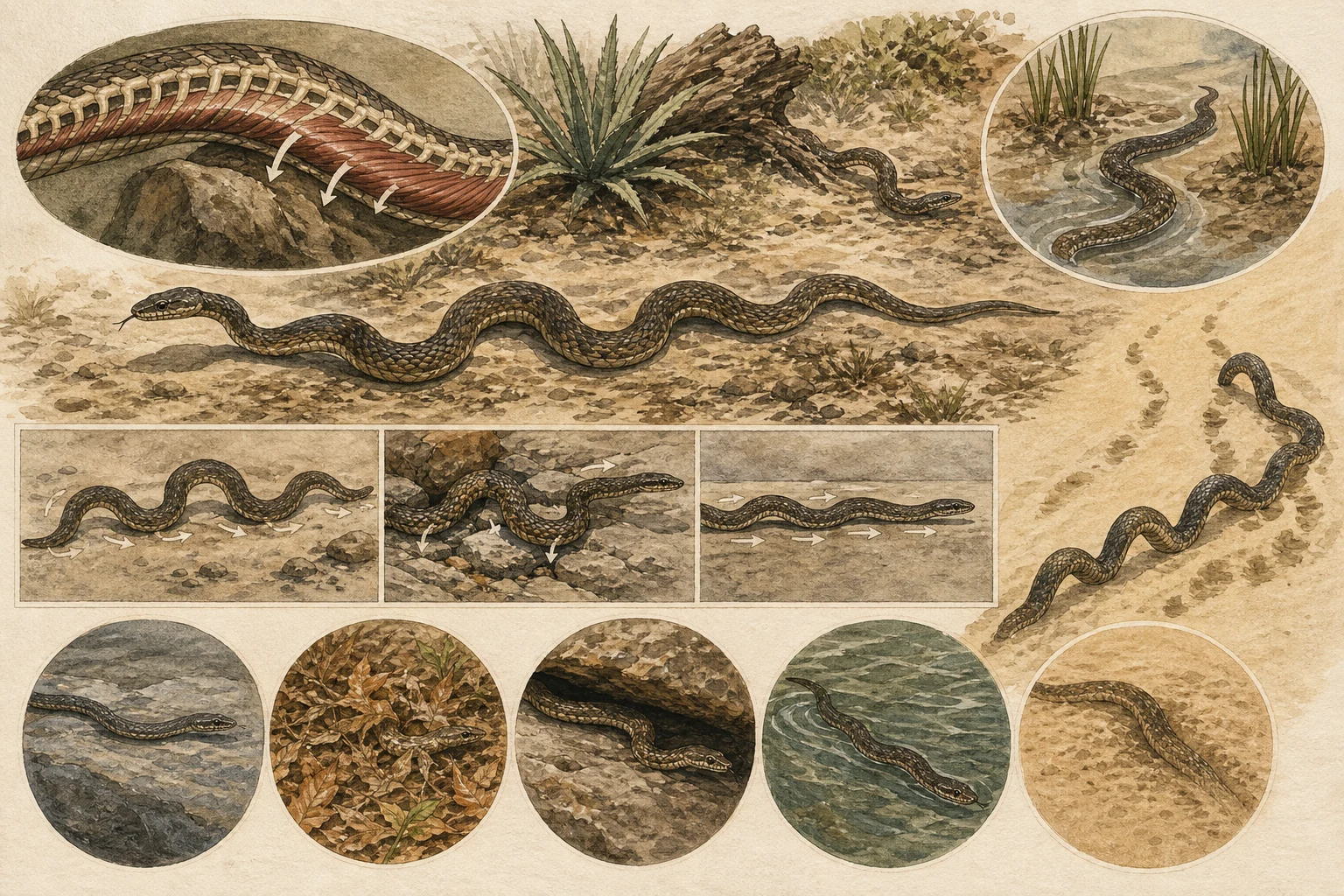
A snake does not simply slither in one universal way. Coordinated muscle activity bends or shortens the body while scales and contact points redirect those internal forces against the surroundings.
Last updated
Turn internal force into external push
A snake's axial muscles pull across hundreds of mobile vertebrae and ribs, but internal shortening alone cannot carry a limbless animal across the ground. Forward progress begins only when curving flanks, ventral scales, or lifted body loops press against surface roughness, pebbles, stems, or sand grains in the surrounding terrain. The ground pushes back with a reaction force that includes a forward component, allowing a traveling muscular wave to translate the entire trunk ahead instead of merely wriggling in place. Whenever a snake crosses slick stone or bare bark, those external push points determine whether muscle work becomes net travel or wasted lateral slip. [1][2]
- Axial muscles bend the vertebral column and shift rib-supported belly skin against the substrate
- Forward motion requires external reaction forces from rocks, stems, crevices, or directional scale friction
- On low-friction surfaces, traveling body waves slip sideways unless the snake finds discrete anchor points
Use more than one movement pattern
Field observers have long grouped snake movement into four classic modes, each suited to different mechanical problems. Lateral undulation sends horizontal waves down the trunk while multiple body curves press sideways against grass stems, stones, or uneven soil. Concertina locomotion alternates anchored, folded body regions with forward reach through narrow burrows, bark furrows, or branches, whereas heavy-bodied species often use rectilinear crawling to advance the belly skin in quiet, nearly straight cycles. Detailed biomechanical recordings show that these named modes are convenient landmarks along a continuum: a single snake frequently blends or shifts kinematics mid-stride as speed and footing change. [1][2]
- Lateral undulation pushes multiple body bends against surrounding irregularities at the same time
- Concertina movement trades continuous speed for static grip inside tunnels, crevices, or smooth channels
- Rectilinear propulsion moves ventral skin forward and pulls the vertebral column along in a straight line
Sidewind across yielding ground
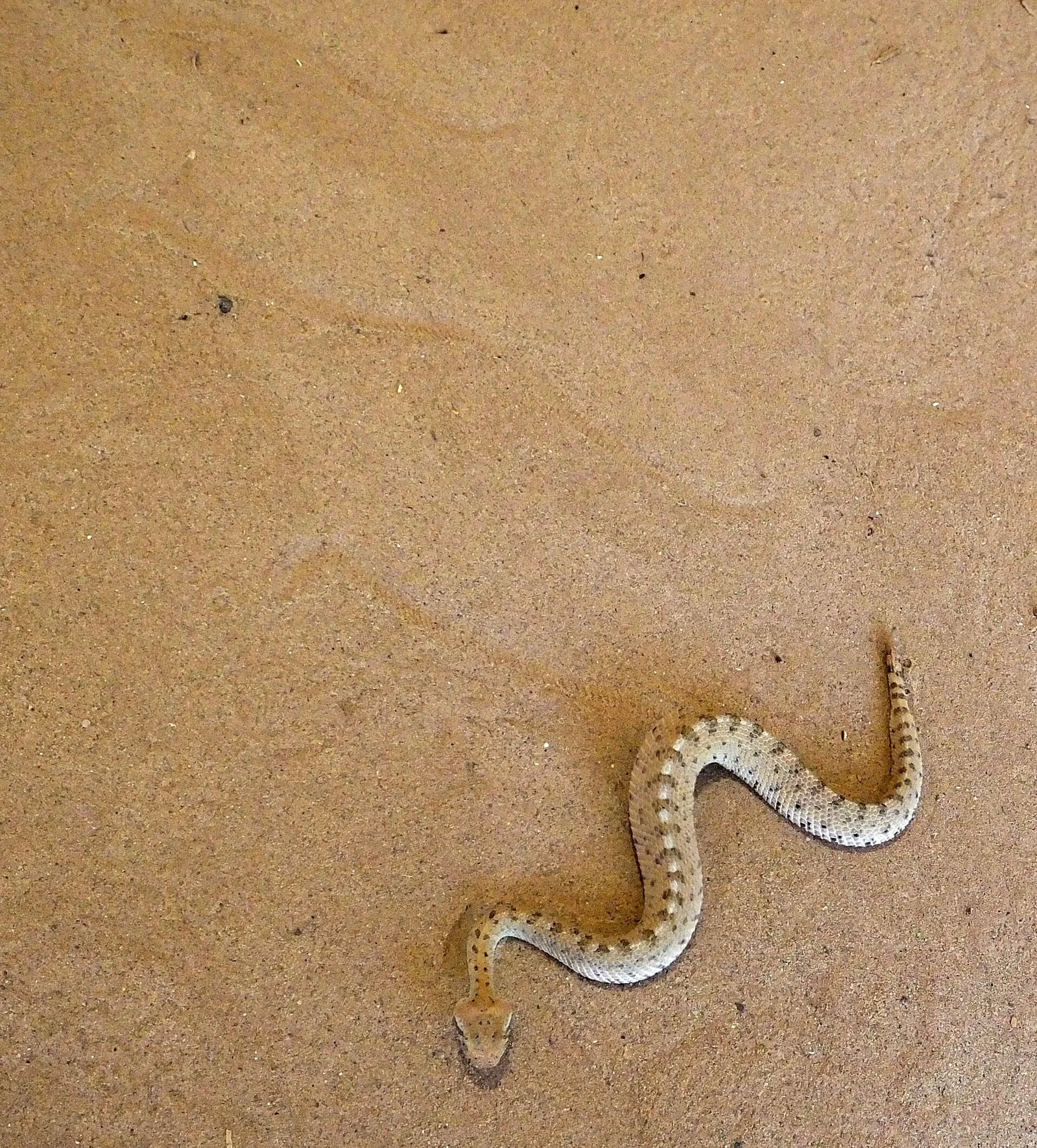
During sidewinding, a snake such as the Colorado Desert sidewinder (Crotalus cerastes) couples a horizontal bending wave with a phase-shifted vertical wave that lifts and lowers successive body segments. Rather than sliding its belly along a continuous path, the snake peels sections of its trunk off the sand, swings them obliquely forward through the air, and sets them down into fresh static contact. Because the grounded segments press downward without shearing the dune surface into an avalanche, the animal climbs loose slopes efficiently and leaves a diagnostic series of offset, J-shaped imprints angled across its line of travel. [3][4]
- Coupled horizontal and vertical body waves lift moving segments clear of yielding sand or mud
- Grounded body sections stay in static contact rather than sliding, reducing slip on steep dune faces
- Modulating wave amplitude and vertical lift lets a sidewinder turn sharply or climb shifting slopes
Read the substrate as part of the motion
A snake's gait is never generated in isolation from the ground beneath it. In laboratory comparisons between loose sand and slick vinyl flooring, sidewinder rattlesnakes adjust wave curvature, lifting height, and body contact length to match how much resistance the surface provides. Across natural habitats, the same individual may glide with broad lateral waves through meadow grass, brace in tight bends between rock ledges, or flatten its ventral scales to creep along a fallen log. Watching how much of the trunk touches the ground—and how long each patch stays still—reveals the mechanical problem the surface is posing. [1][2][4]
- Sidewinders alter body curvature and contact fraction when moving between sand and firm, smooth substrates
- Dense grass, coarse gravel, narrow crevices, and open flats each reward different contact geometry
- Stationary contact patches show exactly where the snake is anchoring or pushing against its surroundings
Reading the trail and the still parts
A sidewinding snake leaves a sequence of separated, roughly parallel marks rather than one continuous sinuous groove, so the trail alone distinguishes it from lateral undulation on the same sand. Watching a moving snake in the field, give the stationary contact patches as much attention as the visibly traveling bends: those anchored regions are where the propulsive push or static brace comes from. Expect the same individual to change how much belly it commits and how sharply it bends as it crosses smooth rock, coarse litter, loose sand, or a burrow entrance, treating textbook gait labels as overlapping field descriptions rather than rigid boxes. [1][2][3][4]
- Separated oblique bars in sand indicate sidewinding, whereas continuous S-grooves mark lateral undulation
- Small heaps of soil or sand pile against the rear-facing outer edges of curves during lateral undulation
- Abrupt changes in bend tightness along a trackway usually mark a transition between substrates or slopes
Related guides
Get Fauna and identify it in the field.
Where this guide comes from
Source-checked editorial guide. Last updated . This guide teaches identification and field skills; it is not a substitute for expert verification when it matters.
- Integrative and comparative biology — What Defines Different Modes of Snake Locomotion? ↗
- Annals of the New York Academy of Sciences — Functional Diversity of Snake Locomotion ↗
- Proceedings of the National Academy of Sciences of the United States of America — Modulation of orthogonal body waves enables high maneuverability in sidewinding locomotion ↗
- Biology open — Locomotor kinematics on sand versus vinyl flooring in the sidewinder rattlesnake Crotalus cerastes ↗