Why geckos cling to walls
Gecko toe pads divide contact across microscopic hairs that end in nanoscale tips. Their enormous combined contact area creates strong but directional surface forces that a moving gecko can engage and release rapidly.
Last updated
Split each contact into finer branches
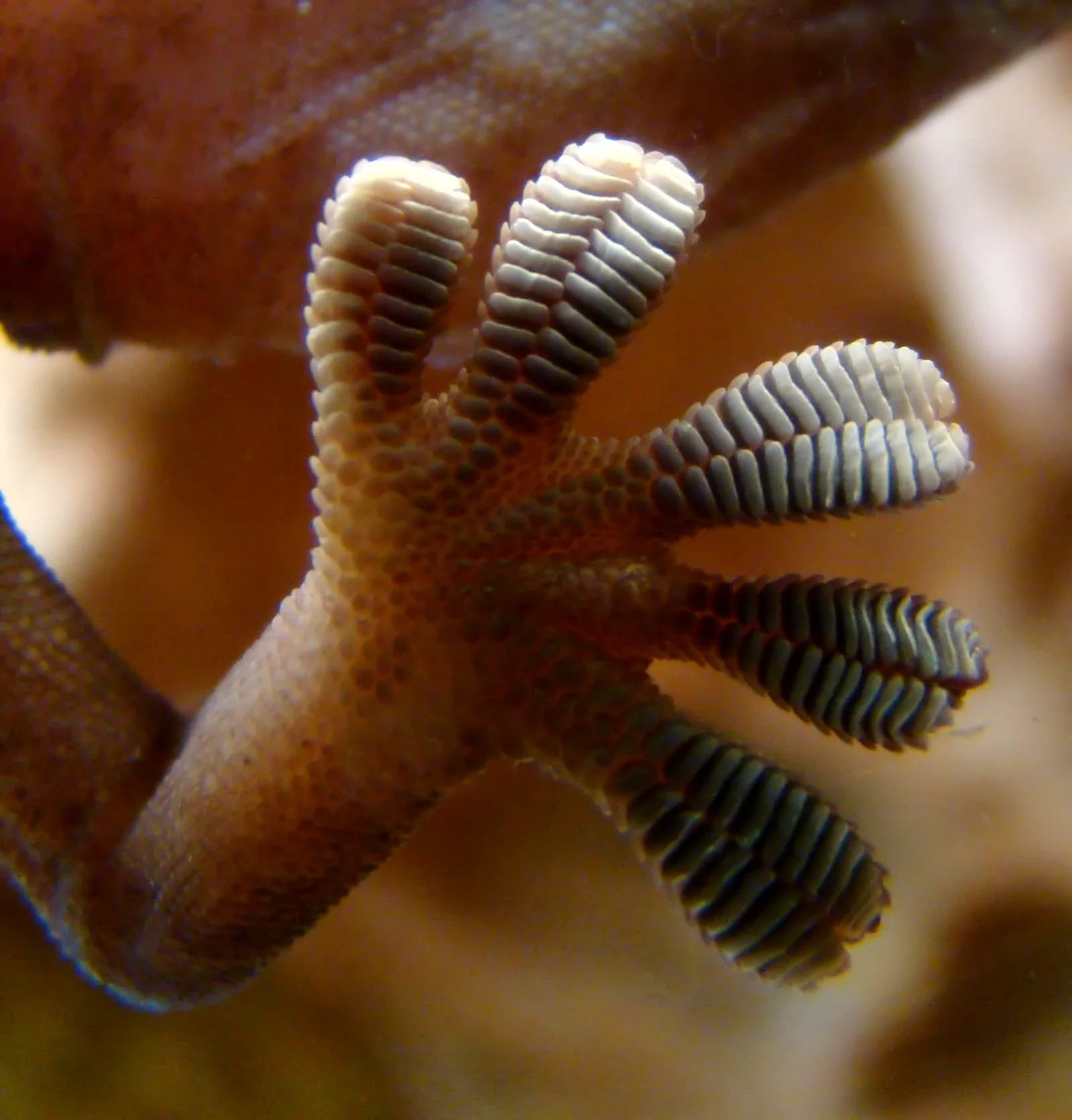
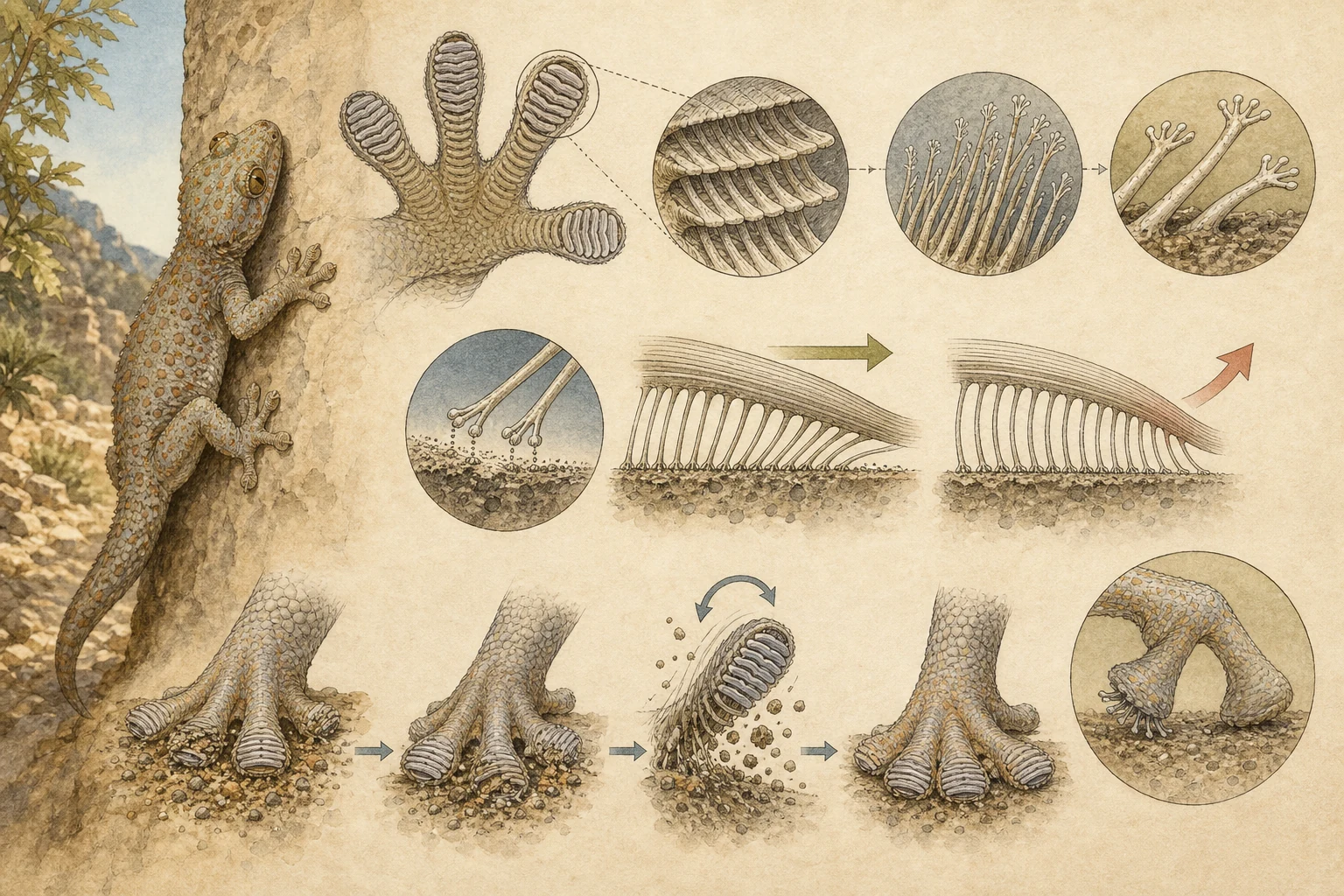
Under a hand lens or against a windowpane, the underside of a pad-bearing gecko's toe shows transverse plates called scansors or lamellae. Each plate carries dense ranks of keratinous hairs known as setae, and each seta subdivides into hundreds of flattened nanoscale tips called spatulae. A stiff, smooth toe pad would bridge across the microscopic peaks and valleys of plaster, bark, or stone, touching only the highest summits. By splitting one foot into millions of compliant filaments, the gecko brings an extraordinary fraction of those terminal tips into intimate physical contact with the irregular contour of the wall. [1][3]
- Visible transverse toe lamellae support microscopic arrays of branching keratinous setae
- Each seta splits into hundreds of nanoscale spatulae that mold to tiny surface irregularities
- Compliance across multiple size scales multiplies real contact area without using liquid glue
Rely on close-range molecular attraction
Laboratory measurements on tokay gecko (Gekko gecko) setae demonstrated that dry intermolecular van der Waals forces account for the animal's grip without requiring suction cups, capillary glue, or wet glandular secretions. Because van der Waals attraction acts only when surfaces approach within a few nanometers, the branching geometry of the spatulae is what makes weak molecular forces sum into an adhesive load strong enough to hold the lizard's full body weight on smooth glass or hydrophobic gallium arsenide wafers. Real walls still test those limits: continuous water films, powdery dust, or micro-roughness tuned close to spatula dimensions can reduce how many tips achieve close-range contact. [1][2]
- Tokay gecko setae generate strong adhesion on both hydrophobic and hydrophilic test surfaces
- Van der Waals attractions operate across nanometer gaps and require no suction or sticky secretion
- Surface moisture, loose dust, and unfavorable roughness scales reduce the number of adhering tips
Grip and release by changing angle
A permanently sticky foot would trap a running lizard on its first step, so gecko setae are built as directional mechanical switches controlled by how the toe is loaded. The hairs grow at an angle to the toe pad and develop high adhesion and friction only when pulled slightly inward along the toe axis while pressed against the substrate. When the gecko prepares to lift its foot, it curls and hyperextends its digits upward from the tips—peeling the setae past a critical shaft angle near thirty degrees where the nanoscale contacts release cleanly in milliseconds with almost no upward pull required. [3][4]
- Setae engage strongly only when brought into contact and loaded inward along the axis of the toe
- Increasing the seta shaft angle above roughly thirty degrees detaches the tips with minimal force
- Distal-to-proximal toe curling (digital hyperextension) peels the pad free in milliseconds during a sprint
Shed dirt while taking steps
Unlike household tape, which loses tack after picking up a single layer of grit, gecko toe pads stay functional across dusty rocks, ceilings, and bark-covered tree trunks. Contact-mechanics experiments show that dirt particles often have stronger attraction to the flat wall surface than to the tiny, flexible spatula tips that touch only a small fraction of the particle's curvature. In addition, when a walking gecko hyperextends its toes at the end of each step, the rapid peeling motion dynamically flings stubborn micro-particles off the setal array, restoring most of the pad's gripping capacity within just a few strides. [2][4]
- Passive self-cleaning occurs because dust grains adhere more strongly to the wall than to tiny spatulae
- Dynamic toe hyperextension accelerates setal tips and sheds contaminating particles during locomotion
- Repeated steps on clean substrate gradually restore gripping force after a foot crosses dusty ground
Watching a gecko work a surface
Because dry adhesion requires nanometer-scale proximity, one of the most informative field observations is noticing where a house or rock gecko commits its weight and where it hesitates. Compare how confidently a gecko sprints across smooth window glass or painted stucco versus wet foliage, flaky rust, or chalky masonry, since surface water, loose dust, and roughness alter how many spatulae make contact. Watching a gecko through a windowpane from indoors reveals the full attachment cycle: the toes unroll flat onto the glass to load the setae, then curl upward from the tips to peel free before each step. [1][2][3][4]
Related guides
Get Fauna and identify it in the field.
Where this guide comes from
Source-checked editorial guide. Last updated . This guide teaches identification and field skills; it is not a substitute for expert verification when it matters.
- Proceedings of the National Academy of Sciences of the United States of America — Evidence for van der Waals adhesion in gecko setae ↗
- Proceedings of the National Academy of Sciences of the United States of America — Evidence for self-cleaning in gecko setae ↗
- Proceedings of the National Academy of Sciences of the United States of America — Adhesion and friction in gecko toe attachment and detachment ↗
- Journal of the Royal Society, Interface — Dynamic self-cleaning in gecko setae via digital hyperextension ↗