How vultures find carrion
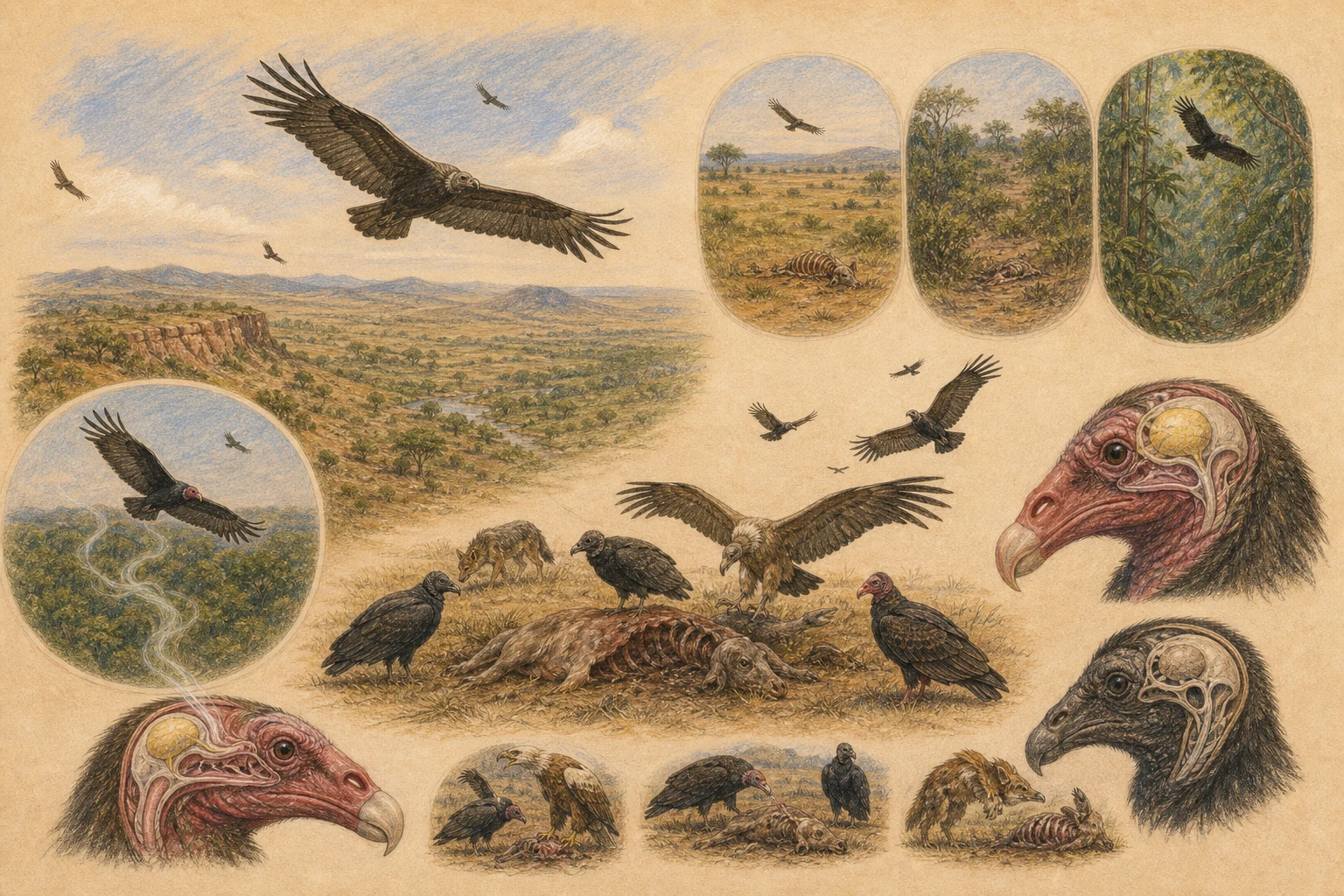
Soaring lets a vulture scan cheaply over large areas. Old World species generally find exposed food visually, whereas turkey and yellow-headed vultures can follow carrion odors through forest cover; descending birds, eagles, and other scavengers then create social information visible from afar.
Last updated
Soaring turns height into a search platform
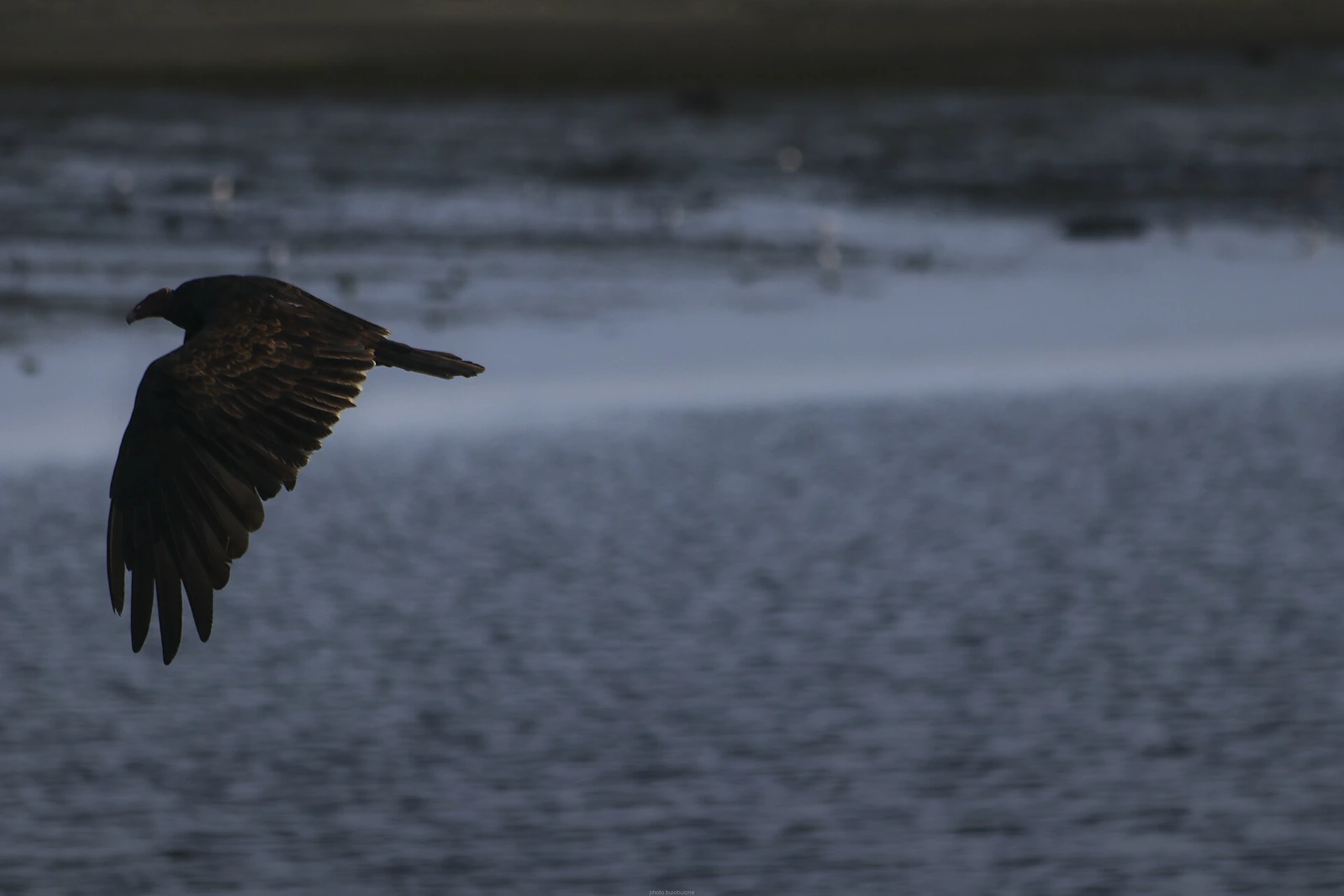
Because dead animals appear unpredictably in space and time, an obligate scavenger cannot afford to burn heavy muscle energy flapping back and forth across a landscape. Both New World vultures (Cathartidae) and Old World vultures (Accipitridae) solve the search-cost problem with low wing loading and broad, slotted primary tips that harvest rising columns of solar-heated air (thermals) and ridge updrafts. When you see a kettle of vultures circling high against a midday sky, they are almost always climbing inside a rising thermal bubble before gliding miles to the next updraft—not hovering over a dying animal. [1][3]
- High-aspect, low-wing-loading airfoils allow vultures to search tens of square kilometers per day using rising thermal columns and ridge lift.
- A circling kettle of vultures in midday sun usually marks a column of rising warm air rather than a carcass directly underneath.
- Vultures often stay perched until morning sunlight warms the ground enough to generate usable thermal updrafts.
Vision dominates many vulture lineages
All Old World vultures—such as griffon vultures (Gyps fulvus), white-backed vultures, and lappet-faced vultures—along with New World black vultures (Coragyps atratus) and Andean condors, locate food primarily by sight. Soaring several hundred meters above open savannas, steppes, or pastures, they scan the ground with large eyes and high retinal ganglion cell density while simultaneously monitoring a three-dimensional sky network of neighboring scavengers. This purely visual strategy excels where large ungulate carcasses lie in open grassland, but fails when a small mammal dies beneath a closed tropical or temperate forest canopy. [1][3][5]
- Old World Gyps vultures and New World black vultures rely on high-acuity vision rather than smell to spot carcasses and other scavengers.
- Visual scavengers soar higher than scent-foraging species so they can monitor wider ground swaths and distant neighbors.
- Closed forest canopies block visual detection of small carcasses until forest-floor scavengers or scent-guided vultures open a path.
Some New World vultures follow odor plumes
Three New World species in the genus Cathartes—the turkey vulture (Cathartes aura), lesser yellow-headed vulture, and greater yellow-headed vulture—possess an extraordinary avian sense of smell that detects volatile sulfur compounds and decomposition gases wafting up through dense forest leaf litter. Comparative neuroanatomy shows that a turkey vulture's olfactory bulb is roughly four times larger than that of a larger-bodied black vulture and contains twice as many mitral cells, fed by an expanded, scroll-shaped nasal concha surface. Watch a turkey vulture hunting and you will see it rocking in a shallow V-shaped dihedral just above the treetops, casting back and forth across the wind until an odor plume fades and it circles back to pinpoint the hidden source. [1][2][3]
- Turkey vultures have an olfactory bulb roughly four times larger than that of sympatric black vultures, with twice the mitral neuron count.
- Scent-foraging Cathartes vultures fly low over treetops with a rocking V-shaped wing dihedral to intercept rising odor plumes.
- Perforate nostrils—allowing you to see daylight straight through the bill from the side—help air flow freely over the nasal epithelium.
Scavengers reveal food to one another
Because carcasses often hold more meat than one bird can consume, scavenging raptors form multi-species information chains across the sky. In the Americas, high-soaring black vultures (Coragyps atratus) and king vultures (Sarcoramphus papa) watch low-cruising turkey vultures drop into the canopy after following a scent plume, then plummet down to the same spot and use their heavier, more aggressive bills or social dominance to take over the carcass. Similarly, in African savannas, white-backed and griffon vultures closely track descending tawny and bateleur eagles—which spot and tear open fresh kills early—turning a single bird's steep dive into a visible beacon that recruits dozens of vultures from kilometers away. [3][4][5]
- High-soaring black and king vultures routinely shadow low-flying turkey vultures and follow them down to concealed forest carcasses.
- In African savannas, Gyps vultures use descending scavenging eagles as early visual beacons to locate fresh carcasses.
- Once at a carcass, larger or more socially aggressive species frequently displace the smaller scent- or sight-guided finder.
Related guides
Get Fauna and identify it in the field.
Where this guide comes from
Source-checked editorial guide. Last updated . This guide teaches identification and field skills; it is not a substitute for expert verification when it matters.
- Animal cognition — Sight or smell: which senses do scavenging raptors use to find food? ↗
- Scientific reports — Anatomical evidence for scent guided foraging in the turkey vulture ↗
- Proceedings. Biological sciences — Scavenging in the realm of senses: smell and vision drive recruitment at carcasses in Neotropical ecosystems ↗
- Proceedings. Biological sciences — Vultures acquire information on carcass location from scavenging eagles ↗
- Smithsonian’s National Zoo — King vulture ↗