Fish schooling vs. shoaling
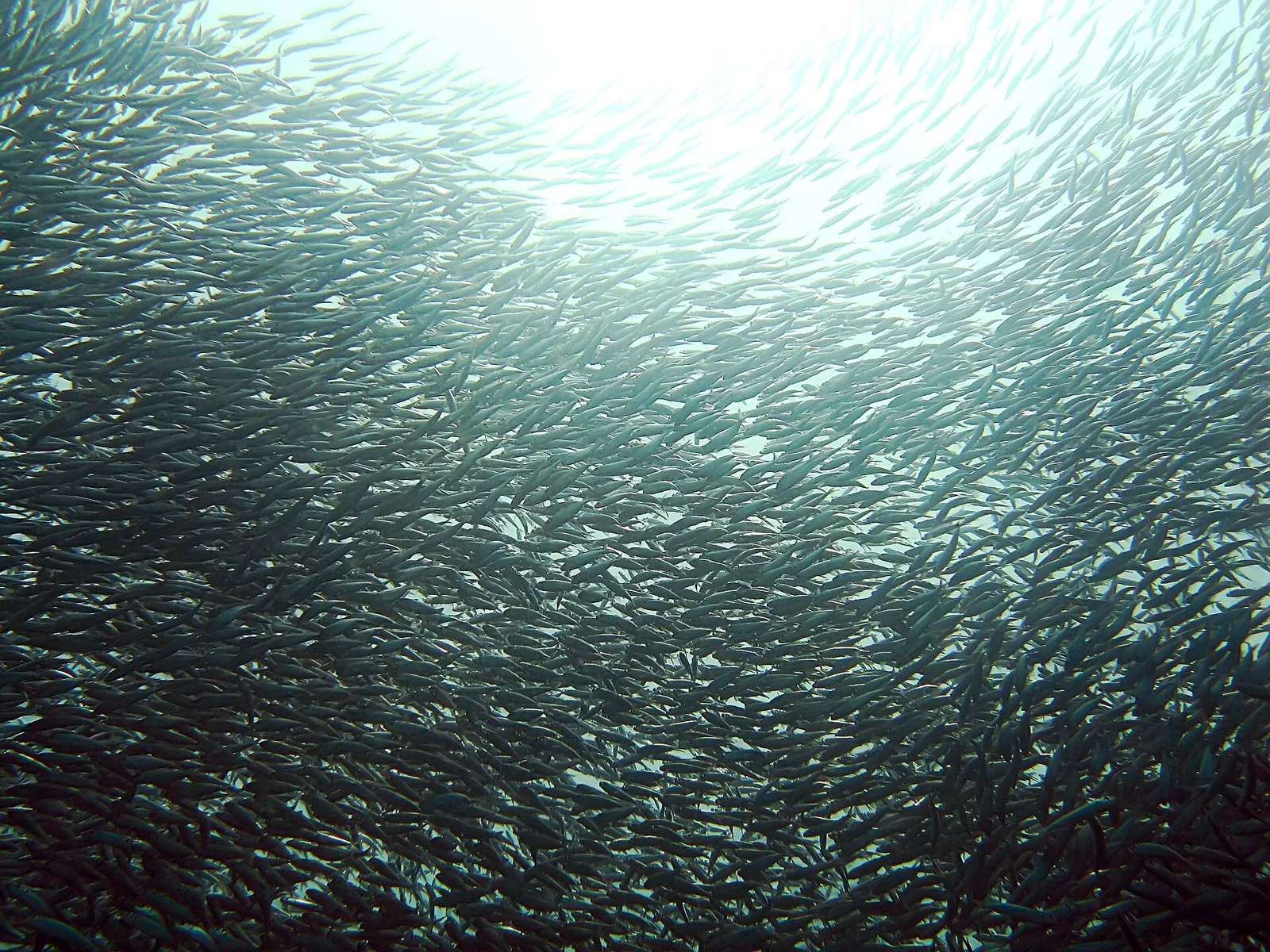
A shoal is a social aggregation of fish, while a school is the more coordinated state in which neighbors align and move in the same direction. Schooling is therefore a kind of shoaling, not a separate permanent identity or a label determined only by group size.
Last updated
School describes an organized state within a shoal
Behavioral ecologists separate two measurable properties of a fish group: cohesion, which tracks how closely individuals stay together for social reasons rather than mere shared attraction to a resource, and polarization, which measures how tightly their body headings align. Every school is a shoal, but a shoal whose members face many directions while foraging over a reef or resting in a backwater is not schooling. Because alignment and nearest-neighbor distance vary along a continuous spectrum, quantitative studies define explicit mathematical thresholds rather than treating the two words as fixed species labels. [1][2]
- A shoal is any group of fish remaining together socially, regardless of which direction individuals face
- A school is a polarized shoal in which members align their headings and synchronize swimming speed
- The same group of fish can shift between loose shoaling and tight schooling within seconds
Coordination emerges from local responses
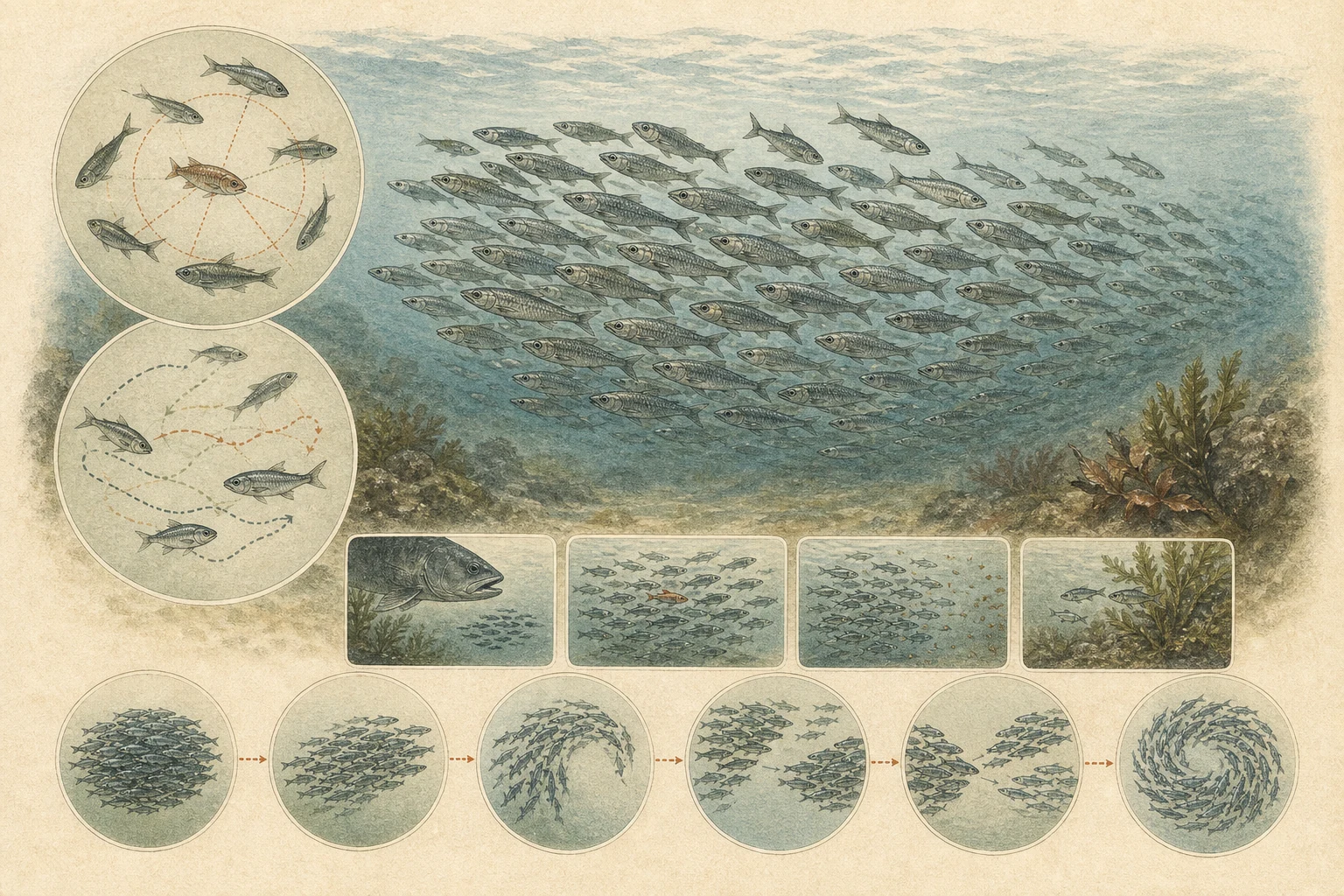
Synchronized schools execute sweeping turns and flash expansions without a permanent leader or a blueprint of the whole formation. High-resolution tracking of golden shiners and zebrafish shows that each individual adjusts its speed and heading primarily in response to the relative positions and velocities of its immediate neighbors, using vision and the mechanosensory lateral line. Attraction toward distant neighbors maintains group cohesion while short-range repulsion prevents collisions, allowing startle waves and directional choices to ripple across hundreds of fish faster than a single predator can strike. [2][4]
- Individual fish adjust speed and direction using the positions and movements of immediate neighbors
- Both vision and the pressure-sensitive lateral line along the body flank help fish maintain spacing
- Directional changes propagate rapidly from neighbor to neighbor without requiring a permanent leader
Grouping can solve several problems
Staying in a group alters risk, information flow, and swimming energetics simultaneously. Many eyes scan for approaching predators, the confusion effect makes it harder for a striker to lock onto one target among dozens of moving silver flanks, and social cues guide members toward patchy food or migration corridors. In polarized schools, swimming within the hydrodynamic wakes shed by neighbors can also reduce tail-beat frequency and oxygen consumption during sustained cruising, though the exact energetic savings depend on spacing, relative position, flow conditions, and swimming speed. [3][5]
- Shared vigilance and the visual confusion effect lower the odds that any single fish is captured by a predator
- Foraging shoals transfer social information when one fish's feeding posture draws neighbors to a food patch
- Swimming in coordinated formations can reduce hydrodynamic drag and oxygen cost at sustained speeds
Read a group through change, not one frame
A single still photograph can show fish clustered together, but only sustained observation reveals whether they are shoaling loosely, schooling in polarized travel, or rotating in a defensive torus mill. Watch how neighbor spacing and alignment shift when a shadow crosses the water, when current stiffens, or when food appears: hungry groups often spread out and lose alignment to search, whereas startled groups snap into tight, parallel formation. Laboratory work with zebrafish confirms that group size, water flow, and familiarity with the arena continuously reshape collective geometry. [1][2][3]
- Watch for transitions: feeding fish often loosen into an unaligned shoal and snap back into a school when startled
- Note neighbor spacing, shared heading, and whether the group is travelling, holding in current, or milling in a circle
- Group size, hunger, water clarity, and predator presence all shift how tightly a species aligns in the field
Related guides
Get Fauna and identify it in the field.
Where this guide comes from
Source-checked editorial guide. Last updated . This guide teaches identification and field skills; it is not a substitute for expert verification when it matters.
- Reviews in Fish Biology and Fisheries — Shoals and schools: definitions and quantitative references ↗
- PloS one — From schooling to shoaling: patterns of collective motion in zebrafish (Danio rerio) ↗
- Current Zoology — Why do fish school? ↗
- Proceedings of the National Academy of Sciences of the United States of America — Inferring the structure and dynamics of interactions in schooling fish ↗
- eLife — Energy conservation by collective movement in schooling fish ↗