How whale songs travel
A singing whale sets seawater particles oscillating, launching sound that spreads, bends, reflects, and weakens. Low-frequency components can travel especially well, yet no song has one fixed range: the ocean changes the signal, and a listener must still detect it above the background.
Last updated
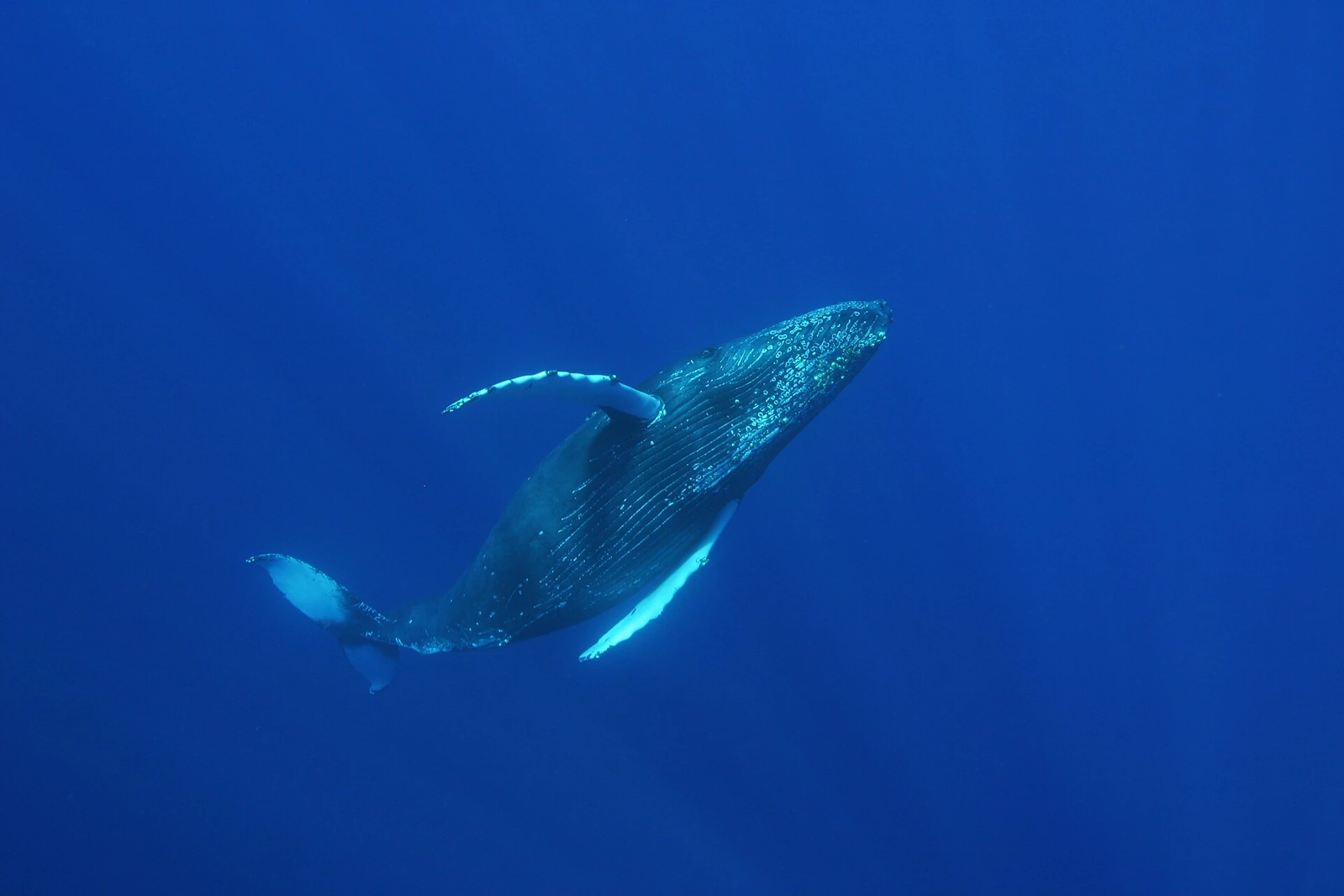
Song is a particular kind of whale sound
Whales produce clicks, whistles, pulsed calls, grunts, and social moans across the ocean, yet acoustic biologists reserve the term song for extended, hierarchically structured displays produced by specific baleen whales. Adult male humpback whales (Megaptera novaeangliae) are the classic singers, hanging head-down in the water column on winter breeding grounds or pausing along migration routes to repeat long sequences. Each humpback song nests individual sound units—ranging from deep, resonant groans to high squeaks—into phrases, groups those phrases into themes, and cycles through those themes in a predictable order lasting minutes to hours. Whereas baleen whales emphasize lower-frequency pressure waves for long-range signaling, toothed whales such as sperm whales and dolphins emit brief, ultrasonic echolocation clicks to resolve nearby prey and obstacles, a fundamentally different acoustic system. [1][4]
- Adult male humpback whales sing structured sequences built from individual units, phrases, and repeated themes.
- Baleen whale vocalizations emphasize lower frequencies than the high-frequency echolocation clicks of toothed whales.
- Non-song feeding calls, social grunts, and surface-active slaps occur in both sexes and lack a fixed thematic cycle.
The ocean bends the route
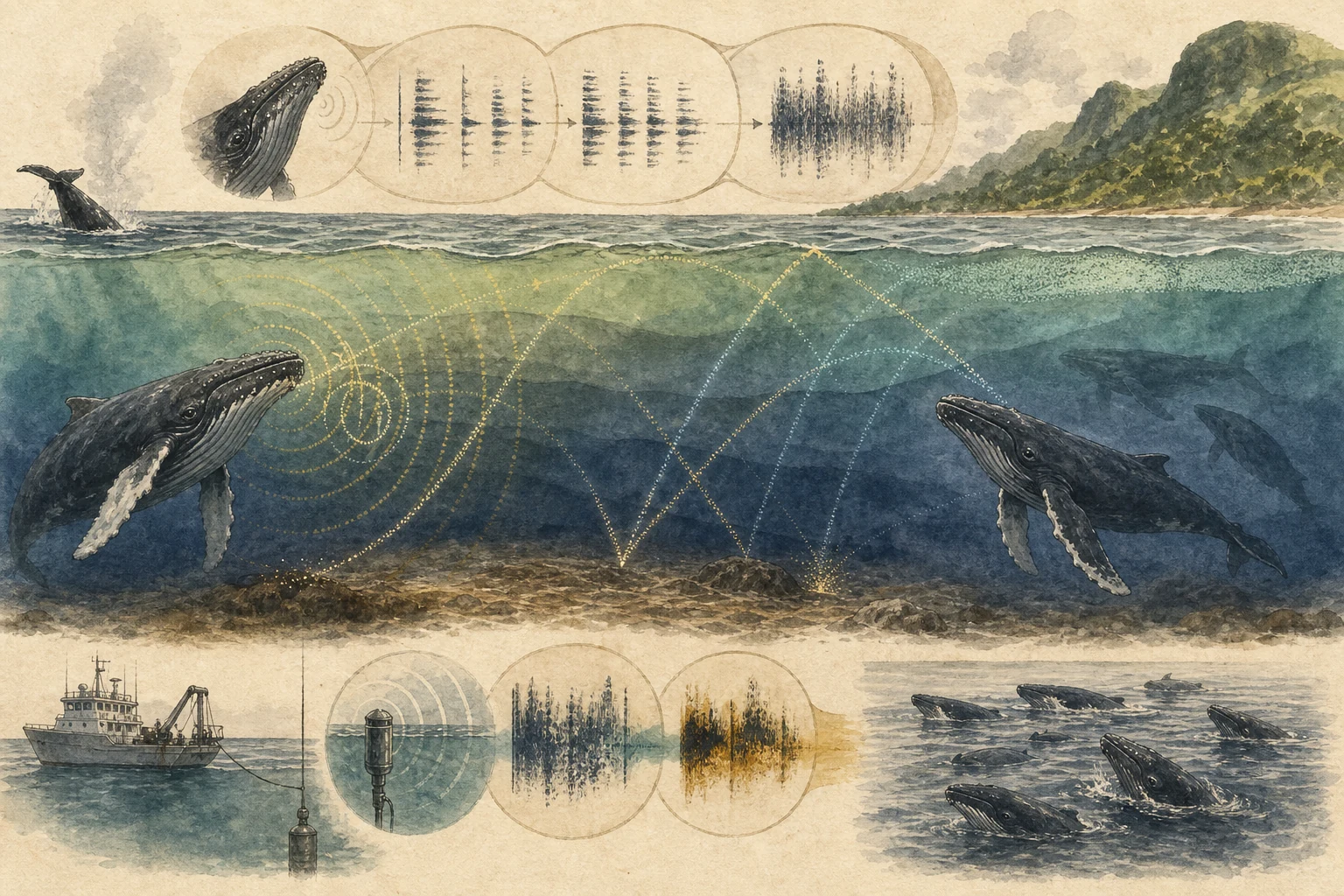
Underwater sound does not travel along a single straight line from singer to listener. Because seawater temperature, hydrostatic pressure, and salinity govern sound speed—roughly 1,500 meters per second, over four times faster than in air—acoustic waves continually refract toward layers where sound travels more slowly. In deep open ocean basins, the SOFAR (sound fixing and ranging) channel forms around the depth of minimum sound speed, bending low-frequency waves back toward the axis before they strike the sea surface or bottom. By contrast, a humpback singing over a shallow continental bank or inside a rocky bay launches waves that repeatedly reflect off rough seafloor sediment and surface chop, scattering energy and creating a very different propagation path than in pelagic water. [2][3]
- Sound speed in seawater varies with temperature, salinity, and pressure, causing acoustic waves to refract across layers.
- Deep-ocean SOFAR channels trap and guide low-frequency energy with minimal loss from surface or bottom contact.
- Shallow coastal banks force whale calls to bounce repeatedly between the surface chop and the seabed.
Useful range is not one mileage figure
Another whale detects a song only while the incoming signal stands clear of ambient background sound. As pressure waves radiate outward from a singing male, geometric spreading, chemical absorption, boundary scattering, and shifting thermoclines steadily weaken and distort the pattern. Meanwhile, breaking wind waves, rain, snapping shrimp, calling fish, commercial shipping propellers, and seismic airguns elevate the surrounding noise floor. Because low-frequency moans lose less energy to absorption per kilometer than high-frequency overtones, the deepest components of a humpback song outlast its higher units over distance. Consequently, effective communication range expands or shrinks from hour to hour depending on call loudness, water depth, seafloor slope, weather, vessel traffic, and the receiving whale's own hearing sensitivity. [2][3][5]
- Low-frequency song units attenuate more slowly than high-frequency harmonics, altering how a song sounds at long range.
- Wind-driven wave noise and commercial shipping traffic raise the low-frequency background and compress detection range.
- Audible range depends on source level, bathymetry, water stratification, and receiver sensitivity rather than a single fixed mileage.
Songs travel through populations as well as water
Within a breeding population of humpback whales, males converge on a shared song type that evolves gradually through the season, yet acoustic surveys across the South Pacific have documented sweeping cultural revolutions in which a song arrangement moves eastward from eastern Australia across ocean basins as populations mix on shared feeding grounds or migratory corridors. Bioacousticians track these song hybridizations and replacements using autonomous seafloor hydrophones and spectrogram analysis, where spliced themes from old and new songs appear side by side. However, a hydrophone trace is not identical to a whale's perception: anthropophony from cargo vessels and industrial operations overlaps key baleen-whale frequency bands, masking subtle phrase transitions and shaping what both instruments and whales actually register. [3][4][5]
- Male humpback whales within an ocean basin converge on a shared song that shifts through social learning and cultural transmission.
- Spectrograms from South Pacific hydrophone arrays document hybrid songs where singers splice themes from two regional traditions.
- Chronic vessel noise overlaps low-frequency baleen whale bands and can mask distant singers from both whales and recorders.
Related guides
Get Fauna and identify it in the field.
Where this guide comes from
Source-checked editorial guide. Last updated . This guide teaches identification and field skills; it is not a substitute for expert verification when it matters.
- NOAA Fisheries — Mammals: Sounds in the Ocean ↗
- NOAA Ocean Service — What is SOFAR? ↗
- Australian Museum — Humpback Whale ↗
- Proceedings of the National Academy of Sciences of the United States of America — Song hybridization events during revolutionary song change provide insights into cultural transmission in humpback whales ↗
- NOAA Ocean Service — What is ocean noise? ↗