Recognizing animal alarm calls
Learn a species' ordinary contact sounds first, note caller posture and receiver responses, look for the possible threat, compare repeated natural episodes, and leave uncertain calls unclassified rather than testing them with playback.
Last updated
Build a baseline before naming an alarm
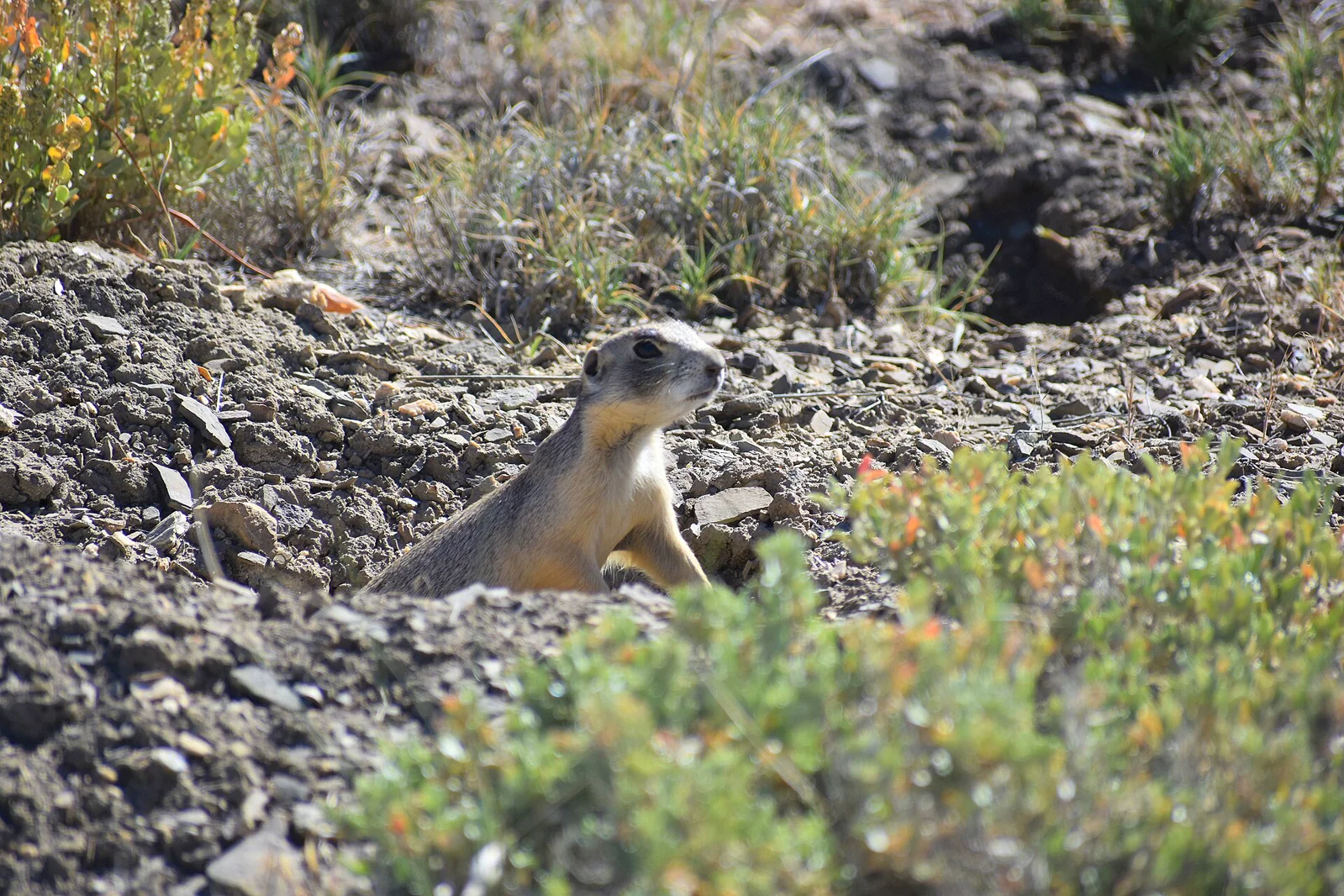
To recognize genuine alarm calling in a prairie-dog colony, songbird flock, or ground-squirrel meadow, spend time listening to the same population during calm, routine activity first. Foraging animals exchange soft contact chips, juvenile begging notes, territorial scolds, and brief startle sounds when a branch snaps or a flock mate crowds too close. To a human ear, a sharp territorial rattle or food squabble can sound deceptively urgent. By logging ordinary vocalizations alongside feeding posture and group spacing, you establish a baseline repertoire so that true shifts in note structure, delivery rate, and body tension stand out clearly across repeated natural encounters. [1][3]
- Listen to calm foraging, contact, and social chatter first so routine sharp notes are not mistaken for predator warnings.
- Log the caller's perch height, body posture, and head orientation alongside the vocalization's rhythm and pitch.
- Require multiple independent natural episodes linking the call, context, and listener reaction before labeling a call type.
Calls can encode different kinds of risk
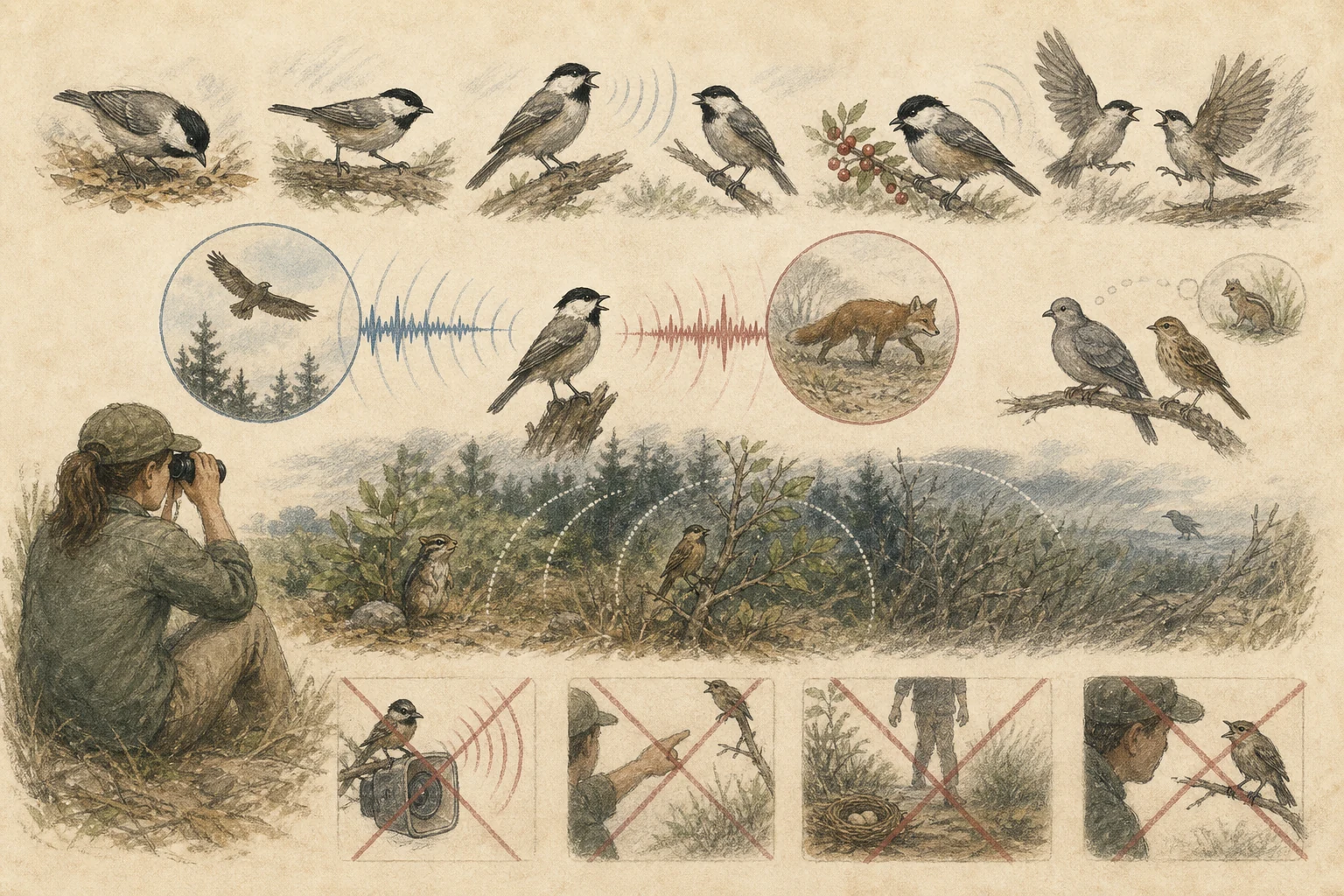
Research on suricates (meerkats) and many birds and rodents shows that alarm systems do not all package information the same way. Some species produce acoustically distinct call classes for aerial raptors versus terrestrial carnivores, whereas others vary call rate, amplitude, or harshness along a gradient of urgency—or combine predator-type cues with urgency in the same sequence. Because human ears can miss subtle acoustic shifts, watch what nearby receivers actually do: animals that bolt into burrows or dense shrubs while glancing skyward have extracted a different message from those that stand tall on hind legs, bunch together, or advance to mob a perched owl or snake. [1][2]
- Watch how listeners respond—bolting to cover, freezing flat, scanning upward, or gathering to mob—to see what cue they extracted.
- Note whether call delivery speeds up or grows harsher as a threat moves closer or changes posture.
- Avoid assuming every species has separate words for hawk and mammal; many systems signal urgency or general disturbance.
Other species may be listening too
Across woodlands, savannas, and marshes, alarm calls regularly cross species boundaries: nuthatches, titmice, squirrels, and ungulates often freeze or scan when a neighbor calls. Yet heterospecific eavesdropping is neither automatic nor uniform. A listener benefits from another species' warning only when both animals share vulnerability to similar predators and when the caller is reliable enough to outweigh the foraging time lost to false alarms. Furthermore, wind, rushing water, and anthropogenic noise mask unfamiliar cross-species calls more severely than conspecific calls, and naive individuals may ignore a neighbor's warning in habitats where the two species rarely associate. [2][3]
- Record which neighboring species react—and which continue feeding—after a sentinel gives a sharp warning call.
- Note wind, traffic, or water noise, which degrades cross-species eavesdropping faster than within-species communication.
- Look for shared vulnerability: ground foragers and canopy birds often attend to different callers depending on the predator.
Observe without manufacturing evidence
Sometimes the most revealing moment in the field is realizing that you are the threat the animals are calling about. If a sentinel squirrel barks steadily at your approach or a songbird chips monotonously outside a thicket, do not step closer, broadcast recorded calls, or flush the animal to confirm what it is watching. Provoking alarms forces wildlife to burn energy, abandon feeding or nest attendance, and betray refuge locations to watching predators. Instead, freeze, lower your silhouette, back away slowly until calm activity resumes, and mark ambiguous vocalizations in your notebook as possible alarms with the surrounding context intact. [3][4]
- Never broadcast recorded alarm calls, owl calls, or distress sounds to test how wild animals react.
- If a sentinel fixes its gaze on you while calling repeatedly, treat yourself as the disturbance and retreat quietly.
- Record uncertain vocalizations as possible alarm or agitation call with full notes on visibility and nearby animals.
Related guides
Get Fauna and identify it in the field.
Where this guide comes from
Source-checked editorial guide. Last updated . This guide teaches identification and field skills; it is not a substitute for expert verification when it matters.
- Proceedings. Biological sciences — The information that receivers extract from alarm calls in suricates ↗
- Ecology and evolution — The evolution of eavesdropping on heterospecific alarm calls: Relevance, reliability, and personal information ↗
- Biology letters — Noise constrains heterospecific eavesdropping more than conspecific reception of alarm calls ↗
- National Park Service — Seven ways to watch wildlife ↗