Finding and comparing microhabitats
Choose patches at a scale meaningful to the organism, compare equal areas for equal time, record environmental variables as well as detections, use repeated matched pairs, and distinguish use from preference.
Last updated
Let the organism define the scale
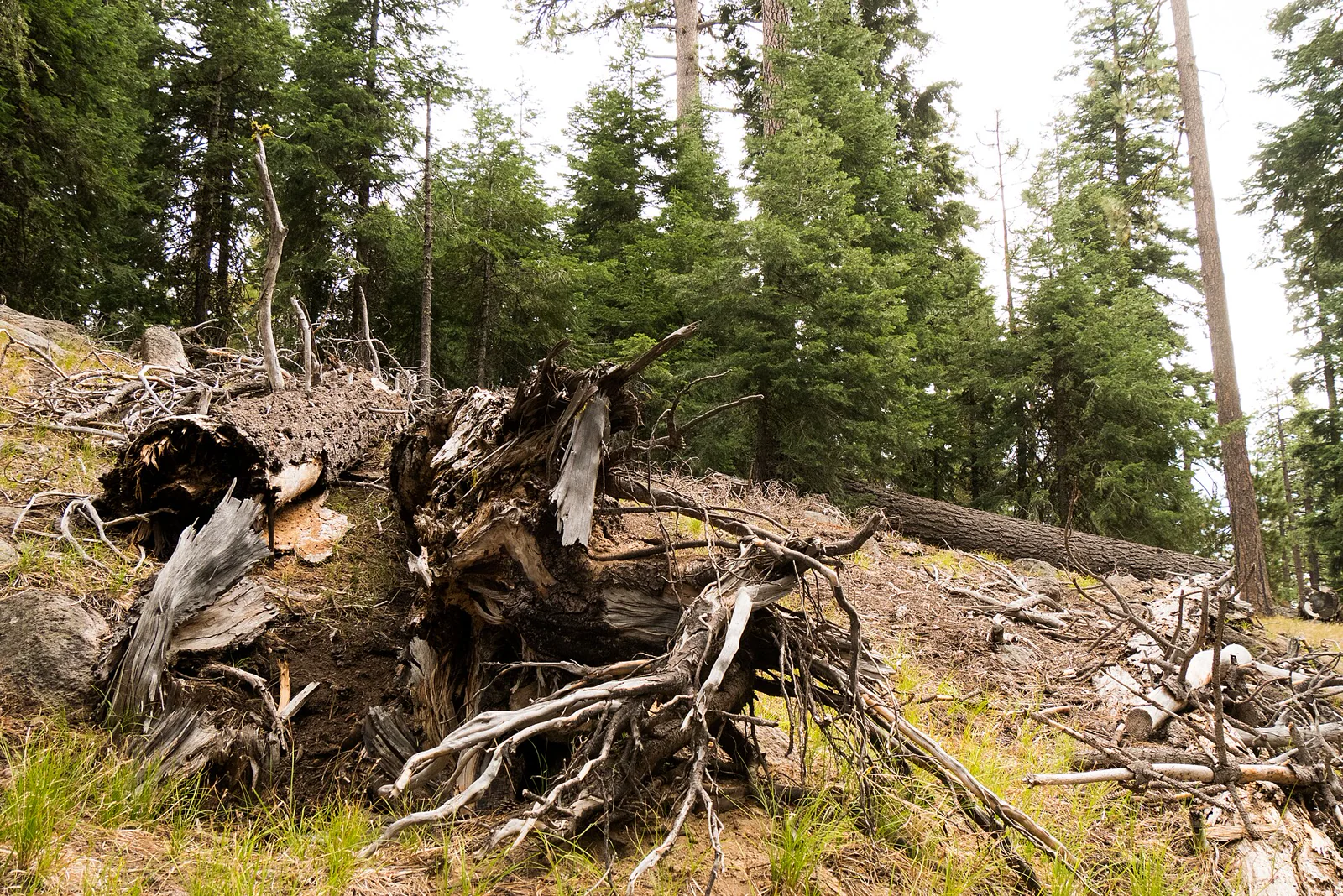
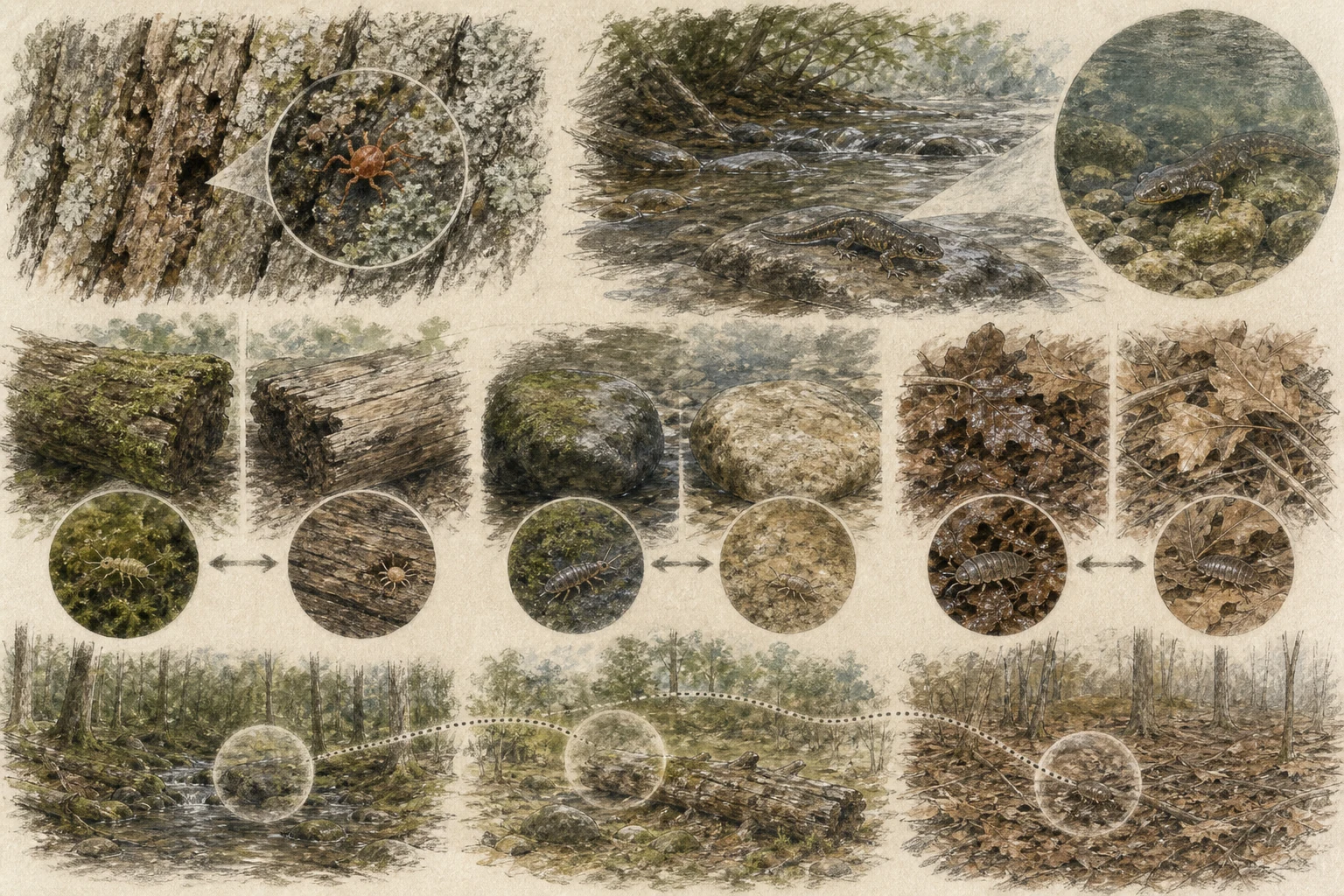
Walk through an Appalachian woodland or across a rocky slope on a warm afternoon and notice how conditions shift over mere centimeters: the north-facing mossy flank of a fallen hemlock stays cool and damp while its sun-baked top bark cracks in the heat. A microhabitat is not simply any small spot, but a fine-scale patch whose physical conditions—surface temperature, relative humidity, light penetration, crevice width, leaf-litter depth, or prey supply—match the daily movement and physiological reach of a focal organism. Before comparing patches, name your target group—such as terrestrial plethodontid salamanders, wolf spiders, or bark-foraging creepers—and define patch boundaries at the scale that animal actually experiences. [1][2]
- Define patch size around the movement range of your focal organism, from bark fissures for mites to shaded talus patches for salamanders.
- List the specific physical variables—moisture, shade, crevice depth, or litter thickness—that distinguish the patches being compared.
- Keep broad landscape habitat labels separate from fine-scale microhabitat structure within the same forest or slope.
Compare matched patches
Inspecting a single decaying log teeming with millipedes and isopods tells you that one object is occupied, but not why. To test whether a feature such as moss cover, canopy shade, or aspect matters, set up replicated matched pairs across the site: compare equal-sized squares on the mossy north face and bare south face of ten separate logs, or pair shaded shale ledges with adjacent sun-exposed ledges of similar rock size and slope. Search each member of a pair for the exact same duration—say, three minutes with a hand lens and flashlight—at the same time of day so that regional weather, season, and observer skill stay balanced across the comparison. [2][3]
- Pair contrasting microhabitats—such as shaded versus sunlit boulders or deep versus shallow leaf litter—within the same site.
- Standardize search area and stopwatch duration across both halves of every matched pair.
- Replicate pairs across multiple independent logs, boulders, or trees rather than subsampling one unusually rich spot.
Measure conditions as well as animals
Because microhabitat structure, thermal buffering, and prey availability often covary, recording only the target animal leaves the mechanism invisible. On every patch, log substrate type, canopy cover, moisture class, litter depth, and surface temperature alongside all detections and zero-counts—and note potential prey such as springtails or midges in the same frame. Always take temperature and humidity readings before disturbing the air pocket or surface you are studying; an infrared thermometer or shaded probe aimed at a rock crevice records the intact microclimate, whereas measuring a stone after flipping it into the sun records your own disturbance. [3][4]
- Measure surface temperature, shade, and moisture before disturbing the patch or leaning over it for a long count.
- Record potential prey items, web anchor points, and refuge crevices alongside focal animal counts.
- Log empty patches with full environmental measurements so unoccupied conditions are represented in your comparison.
Use does not automatically mean preference
Finding five spiders on open shale and two in dense grass shows where you detected them during that hour, not necessarily what habitat they prefer. In habitat-selection studies, observed use must be weighed against both the proportional availability of each microhabitat across the site and differences in detectability between open and cluttered substrates. Moreover, animals shift patches between midday heat and cool night hours. Keep field conclusions grounded in observed occupancy, and inspect crevices, bark surfaces, and pool margins visually without prying off loose bark, breaking rotten heartwood, or leaving cover objects overturned—destroying a refuge ruins the very microclimate that made it habitable. [1][4]
- Account for visibility differences when comparing open rock or bare bark against tangled moss or deep leaf litter.
- Distinguish observed patch occupancy at one hour of the day from true habitat preference relative to availability.
- Inspect logs, bark, and stones non-destructively; never peel bark or break decaying wood that takes years to form.
Related guides
Get Fauna and identify it in the field.
Where this guide comes from
Source-checked editorial guide. Last updated . This guide teaches identification and field skills; it is not a substitute for expert verification when it matters.
- Ecological applications : a publication of the Ecological Society of America — Conceptual and methodological advances in habitat-selection modeling: guidelines for ecology and evolution ↗
- Scientific reports — Differences between microhabitat and broad-scale patterns of niche evolution in terrestrial salamanders ↗
- Ecology and evolution — Habitat characteristics and climatic factors influence microhabitat selection and arthropod community structure in a globally rare central Appalachian shale barren ↗
- Ecology and evolution — Disentangling controls on animal abundance: Prey availability, thermal habitat, and microhabitat structure ↗