How snails build shells
A snail does not move into a larger shell. Its living mantle adds material at the aperture and can thicken inner surfaces, so the shell records continuous accretion from the tiny oldest apex to the newest outer lip.
Last updated
Secrete a mineralized composite
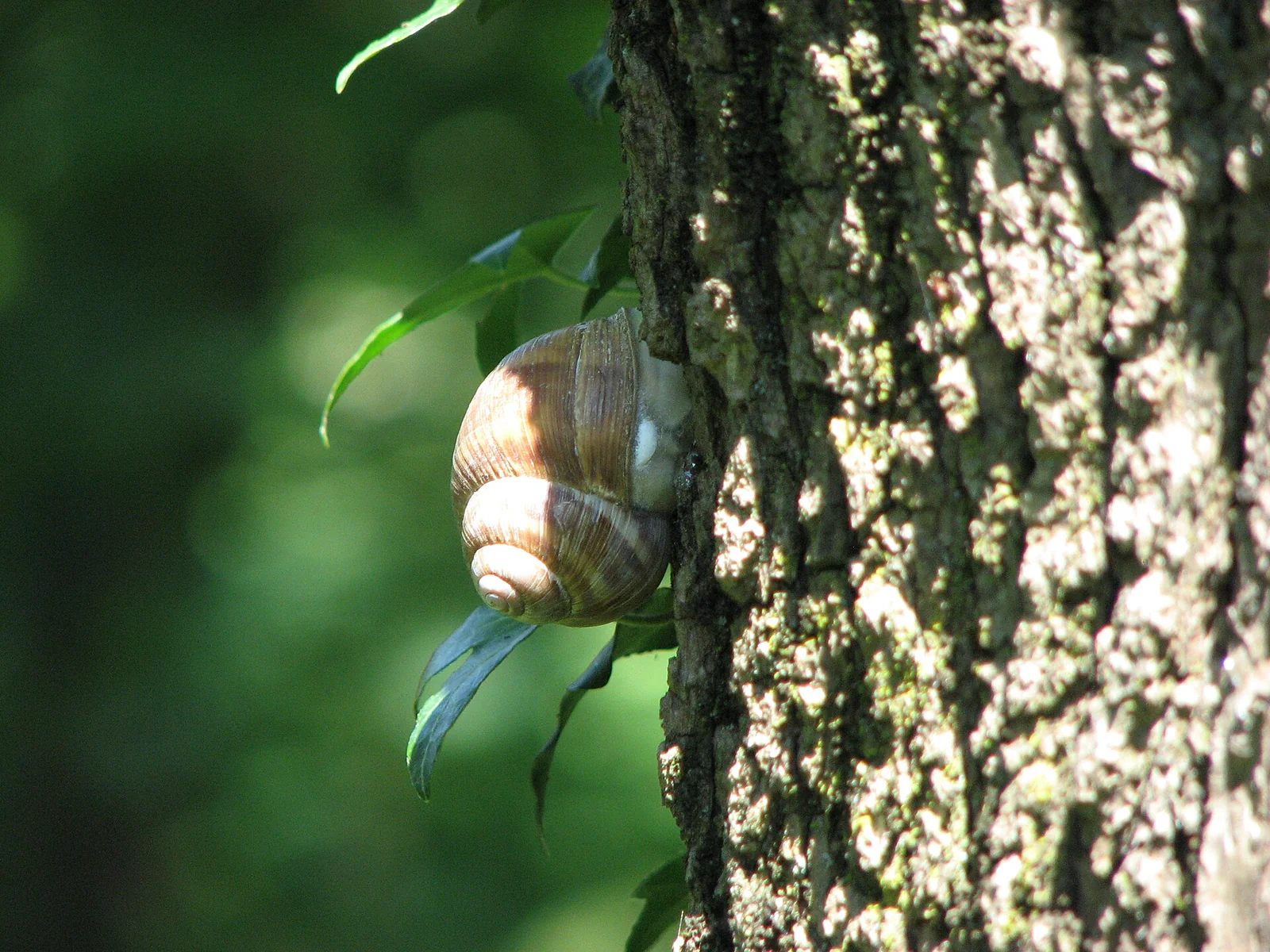
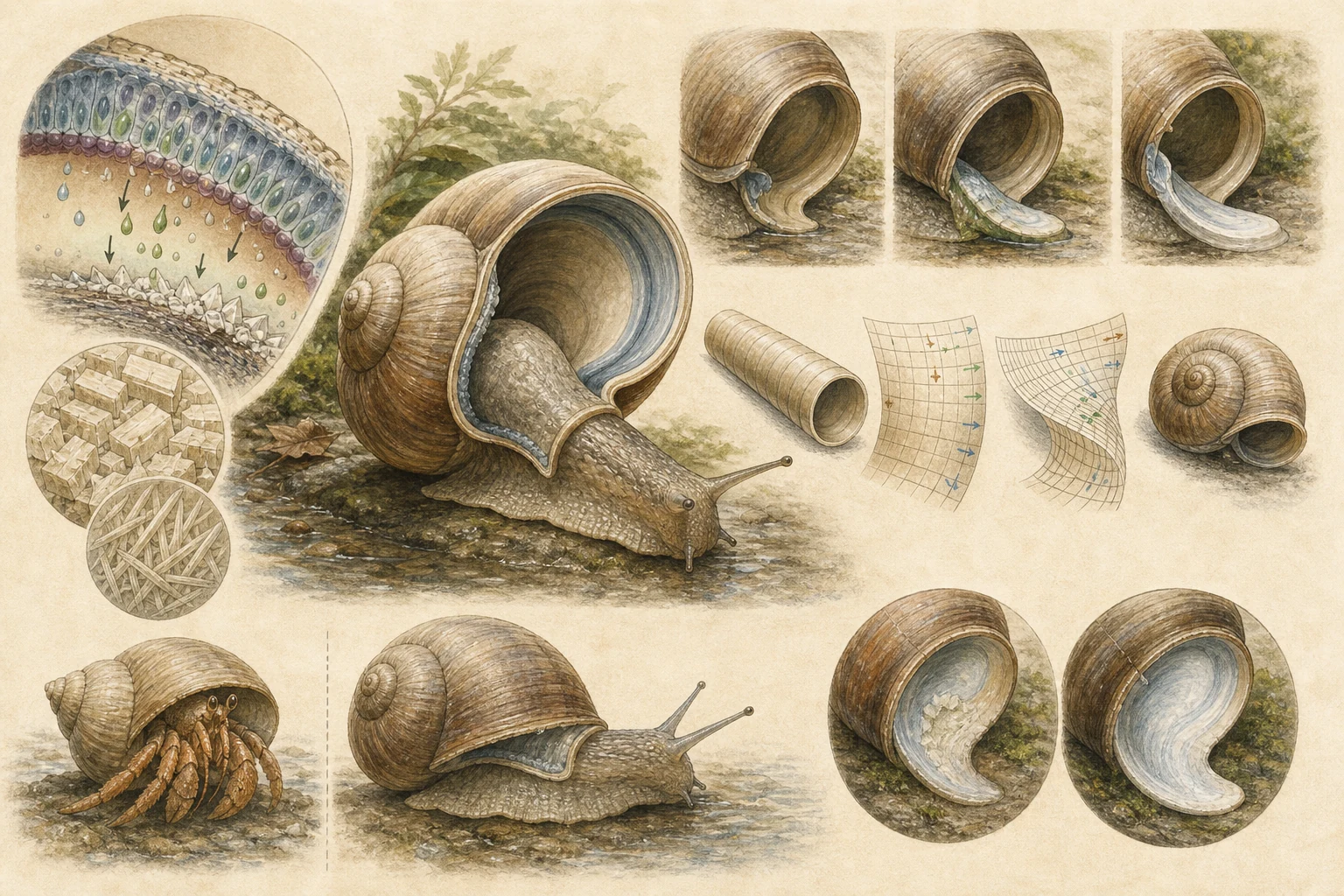
Pure calcium carbonate chalks and shatters easily, yet a marine periwinkle or garden snail shell resists crushing crab claws and bird beaks because it is built as a multi-layered biological composite. Along the muscular collar of the mantle, specialized epithelial zones secrete an outer horny protein skin—the periostracum—which seals a narrow extrapallial fluid space against the existing shell rim. Mantle cells then pump calcium and bicarbonate ions into that sealed pocket alongside acidic matrix proteins and chitin, which direct calcium carbonate to crystallize into interlocking microscopic bricks or crossed-lamellar sheets of aragonite and calcite under hormonal and cellular regulation. [3][4]
- An outer proteinaceous periostracum seals the shell margin and protects underlying mineral layers from acid dissolution
- Organic matrix proteins (<5% of shell weight) organize brittle calcium carbonate into fracture-resistant microstructures
- Pigment-secreting cells along the mantle collar lay down spots, flames, or continuous bands as the rim advances
Add shell at the aperture
Hold a garden snail (Cornu aspersum) or a wave-worn whelk shell under a hand lens and trace the surface from the tiny, smooth embryonic protoconch at the tip of the spire down to the wide outer lip of the aperture: you are reading the animal's entire life chronologically. Because hardened shell mineral cannot stretch, all outward enlargement happens by marginal accretion along the open aperture rim. During warm, damp nights with abundant calcium-rich food, the mantle collar lays down wide, thin, translucent strips; during winter hibernation, summer drought estivation, or cold tides, growth halts and leaves a raised growth line or thickened rib. [1][4]
- The tiny button-like apex (protoconch) is the original larval or embryonic shell carried since hatching
- Fine transverse growth lines mark daily or tidal pauses, while heavy ribs or varices mark seasonal stops or defensive thickenings
- In a still-growing juvenile snail, the extreme outer edge of the aperture lip feels thin and slightly flexible
Turn unequal growth into a coil
Why does a growing snail shell wind into a spiral rather than extending straight out like a drinking straw? Developmental and biomechanical studies show that the mantle margin does not secrete new shell at a uniform rate all the way around the circular aperture. When the outer (dorsal or abapical) edge of the mantle deposits material faster than the inner columellar edge, the growing tube curves continuously around an axis in an approximately logarithmic spiral. Shifting the relative rates of aperture expansion, rotation, and downward translation along the coiling axis transforms the same basic mantle program into flat ram's-horn coils (Planorbis), high-spired augers (Turritella), or open-coiled limpet caps. [1][2]
- Faster shell accretion on one side of the mantle collar than the other bends the growing tube into a spiral
- Three geometric parameters—aperture expansion rate, distance from the axis, and downward translation—generate diverse shell shapes
- Most gastropod species coil dextrally (opening on the right when the spire points up), though sinistral species and mutants occur
Maintain a shell that stays attached
Unlike a hermit crab, which borrows and swaps empty shells as it grows, a living snail is permanently anchored inside its own shell by a strong columellar muscle wound around the central pillar and by the delicate visceral mass filling the upper whorls. Never pull a grazing snail straight off a rock or garden wall, as tearing the columellar attachment or snapping the thin growing lip inflicts serious injury. If a bird's beak chips the outer aperture rim, the flexible mantle edge can reach forward and rebuild the missing margin; if a crack punctures an older whorl higher up the spire, the general mantle epithelium can only plaster a smooth mineral patch from the inside. [3][4]
- A powerful columellar muscle attaches the snail's body to the internal central axis of the shell
- Chips at the aperture lip can be rebuilt with patterned outer shell, whereas holes in older whorls are patched from inside
- Acidic forest soils or low-calcium waters force snails to build thinner shells and scavenge calcium from bone, limestone, or empty shells
Related guides
Get Fauna and identify it in the field.
Where this guide comes from
Source-checked editorial guide. Last updated . This guide teaches identification and field skills; it is not a substitute for expert verification when it matters.
- University Museum, University of Tokyo — Architecture of Shells ↗
- Proceedings of the National Academy of Sciences of the United States of America — Growth and morphogenesis of the gastropod shell ↗
- Scientific reports — The calcitonin-like system is an ancient regulatory system of biomineralization ↗
- Digital Atlas of Ancient Life — Class Gastropoda ↗