How sea stars regrow arms
Sea-star regeneration is slow coordinated reconstruction, not a detached limb simply stretching back. Wound closure is followed by cell migration, proliferation, patterning, and the rebuilding of several integrated organ systems.
Last updated
Lose an arm at a controlled plane
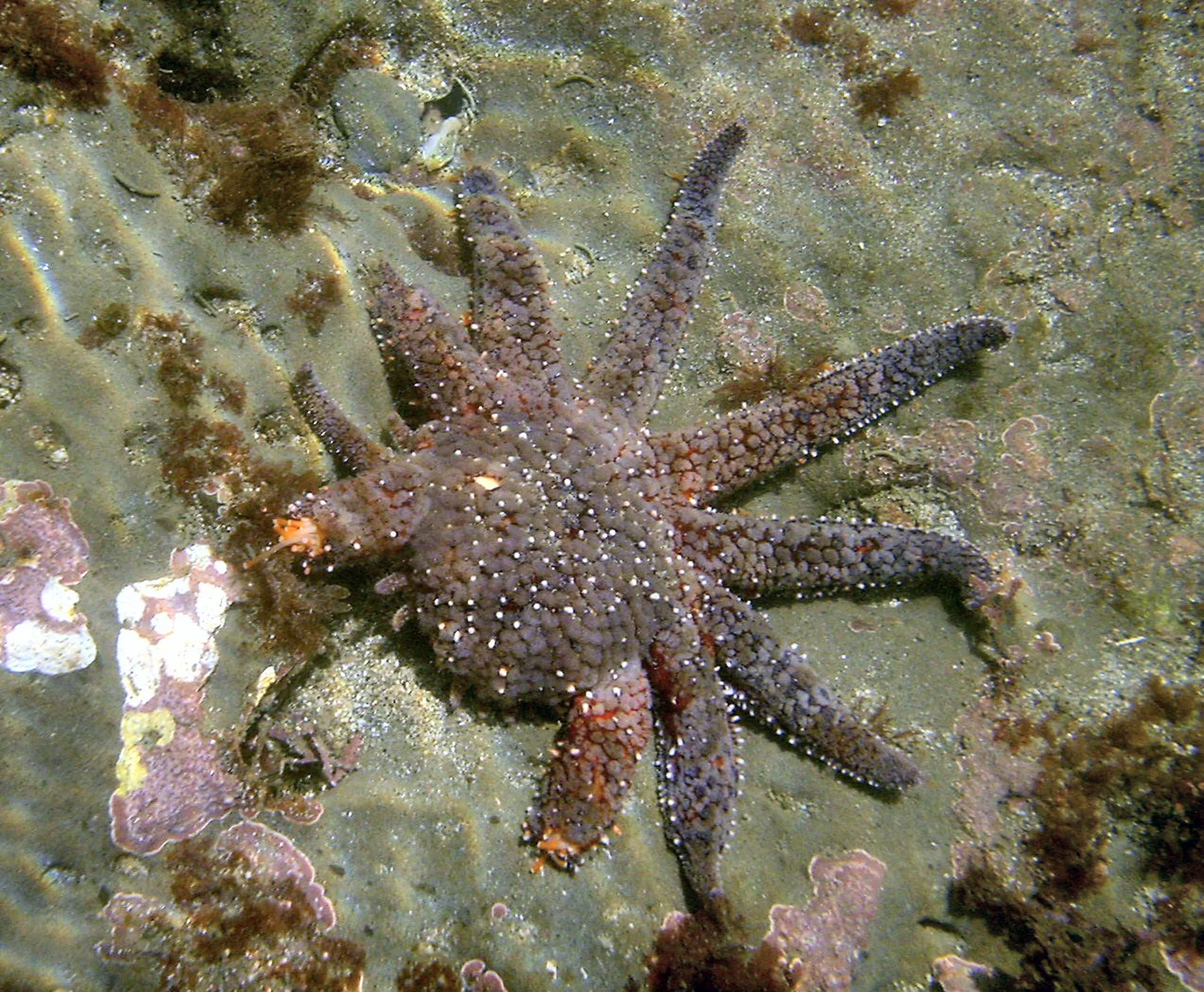
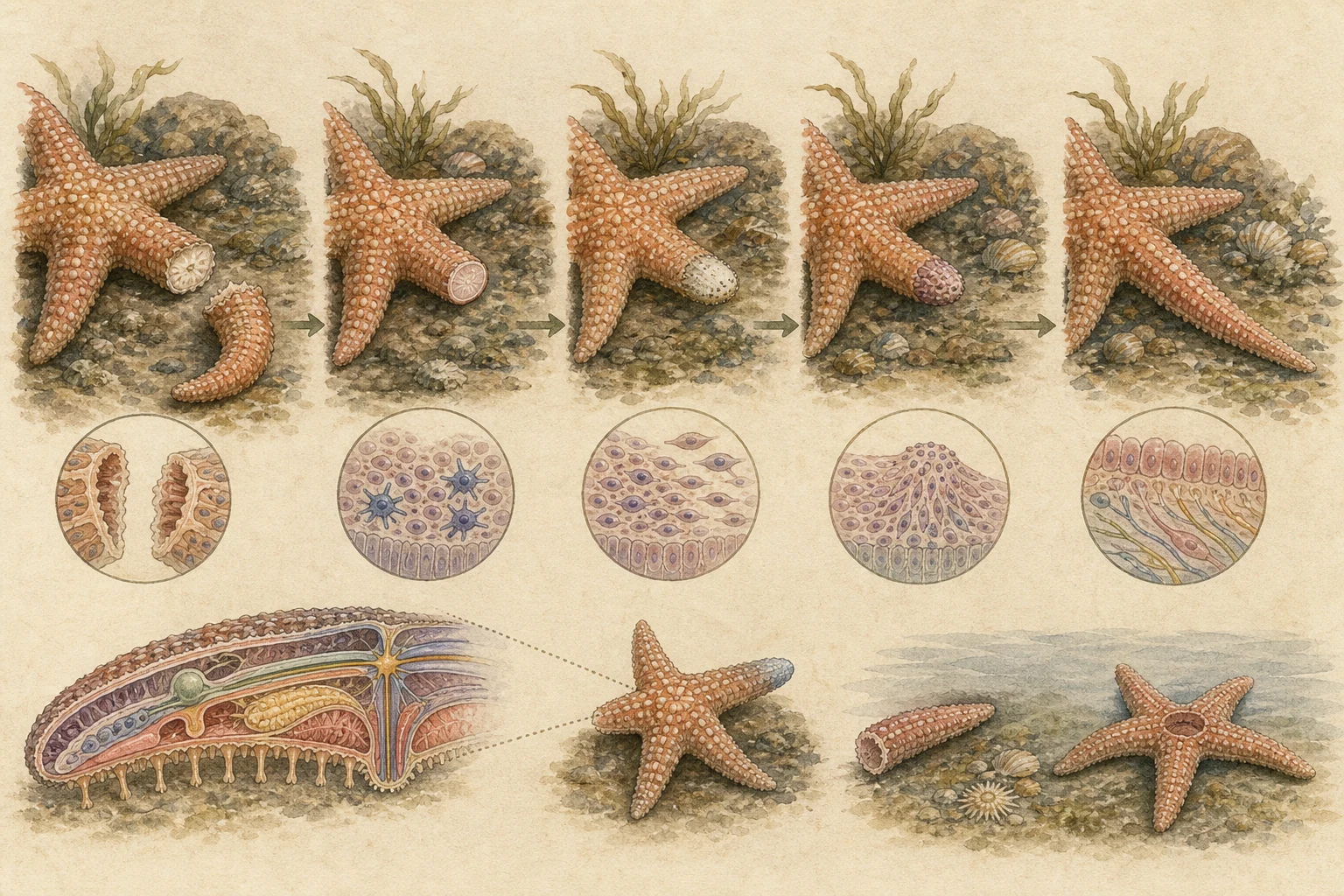
When a crab, gull, or predatory sea star seizes an arm of a common sea star (Asterias rubens), the animal often escapes by shedding the appendage through autotomy rather than waiting for tissues to tear raggedly. Across the base of each ray sits a specialized autotomy plane bridged by mutable collagenous tissue (catch connective tissue) under direct nervous control. Neurosecretory signals rapidly depolymerize the interfibrillar cross-links holding those collagen bundles stiff, softening the ligamentous connections between calcareous ossicles and muscle bundles so the arm detaches cleanly while circular body-wall muscles constrict tightly around the break. [1][3]
- Mutable collagenous tissue at the base of the ray softens on neural command to allow clean autotomy
- Constricting body-wall muscles narrow the stump immediately after separation to limit coelomic fluid loss
- Shedding an arm saves the animal's life but sacrifices digestive pyloric caeca and gonads stored inside that ray
Seal and reorganize the stump
During the initial repair phase after autotomy, contraction of the muscular body wall draws the edges of the wound inward while circulating immune-like coelomocytes aggregate into a cellular clot and clear damaged cells and foreign microbes. Stretched epidermal cells migrate over the raw surface to form a continuous wound epidermis before extensive cell division begins. Rather than relying on a single uniform stem-cell blastema, sea-star regeneration recruits dedifferentiating cells from the coelomic epithelium, radial nerve stump, and mesenchymal tissues, which remodel extracellular matrix and enter a proliferative phase only after the wound is securely sealed. [2][4]
- Circulating coelomocytes plug the wound and clear cellular debris while body-wall muscles cinch the opening
- Surrounding epidermis stretches and migrates across the stump to re-establish a protective outer barrier
- Progenitors arise from coelomic epithelia and local stump tissues rather than one uniform stem-cell pool
Rebuild a radial body system
Because every sea-star ray houses a repeating module of the five-part body plan, a growing arm bud must extend far more than outer skin and dermal ossicles. Outgrowth begins at the severed tip of the radial nerve cord—where neuroepithelial cells and neuropeptides such as SALMFamide-1 accompany new axonal tracts—and the radial canal of the water-vascular system. Behind a protective terminal tentacle and crimson eyespot that form early at the tip of the tiny regenerate, new pairs of tube feet, ampulla bulbs, calcite ambulacral plates, and digestive pyloric caeca differentiate sequentially from the stump outward over months. [2][3][4]
- The regenerating radial nerve cord and water-vascular canal lead outgrowth at the tip of the new arm bud
- A tiny terminal sensory tentacle and pigmented eyespot differentiate early at the apex of the growing ray
- Pairs of functional tube feet and skeletal ossicles are added progressively between the stump and the growing tip
Keep the whole-animal claim narrow
Popular beach lore often claims that any severed sea-star arm will grow into a complete second sea star, but in most species—including intertidal ochre stars (Pisaster ochraceus) and northern sea stars (Asterias rubens)—an isolated arm lacking a piece of the central disk and ring canal eventually dies without regenerating. Only a few specialized lineages, notably tropical comet stars in the genus Linckia and several self-dividing brittle and sea stars, routinely regenerate a complete central disk and four tiny new rays from a single cast-off arm, producing the asymmetrical 'comet' form seen on Indo-Pacific coral reefs. [1][2]
- In most temperate sea stars, regeneration requires an intact portion of the central disk and ring canal
- Tropical Linckia species can regrow a full disk and new rays from a single detached arm, forming a 'comet'
- Cold water, poor prey availability, or repeated sublethal injuries slow arm regrowth to many months or years
Recognizing regeneration on the shore
In a rocky low-tide pool, a regenerating sea-star arm is easy to identify without prying the animal from the stone: look for a ray that is markedly shorter, paler, and narrower than its neighbors, emerging from a smooth, constricted collar where autotomy occurred. If you look closely with a hand lens at the upturned tip of that short ray, you can often spot the tiny orange-red optic cushion and sensory tentacle already in place while new tube feet are still budding behind it. Never pull a sea star off a boulder to inspect its underside, as forcibly tearing hundreds of adhered tube feet damages the water-vascular system. [1][3][4]
- A short, pale ray tapering from a smooth basal constriction marks an arm regrowing after clean autotomy
- The upturned tip of even a small regenerating bud usually carries a miniature eyespot and sensory tentacle
- Leave clinging sea stars attached to the rock so their adhered tube feet and regenerating tissues are not torn
Related guides
Get Fauna and identify it in the field.
Where this guide comes from
Source-checked editorial guide. Last updated . This guide teaches identification and field skills; it is not a substitute for expert verification when it matters.
- Marine drugs — Morphological and Physiological Aspects of Mutable Collagenous Tissue at the Autotomy Plane of the Starfish Asterias rubens L. (Echinodermata, Asteroidea): An Echinoderm Paradigm ↗
- Genesis (New York, N.Y. : 2000) — Origin and development of the germ line in sea stars ↗
- Proceedings. Biological sciences — Expression of the neuropeptide SALMFamide-1 during regeneration of the seastar radial nerve cord following arm autotomy ↗
- Cell and tissue research — Regeneration of starfish radial nerve cord restores animal mobility and unveils a new coelomocyte population ↗