Ecological resilience and tipping points
Resilience can mean rapid return to a prior state or the capacity to retain core functions and feedbacks through disturbance. Some ecosystems have alternative regimes separated by thresholds, but abrupt change can also track an abrupt driver without self-reinforcing tipping dynamics. Evidence must distinguish these possibilities.
Last updated

Resilience has more than one definition
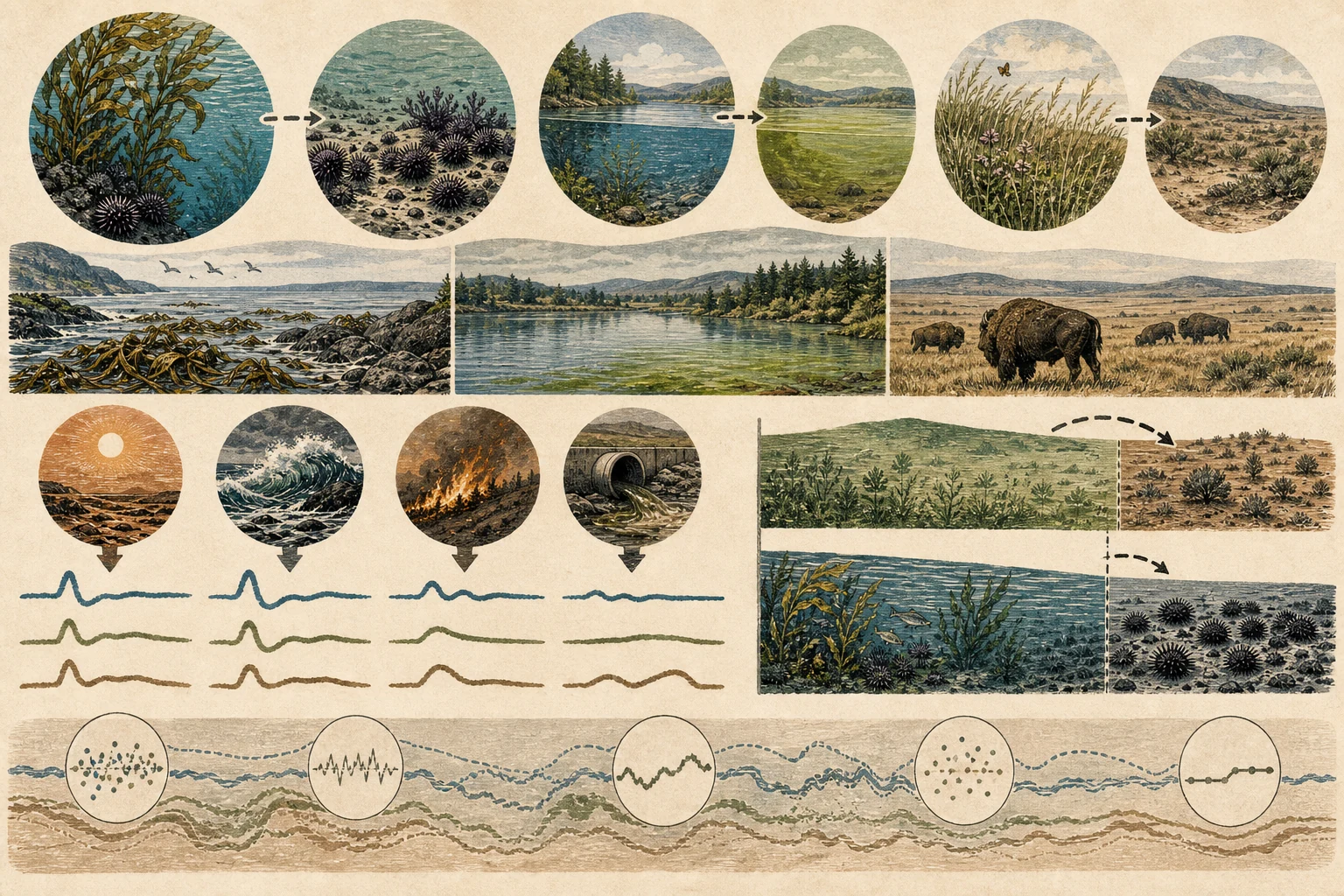
Ecologists use the word resilience in two distinct ways that must be specified before interpreting field data. Engineering resilience measures how fast a system bounces back to its pre-disturbance baseline after a perturbation—such as how quickly canopy cover or insect biomass returns after a storm. Ecological resilience, by contrast, asks how much disturbance or chronic stress a system can absorb before its stabilizing feedbacks break down and it reorganizes into a fundamentally different state. Because different ecosystem attributes recover on different schedules, a reef's total fish biomass, branching coral cover, carbonate accretion, and grazing rates must each be defined and measured at an explicit spatial and temporal scale. [1][2]
- Engineering resilience tracks recovery speed after a disturbance, whereas ecological resilience measures the capacity to resist switching regimes.
- Different variables in the same habitat—such as species richness, biomass, and nutrient cycling—can show very different recovery rates.
- Meaningful resilience assessments always specify resilience of what attribute, to what disturbance, over what time window.
Feedbacks can stabilize alternative regimes
In shallow lakes, tropical coral reefs, semi-arid savannas, and temperate kelp beds, internal biological and physical feedbacks can lock an ecosystem into one of several alternative stable regimes. In a clear shallow lake, rooted aquatic plants stabilize bottom sediment, absorb nutrients, and shelter zooplankton that graze down phytoplankton blooms. If heavy nutrient runoff clouds the water enough to kill those submerged plants, waves stir up loose sediment and recycle phosphorus, stabilizing a turbid, algae-dominated state. Because the new feedbacks reinforce themselves, simply cutting nutrient inputs back to the threshold where the switch occurred may not restore clear water—a path-dependent pattern called hysteresis. [1][3]
- Self-reinforcing feedbacks among organisms and their physical environment can stabilize contrasting ecosystem regimes under the same climate.
- Hysteresis means that reversing an environmental pressure back to its pre-collapse level may not be enough to restore the original state.
- Seeing two different habitats side by side does not prove alternative stable states without experimental evidence of stabilizing feedbacks.
Abrupt change is not automatically a tipping point
When a forest, lake, or reef changes dramatically over a single season, it is tempting to declare that a tipping point has been crossed, yet sudden ecological change often reflects a sudden external shock—such as an extreme marine heatwave, hurricane, wildfire, or toxic spill—rather than a self-amplifying threshold. Widespread coral bleaching on a Samoan reef, for example, is an acute physiological stress response in which corals expel their photosynthetic algal symbionts during abnormal heat. Whether that bleached reef recovers its coral canopy or shifts toward fleshy macroalgae depends on heat duration, coral mortality, herbivorous fish grazing, larval supply, and water quality over the years that follow. [2][4]
- A sudden ecosystem decline can be a direct response to a severe weather event or pollutant pulse rather than a self-reinforcing tipping point.
- Coral bleaching is a physiological stress response to heat; long-term reef trajectory depends on subsequent mortality, grazing, and larval recruitment.
- True tipping points involve nonlinear thresholds where internal feedbacks propel further change after the initial push.
Early warnings remain conditional tools
Mathematical theory predicts that as an ecosystem approaches certain bifurcation thresholds, its rate of recovery from small everyday disturbances slows down—a phenomenon called critical slowing down that can show up in time series as rising variance and higher lag-1 autocorrelation. While whole-lake manipulations and laboratory microcosms have detected these statistical signatures ahead of regime shifts, applying generic early-warning indicators in the wild is fraught with limits. Short or noisy monitoring records, changing external weather variance, spatial heterogeneity, and sudden extreme events can either mask slowing down or trigger false alarms, so managers pair statistical indicators with direct monitoring of ecological feedbacks and stress drivers. [3][4]
- Critical slowing down near a threshold can increase statistical variance and autocorrelation in high-resolution time series.
- Noisy field data, short monitoring records, or abrupt environmental shocks can cause generic early-warning signals to fail or misfire.
- Reducing known chronic stressors like nutrient pollution or overfishing builds resilience even when exact thresholds remain uncertain.
Related guides
Get Fauna and identify it in the field.
Where this guide comes from
Source-checked editorial guide. Last updated . This guide teaches identification and field skills; it is not a substitute for expert verification when it matters.
- Philosophical Transactions of the Royal Society B: Biological Sciences — Resilience indicators: prospects and limitations for early warnings of regime shifts ↗
- Proceedings. Biological sciences — Forecasting the limits of resilience: integrating empirical research with theory ↗
- Proceedings of the National Academy of Sciences of the United States of America — Predicting tipping points in complex environmental systems ↗
- Nature sustainability — Measuring resilience is essential if we are to understand it ↗