Tidepooling without harm
Low tide opens a temporary window into the intertidal zone. The best visit is timed conservatively, made from stable bare ground, and leaves every organism in its exact place.
Last updated
Plan around the local water, not a generic time
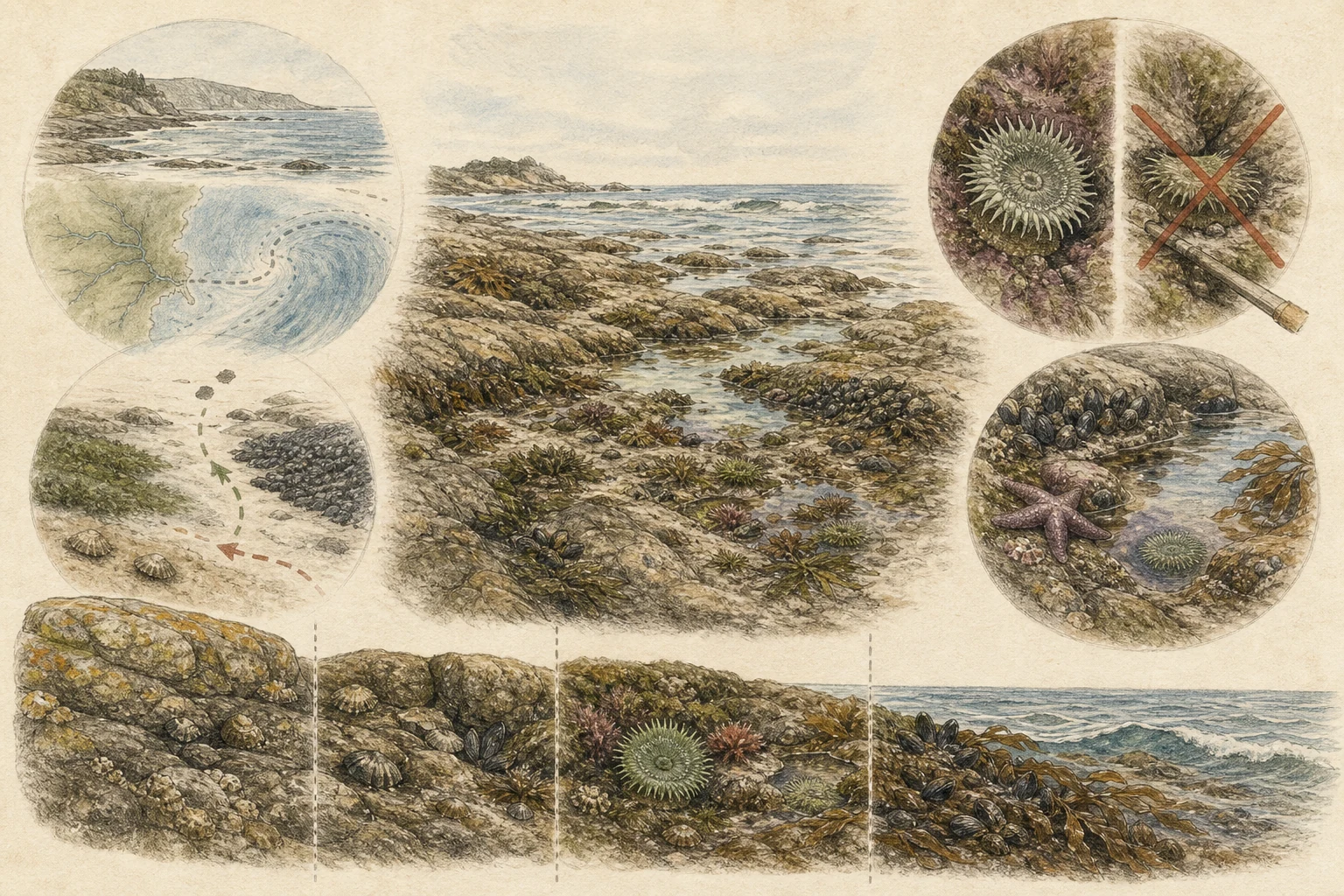
Tide pools are rocky basins that trap seawater as the ocean recedes, but the safe, productive window on any shore depends on local tidal datum, coastal topography, swell height, and wind direction. Check the official tide table for the nearest reference station alongside marine weather and park access notices before setting out. Arrive while the water is still ebbing so advancing dry rock guides your footing, pick an unmistakable landmark and turnaround time on the upper shore, and begin working back upslope as soon as the lowest water turns. [1][2][3]
- Consult the tide prediction for the specific cove or headland rather than relying on a regional average
- Walk out on a falling tide so newly exposed rock is easiest to read and channels do not fill behind you
- Factor in offshore swell and wind, which can push sneaker waves well above the predicted tidal height
Move low, slow, and on bare ground
Keep the seaward horizon in your peripheral vision and test each foothold before committing your weight. Bare rock and coarse sand patches offer the safest traction and the lowest ecological impact, whereas wet rockweed, kelp blades, and encrusted beds of mussels or barnacles are both slippery and alive. Crouch rather than bend from the waist when peering into a basin so your center of gravity stays low, and stay out of the water itself so boots do not crush delicate coralline algae, nudibranchs, or sculpin eggs. [1][2][3][5]
- Never turn your back on the open surf, especially on outer benches where larger wave sets arrive without warning
- Place boots only on bare rock or sand—never on seaweed drapes, mussel beds, or barnacle crusts
- Stay on dry margins rather than wading through pools, which stirs sediment and crushes cryptic bottom life
Let attached life stay attached
Chitons, limpets, sea stars, anemones, barnacles, and mussels anchor themselves with muscular feet, byssal threads, or natural cement to survive pounding surf and low-tide desiccation. Prying an animal loose tears its holdfast or foot tissue and leaves it unable to reattach before the next wave sweeps the bench. Keep hands out of the water, never poke open anemones or transfer crabs between pools, and leave cobbles and boulders untouched: overturning a rock exposes sheltered crabs, brittle stars, and egg capsules to drying air, crushing weight, and gull predation. [2][3][4][5]
- Prying a limpet, chiton, or sea star off rock damages its muscular foot or tube feet and usually proves fatal
- Leave stones and boulders unmoved so under-rock sponges, worms, and brooding octopuses or fish stay wet and sheltered
- Keep hands, sunscreen, and dogs out of small basins where trapped water heats and fouls quickly
Read the shore as a set of zones
A rocky shore is organized by immersion time, from the salt-spray splash fringe down through upper barnacle and rockweed bands, middle mussel beds, and the low intertidal fringe that uncovers only on minus tides. Comparing these vertical bands reveals how physical stress—heat, drying, salinity swings, and wave force—gives way to biological pressures such as sea star predation and space competition lower down. Photograph both the wide zonation band and the individual organism in situ, noting whether it is submerged, closed tight against the air, or actively filter-feeding. [1][4]
- Compare upper splash rock, mid-shore mussel and rockweed beds, and the low kelp-edged fringe on minus tides
- Notice how high-shore animals seal moisture inside shells while low-shore species rely on constant dampness
- Wait quietly beside a single deep pool for five minutes so hermit crabs, blennies, and shrimp resume foraging
Related guides
Get Fauna and identify it in the field.
Where this guide comes from
Source-checked editorial guide. Last updated . This guide teaches identification and field skills; it is not a substitute for expert verification when it matters.