How crocodilians guard their young
Crocodilian parental care starts before hatching in many species. Adults may guard a nest, respond to calls from within the eggs, excavate emerging young, transport them gently, and remain near a nursery group.
Last updated
Begin care at the nest
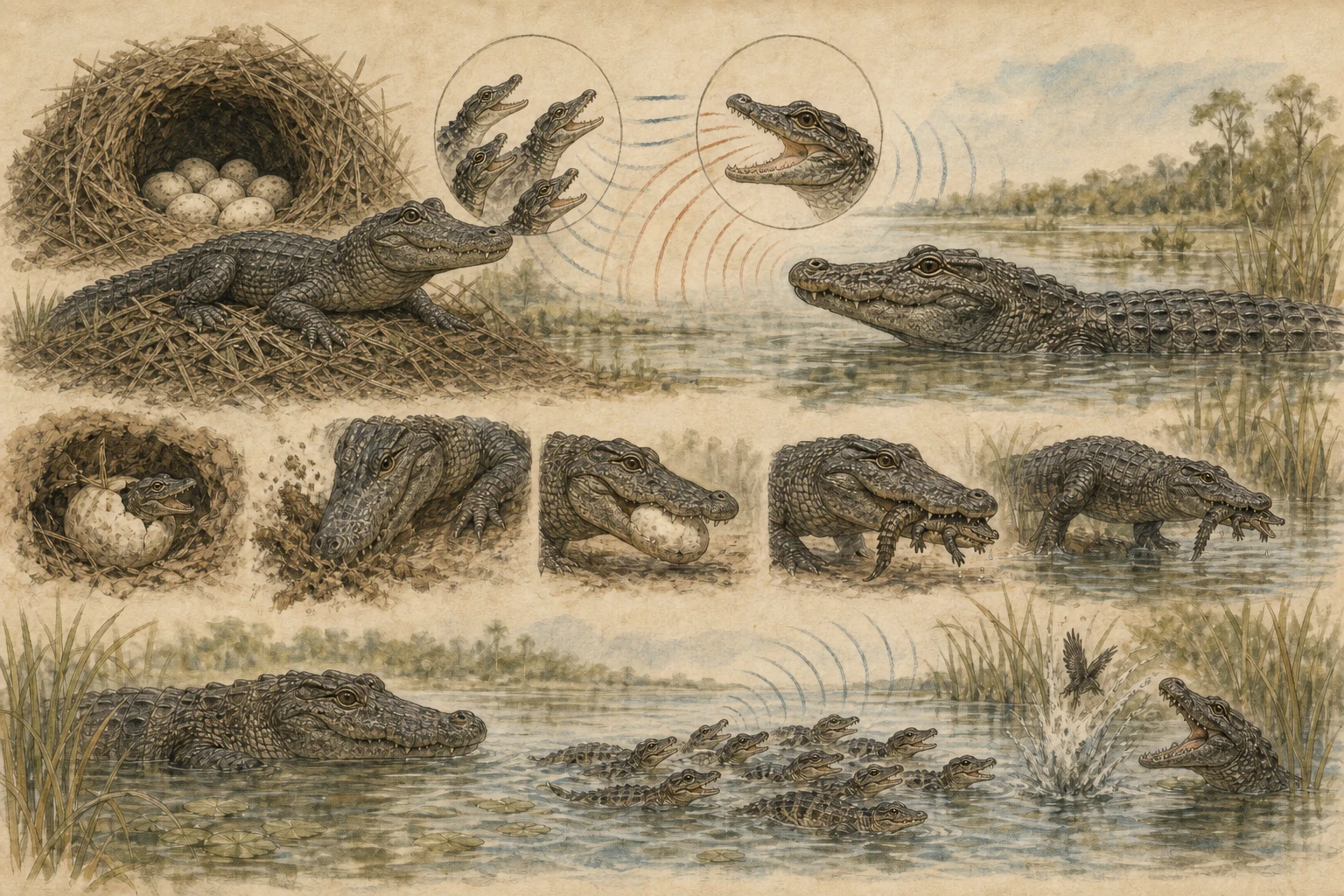
Living crocodilians build two main nest types: scraped sand or soil holes, typical of Nile crocodiles (Crocodylus niloticus) and gharials (Gavialis gangeticus), and heaped mounds of rotting marsh vegetation, constructed by American alligators (Alligator mississippiensis) and all caimans. During the two- to three-month incubation period, many females rest in shaded wallows or shallow water within sight of the nest, lunging out to drive away monitor lizards, raccoons, or wading birds. Comparative reviews show that nest attendance varies widely across species, disturbance history, and habitat, so an empty bank at midday never guarantees a nest is unguarded. [3][4]
- Crocodilians construct either excavated hole nests in banks or decaying vegetation mounds in wetlands
- Attending females often wait submerged in adjacent pools or mud wallows rather than sitting atop the eggs
- Never approach a riverside sand mound or marsh vegetation heap, as a guarding parent may be concealed nearby
Listen for the hatching chorus
Days or hours before pipping through their leathery shells, embryonic crocodilians begin emitting short, repetitive grunting vocalizations from inside the buried egg chamber. These underground calls help synchronize hatching across the entire clutch and summon the attending mother to dig open the sun-baked soil or matted vegetation above them. Field acoustic playback experiments with wild Nile crocodiles in Botswana's Okavango Delta demonstrated that mothers are finely tuned to the pitch and formant structure of juvenile calls, approaching and defending acoustic cues characteristic of smaller, freshly hatched young much more strongly than calls from older juveniles. [2][4]
- Pre-hatching vocalizations synchronize sibling emergence and prompt the mother to excavate the chamber
- Wild Nile crocodile mothers respond most intensely to acoustic traits indicating smaller, younger hatchlings
- Faint, repetitive grunts or chirps near a wetland bank indicate an active pod and an attending adult nearby
Excavate and transport gently
Once hatchlings call from inside the nest, an attending mother scrapes away the compacted earth or tough root mat with her forelimbs and heavy jaws—a physical barrier that many neonates could never penetrate on their own before suffocating or overheating. In American alligators, Nile crocodiles, and several relatives, the female picks up emerged hatchlings—or even unhatched eggs—inside her muscular buccal pouch, gently rolling intact eggs between her tongue and palate to help crack the shell before carrying the brood to water. What looks to an untrained shoreline observer like predation or cannibalism is actually delicate maternal transport. [1][3][4]
- Excavation by the parent frees hatchlings from sun-hardened clay, sand, or dense rotting vegetation
- Mothers carry several hatchlings at once in the depressed floor of the mouth without puncturing them
- Some females gently press pipping eggs between tongue and palate to assist emergence before releasing young in water
Stay near a mobile nursery
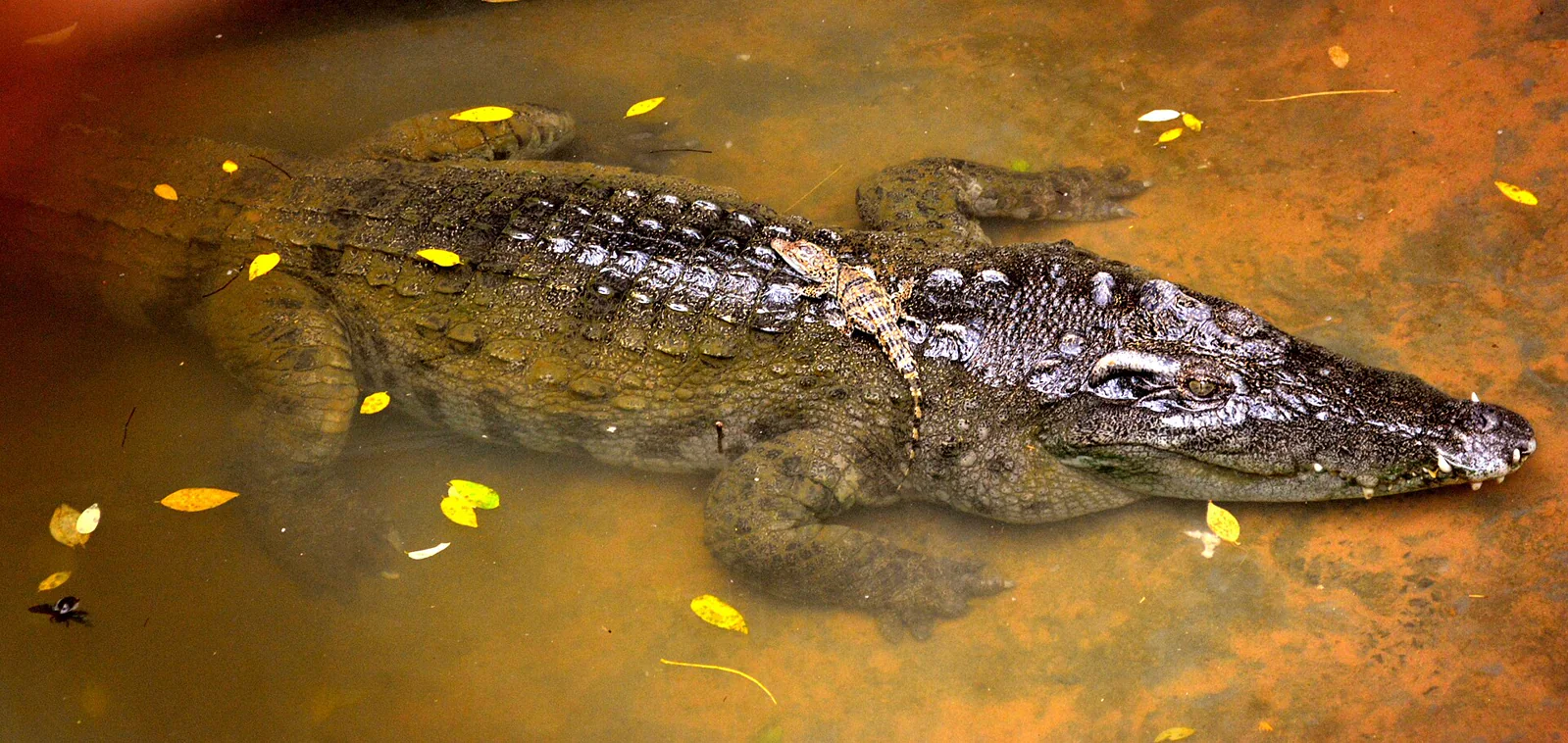
After reaching shallow nursery cover among reeds or flooded tree roots, young crocodilians cluster in cohesive groups called pods or crèches, basking on the parent's broad snout and armored back while maintaining contact with soft grunts. If a heron, large predatory fish, or mammal threatens the group, a hatchling's sharp distress call brings the guarding adult surging across the shallows. Care duration and male participation differ across the order: American alligator mothers may stay near pods for a year or more, and male mugger crocodiles and gharials also guard crèches, whereas some species disperse much earlier. [2][3][4]
- Hatchling pods cluster in shallow shoreline vegetation and bask directly on the attending adult's head and back
- Sharp juvenile distress calls draw immediate defensive approaches from mothers and sometimes nearby adults
- Male parental care and crèche defense occur regularly in species such as gharials and mugger crocodiles
Related guides
Get Fauna and identify it in the field.
Where this guide comes from
Source-checked editorial guide. Last updated . This guide teaches identification and field skills; it is not a substitute for expert verification when it matters.
- National Park Service — Mother Alligator Excavates and Transports Hatchlings ↗
- Scientific reports — Size does matter: crocodile mothers react more to the voice of smaller offspring ↗
- Ecology and evolution — The evolution of crocodilian nesting ecology and behavior ↗
- IUCN SSC Crocodile Specialist Group ↗