Brood parasitism explained
Some birds occasionally lay in neighbors' nests, while obligate brood parasites depend on hosts for reproduction. Parasites must reach a suitable nest and their young must survive there; hosts may recognize adults, eggs, or chicks, but every defensive choice carries risks and costs.
Last updated
Parasitism ranges from occasional to obligatory
Avian brood parasitism is not a single habit restricted to one bird family. Many ducks, colonial swallows, and weavers practice facultative intraspecific brood parasitism—females build their own nests and incubate a clutch, yet opportunistically slip extra eggs into a neighboring conspecific's nest. By contrast, roughly 1 percent of living bird species are obligate interspecific brood parasites that never build a nest or feed their own young, depending entirely on other species. This life history evolved independently seven times across birds: in three clades of cuckoos (Cuculidae), the New World cowbirds (Icteridae), African indigobirds and whydahs (Viduidae), African honeyguides (Indicatoridae), and the South American black-headed duck (Heteronetta atricapilla). [1][4][5]
- Facultative brood parasites raise their own clutches while occasionally dumping extra eggs into neighbors' nests.
- Obligate interspecific brood parasitism evolved independently seven times across cuckoos, cowbirds, finches, honeyguides, and waterfowl.
- Over half of the world's cuckoo species—including yellow-billed cuckoos and roadrunners—build their own nests and rear their own young.
A parasite must match a chain of host decisions
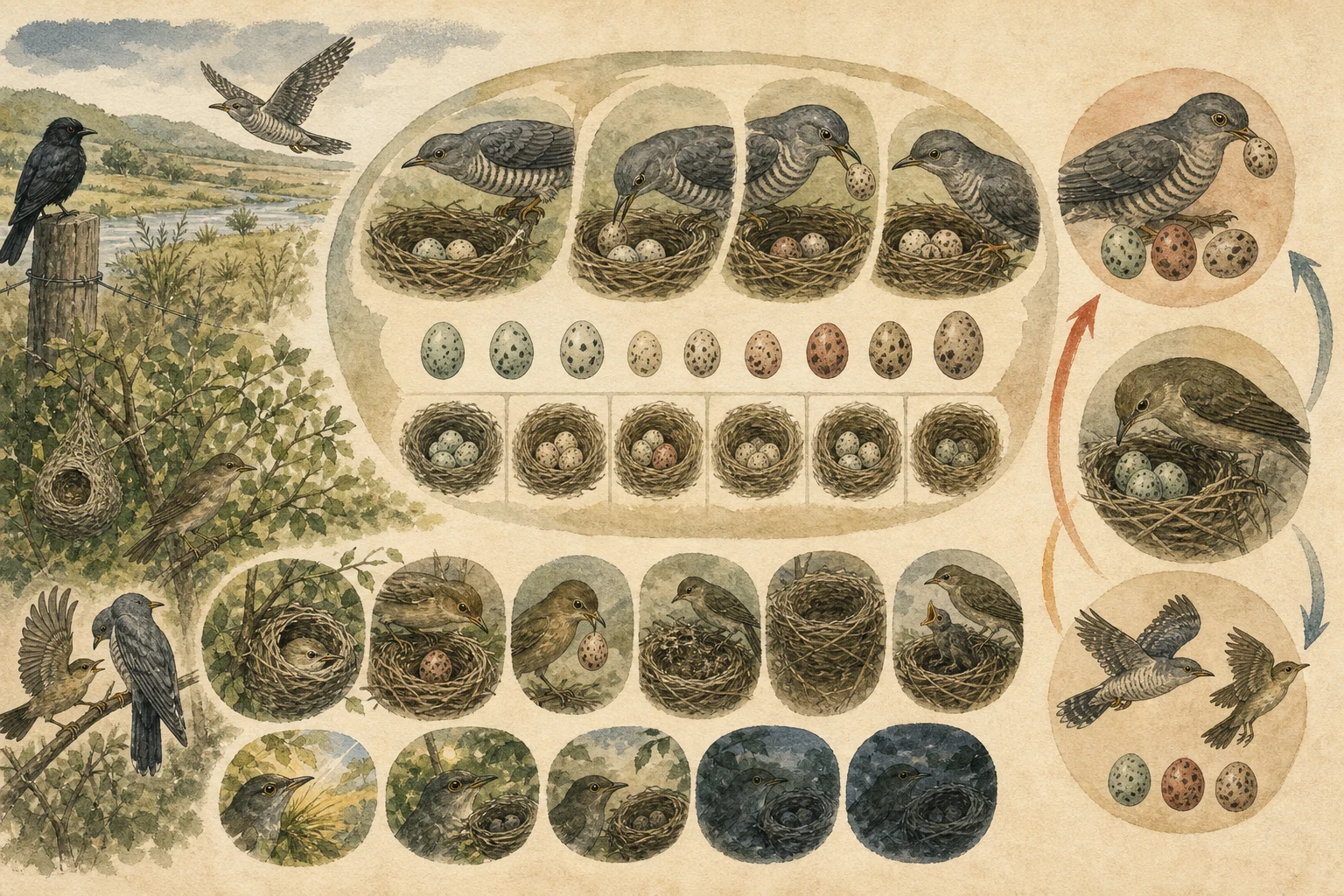
To succeed, a female common cuckoo (Cuculus canorus) or brown-headed cowbird (Molothrus ater) must silently watch host pairs building nests in woodland edges or reedbeds, synchronize her ovulation with the host's laying window, slip onto the nest when the owners step away, lay her egg in seconds, and often remove or puncture one host egg. In specialist cuckoos, females belong to host-specific maternal lineages (gens) whose eggs match a target warbler or redstart clutch in background hue and maculation. Once hatched, strategies diverge sharply: newly hatched common cuckoo and honeyguide chicks evict or kill host young to monopolize food, whereas cowbird and whydah chicks grow alongside host nestlings and outbeg them. [1][2][3]
- Female brood parasites monitor host nest-building quietly from perches so they can lay during the host's egg-laying window.
- Specialist cuckoo maternal lineages lay eggs that mimic their specific host's eggshell color and spotting pattern.
- Common cuckoo and honeyguide hatchlings eliminate host nestmates, whereas brown-headed cowbirds and indigobirds rear alongside host young.
Hosts defend at several stages
Host birds are not passive victims; they mount sequential lines of defense across the breeding cycle. Before laying, reed warblers, fairy-wrens, and yellow warblers mob adult cuckoos or cowbirds near the nest and warn mates with specific alarm calls. Once an odd egg appears, some hosts puncture or grasp it in the bill to eject it, desert the nest entirely, or—like North American yellow warblers (Setophaga petechia)—weave a fresh floor over the parasitized clutch to bury the foreign egg. Visual modeling using avian tetrachromatic photoreceptors shows that hosts weigh ultraviolet and visible color differences against the costly risk of accidentally piercing or tossing one of their own eggs in dim nest light. [1][2][3]
- Hosts mob adult parasites near the nest before laying, eject odd eggs, abandon parasitized clutches, or build a new nest floor over them.
- Small-billed warblers that cannot grasp a large, thick-shelled cowbird or cuckoo egg must either puncture-eject it, bury it, or desert.
- Egg rejection carries recognition risk: in dim forest or cavity light, overly aggressive hosts risk rejecting their own variable eggs.
Coevolution is an uneven, changing contest
Reciprocal selection between brood parasites and their hosts produces some of the clearest evolutionary arms races in nature: as hosts evolve finer egg-pattern discrimination or distinctive signature markings on their clutches, selection favors parasite lineages with ever closer eggshell mimicry, thicker shells that resist host bill puncture, or rapid 11-day incubation that hatches the parasite first. Yet many common hosts—such as dunnocks (Prunella modularis) parasitized by common cuckoos, or song sparrows and common yellowthroats hosting brown-headed cowbirds—readily accept starkly mismatched eggs because the evolutionary contact is recent, rejection costs exceed acceptance costs, or parasite mafia behavior punishes egg rejection. [2][4][5]
- Coevolution drives tighter egg mimicry in specialist cuckoos and complex signature spotting in discriminating host species.
- African Viduidae finch nestlings mimic the exact intricate mouth-lining spots, gape flanges, and begging calls of their estrildid finch hosts.
- Many hosts accept non-mimetic eggs when parasitism rates fluctuate, bill size prevents ejection, or evolutionary contact is relatively recent.
What a parasitized nest looks like
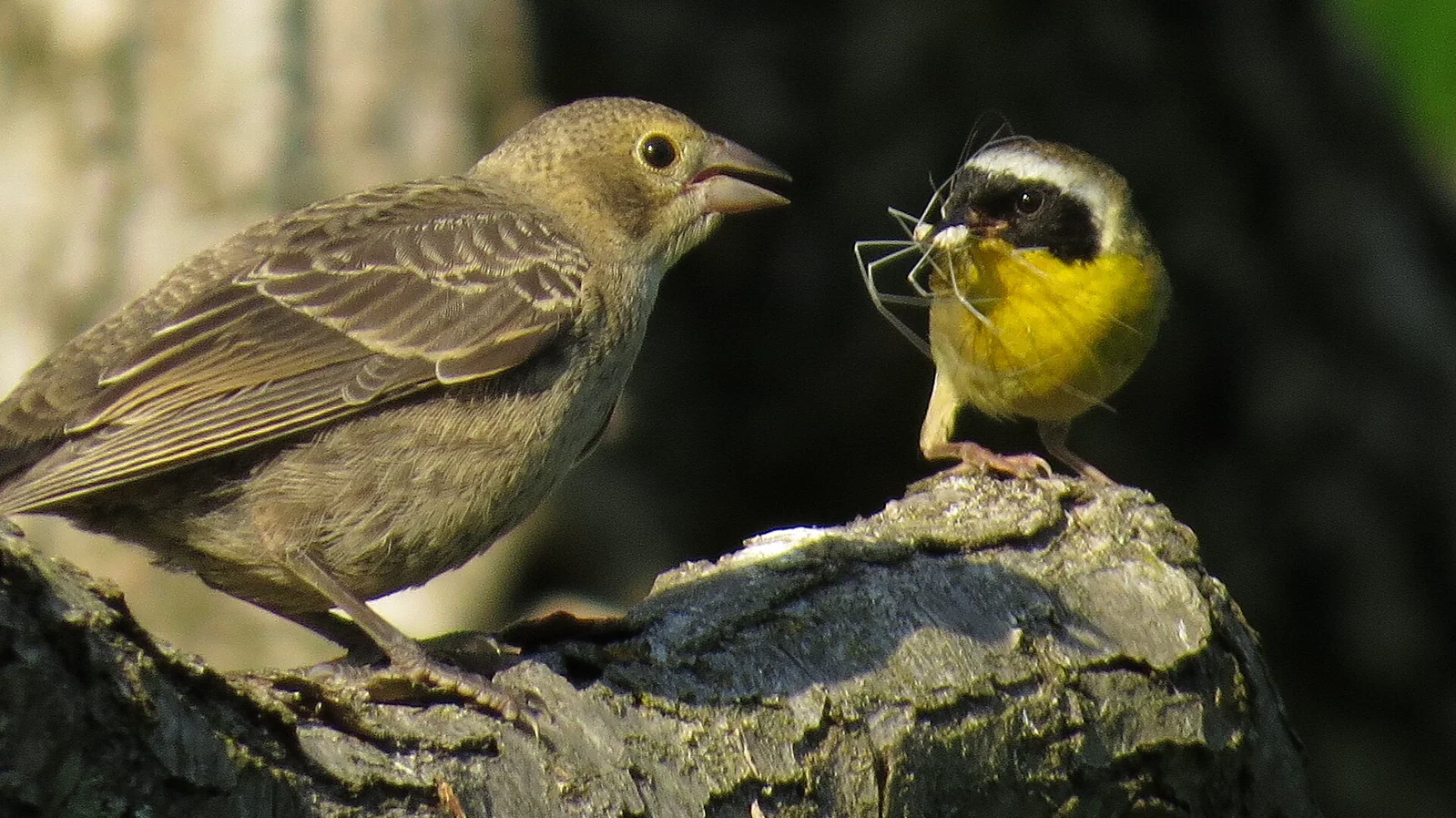
In the field, the most familiar sign of brood parasitism appears after fledging: a small warbler, vireo, sparrow, or reed warbler working tirelessly to stuff caterpillars into the gaping beak of a juvenile brown-headed cowbird or common cuckoo twice its own body mass. Earlier in the season, a brief check of an open cup nest from a respectful distance may reveal an oversized, densely brown-speckled cowbird egg sitting beside smaller host eggs, or a multi-tiered yellow warbler cup unusually tall from buried clutches. Remember, however, that conspecific egg dumping in ducks and cliff swallows produces extra-large clutches of identical-looking eggs without an interspecific parasite. [1][2][3]
- A small songbird adult repeatedly feeding a fledged juvenile twice its own size is the classic field sign of interspecific brood parasitism.
- In open songbird cups, a brown-headed cowbird egg often stands out by its larger dimensions and dense brown-and-gray speckling.
- Unusually large clutches of 15 or more eggs in wood duck boxes or grebe nests usually indicate intraspecific egg dumping by neighboring females.
Related guides
Get Fauna and identify it in the field.
Where this guide comes from
Source-checked editorial guide. Last updated . This guide teaches identification and field skills; it is not a substitute for expert verification when it matters.
- Nature Education — Ecology of avian brood parasitism ↗
- Philosophical transactions of the Royal Society of London. Series B, Biological sciences — Cuckoos, cowbirds and hosts: adaptations, trade-offs and constraints ↗
- Philosophical transactions of the Royal Society of London. Series B, Biological sciences — Colour, vision and coevolution in avian brood parasitism ↗
- Current zoology — From micro- to macroevolution: brood parasitism as a driver of phenotypic diversity in birds ↗
- Ecology letters — The overlooked complexity of avian brood parasite-host relationships ↗