Watching nests without disturbing
A nest is a sensitive place, not a closer-look invitation. The best view usually comes from a settled position with binoculars, a short observation plan, and an immediate retreat when adults change behavior.
Last updated
Let behavior set the distance
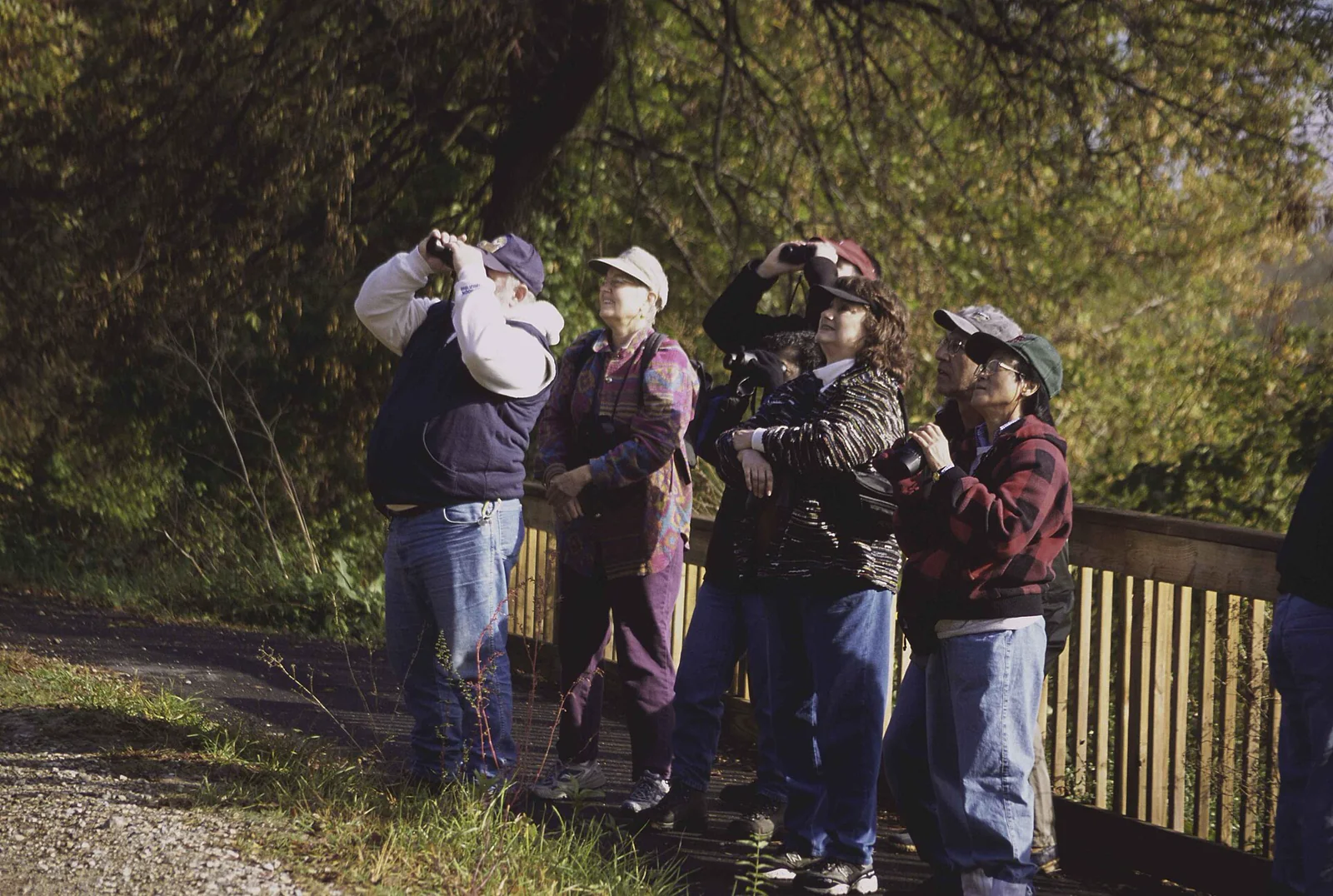
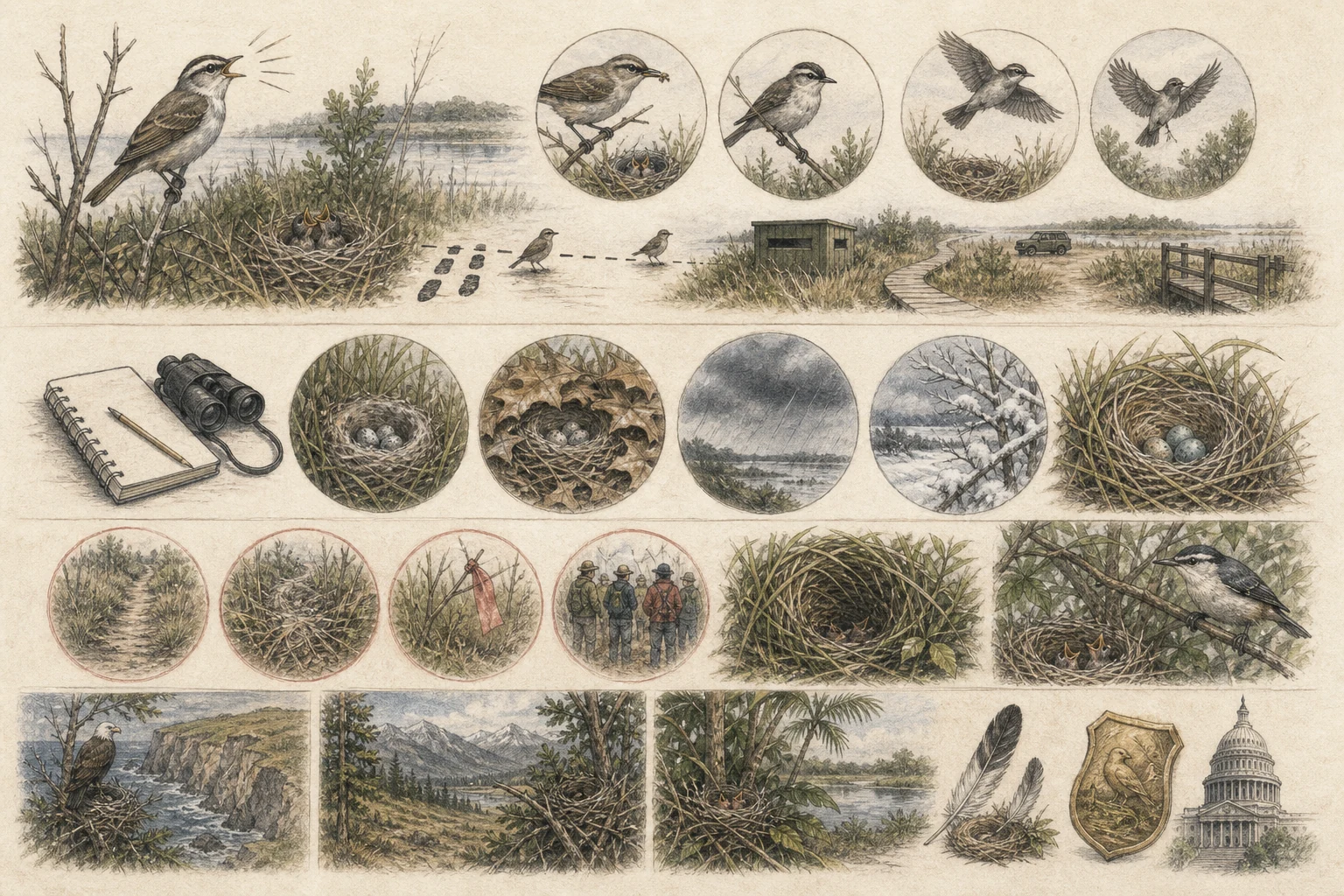
Most active bird nests are discovered not by peering into bushes, but by standing quietly with binoculars and watching an adult carry nesting fibres, a beakful of caterpillars, or a white fecal sac. Once you know where a nest is, let the parent birds dictate your viewing distance: if an adult hesitates on an outer perch with food in its bill, gives sharp chip notes, feigns a broken wing, or circles overhead instead of dropping in, you are standing inside its alert zone and need to step back until normal deliveries resume. [1][4][5][6]
- Choose the viewpoint before settling in.
- Use optics instead of edging closer.
- Keep a clear route for adults to enter and leave.
Keep any close check exceptional and brief
For everyday wildlife watching, there is no reason to walk up to an active nest at all. Even when observers participate in structured citizen-science monitoring such as Cornell Lab's NestWatch, strict field rules apply: nests are checked only once every three or four days for less than a minute, avoided during early nest-building and incubation when abandonment risk is highest, skipped in cold or wet weather when uncovered eggs chill rapidly, and never approached when older nestlings are close to fledging and could burst from the cup prematurely. [1][2][6]
- Never force a sitting bird to leave.
- Do not approach fully feathered, alert young that may fledge prematurely.
- Postpone a protocol check in cold, damp, rainy, or otherwise unsuitable conditions.
Do not advertise the nest
Predators such as crows, jays, raccoons, foxes, and domestic cats are acute observers of human activity and readily follow trampled grass or human scent trails. Walking a dead-end path straight to a shrub and turning back leaves a physical and olfactory arrow pointing directly at the clutch; NestWatch monitors walk past a nest on a continuous tangential loop so no path ends at the site. Never tie flagging tape nearby, never bend or clip concealing leaves for a clearer camera angle, and keep active nest coordinates off public social feeds until after the young have fledged. [1][2][4][6]
- Do not trim branches for a photograph.
- Leave by a different low-impact route only when doing so does not trample more habitat.
- Keep pets away from nesting habitat.
Know the rules before acting
Legal protections around bird nests are strict and frequently misunderstood. In the United States, the Migratory Bird Treaty Act makes it unlawful to take, possess, or destroy active nests, eggs, or chicks of native migratory birds without a federal permit, and the Bald and Golden Eagle Protection Act protects eagle nests even when they are inactive between breeding seasons. Many other countries enforce parallel breeding-season disturbance laws, so never move a nest, collect an abandoned-looking egg, or alter nest trees without consulting the appropriate wildlife agency. [1][3]
- Never handle eggs or young as part of ordinary watching.
- Ask a wildlife professional about a nest in immediate conflict or danger.
- Follow site closures and species-specific buffers where they are posted.
Related guides
Get Fauna and identify it in the field.
Where this guide comes from
Source-checked editorial guide. Last updated . This guide teaches identification and field skills; it is not a substitute for expert verification when it matters.
- Cornell Lab NestWatch — Code of Conduct ↗
- Cornell Lab NestWatch — Nest Monitoring Protocol ↗
- U.S. Fish & Wildlife Service — bird nests and federal protections ↗
- Cornell Lab NestWatch — How to Find Nests ↗
- National Park Service — seven ways to safely watch wildlife ↗
- National Audubon Society — ethical bird photography and nest observation ↗