Why birds form flocks
A flock gives each member more eyes and ears and can transform many local reactions into coordinated group motion. The same crowd also brings competition, disease, conspicuousness, and unequal positions, so birds join, leave, and rearrange flocks as risks and resources change.
Last updated
More observers can change predator risk
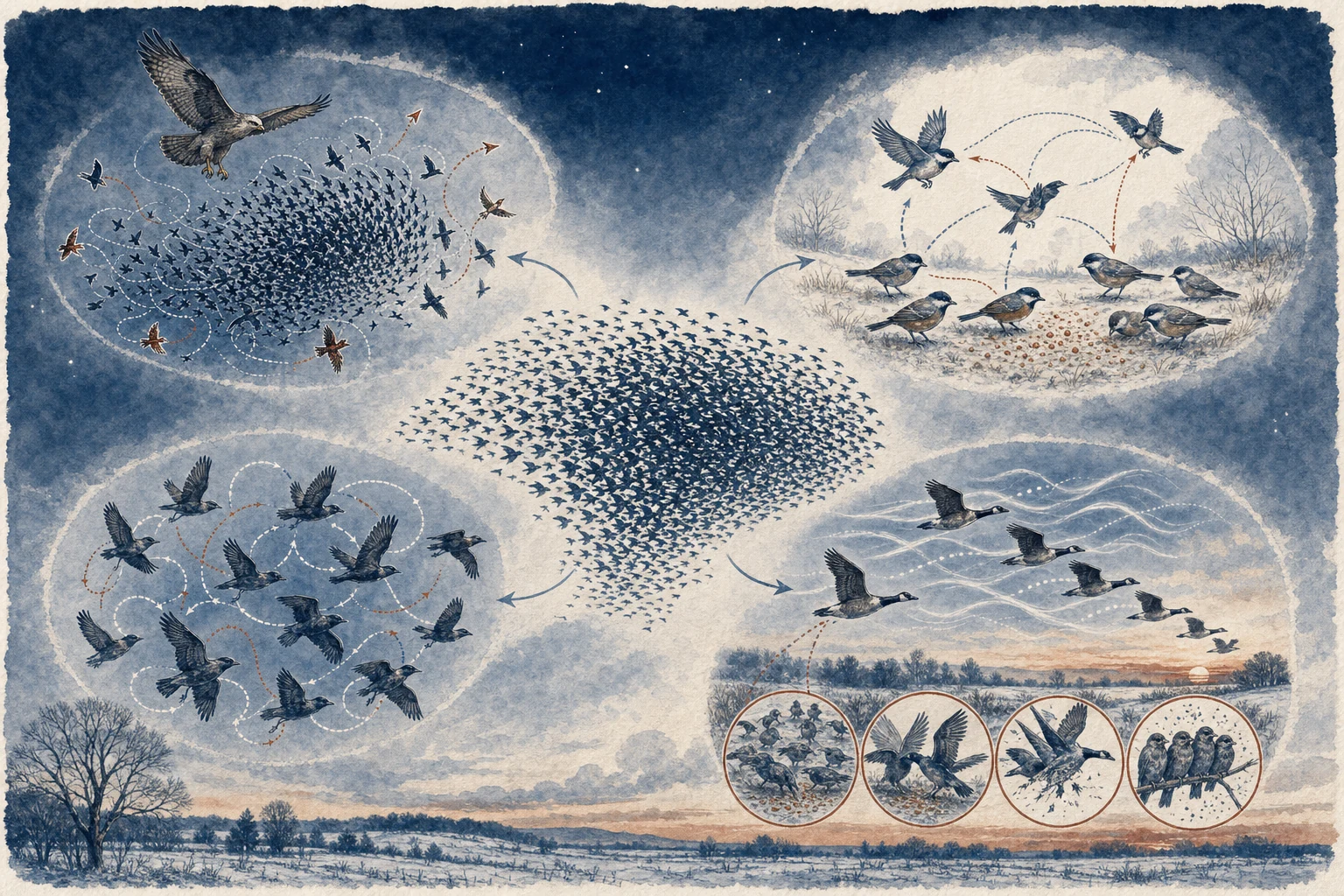
Watch a winter flock of dunlins on a mudflat or European starlings (Sturnus vulgaris) foraging in pasture and you will see individual birds spending more seconds probing the soil and fewer seconds with their heads raised scanning the sky than a lone bird ever could. This many-eyes effect lets a group spot an approaching peregrine falcon or merlin earlier while diluting any single member's statistical probability of being seized. Once a falcon stoops, starlings and shorebirds compress into tight aerial balls that wheel, split, and send dark agitation waves racing across the sky, creating visual confusion that makes it harder for a raptor to lock onto one target—unless a straggler gets isolated on the flock margin. [2][5]
- Shared vigilance in a foraging flock lets each bird lower its head-up scanning rate while keeping overall predator detection high.
- When a falcon stoops, starlings and shorebirds compress and propagate rapid escape waves that disrupt predator target tracking.
- Birds pushed to the outer edges of a feeding or flying group often experience higher predation risk than those in the interior.
Flocks move information about food and routes
Flocks also function as mobile information networks where an individual's posture, pecking rate, or sudden flight cues neighbors to ephemeral food patches. In winter woodlands across North America and Eurasia, chickadees, titmice, nuthatches, kinglets, creepers, and woodpeckers assemble into mixed-species foraging flocks that move through the trees together; nuclear species such as black-capped chickadees or great tits give high-pitched contact and alarm calls that organize group cohesion while reducing overlap in exact bark- or twig-gleaning niches. At dusk, communal winter roosts of American crows (Corvus brachyrhynchos), ravens, and starlings gather thousands of birds that exchange social cues and share body warmth. [3][5]
- Foraging birds watch neighbors' pecking rates and postures to locate patchy seeds, berries, or insect flushes faster than searching alone.
- Mixed-species woodland flocks pair nuclear sentinel species like chickadees and tits with creepers, nuthatches, and warblers.
- Large winter roosts of crows, ravens, and starlings concentrate birds in sheltered trees or reedbeds to buffer night wind and predation.
Local rules generate coordinated motion
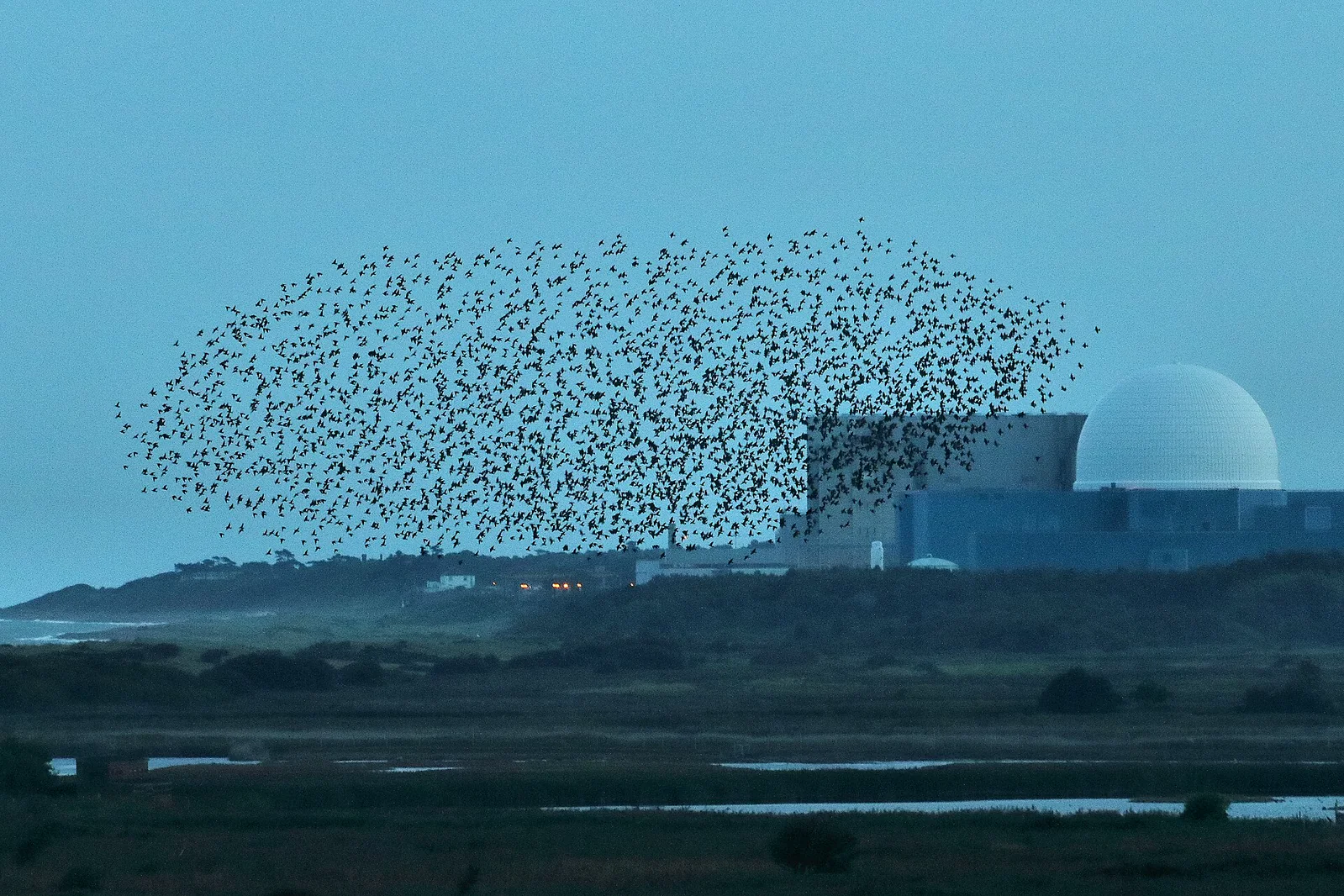
A dusk murmuration of thousands of European starlings twisting over a winter reedbed looks as if a single choreographer were steering the cloud, yet multi-camera stereoscopic reconstructions in Rome revealed that the pattern emerges from simple local rules without a central leader. Each flying starling tracks and adjusts its velocity and banking angle relative to a topological neighborhood of roughly six to seven nearest neighbors—regardless of whether the flock is loosely spread or tightly packed—while scale-free behavioral correlations transmit a turn initiated by a few birds on the flank across the entire group with minimal signal damping. [1][2][5]
- Stereoscopic 3D tracking of starling murmurations shows each bird coordinates with its six or seven nearest neighbors rather than a fixed distance radius.
- Topological interaction keeps the flock cohesive even when a stooping falcon causes group density to expand or contract sharply.
- Scale-free correlations in velocity and heading changes allow escape turns to sweep across thousands of birds almost instantaneously.
Some formations save energy, but flocking still costs
Not all flocks are dense clouds; migrating geese, cranes, pelicans, and northern bald ibises fly in crisp V-formations or diagonal echelons where trailing birds position their wingtips inside the upward-rotating vortex wake shed by the bird ahead. Heart-rate loggers and GPS-accelerometer studies confirm that birds flying in formation or trailing behind a leader can reduce wingbeat effort and metabolic flight cost compared with solo flight. By contrast, tight cluster flocks of pigeons or songbirds may actually pay a slight aerodynamic penalty from turbulent wakes, accepting higher flight or foraging competition costs—and greater exposure to avian parasites and pathogens—in exchange for predator defense and navigation. [4][5]
- Large birds flying in V-formations and echelons time their wingbeats and wingtip positions to capture upwash from the vortex wake ahead.
- Heart-rate and respirometry studies show trailing birds in organized small groups expend less metabolic energy than lone flyers.
- Dense cluster flocks trade aerodynamic turbulence, food competition, and pathogen transmission for safety from aerial predators.
Related guides
Get Fauna and identify it in the field.
Where this guide comes from
Source-checked editorial guide. Last updated . This guide teaches identification and field skills; it is not a substitute for expert verification when it matters.
- Proceedings of the National Academy of Sciences of the United States of America — Interaction ruling animal collective behavior depends on topological rather than metric distance: evidence from a field study ↗
- Behavioral ecology and sociobiology — Complex patterns of collective escape in starling flocks under predation ↗
- RSPB (UK) — Starlings and murmurations ↗
- Proceedings of the National Academy of Sciences of the United States of America — It pays to follow the leader: Metabolic cost of flight is lower for trailing birds in small groups ↗
- Proceedings of the National Academy of Sciences of the United States of America — Scale-free correlations in starling flocks ↗