Why insects emerge all at once
Long developmental schedules create a ready cohort, while soil or water temperature, rain, day length, and flow can tighten the final timing; ecological benefits then favor individuals that emerge with the group.
Last updated
A cohort must be ready before a cue can release it
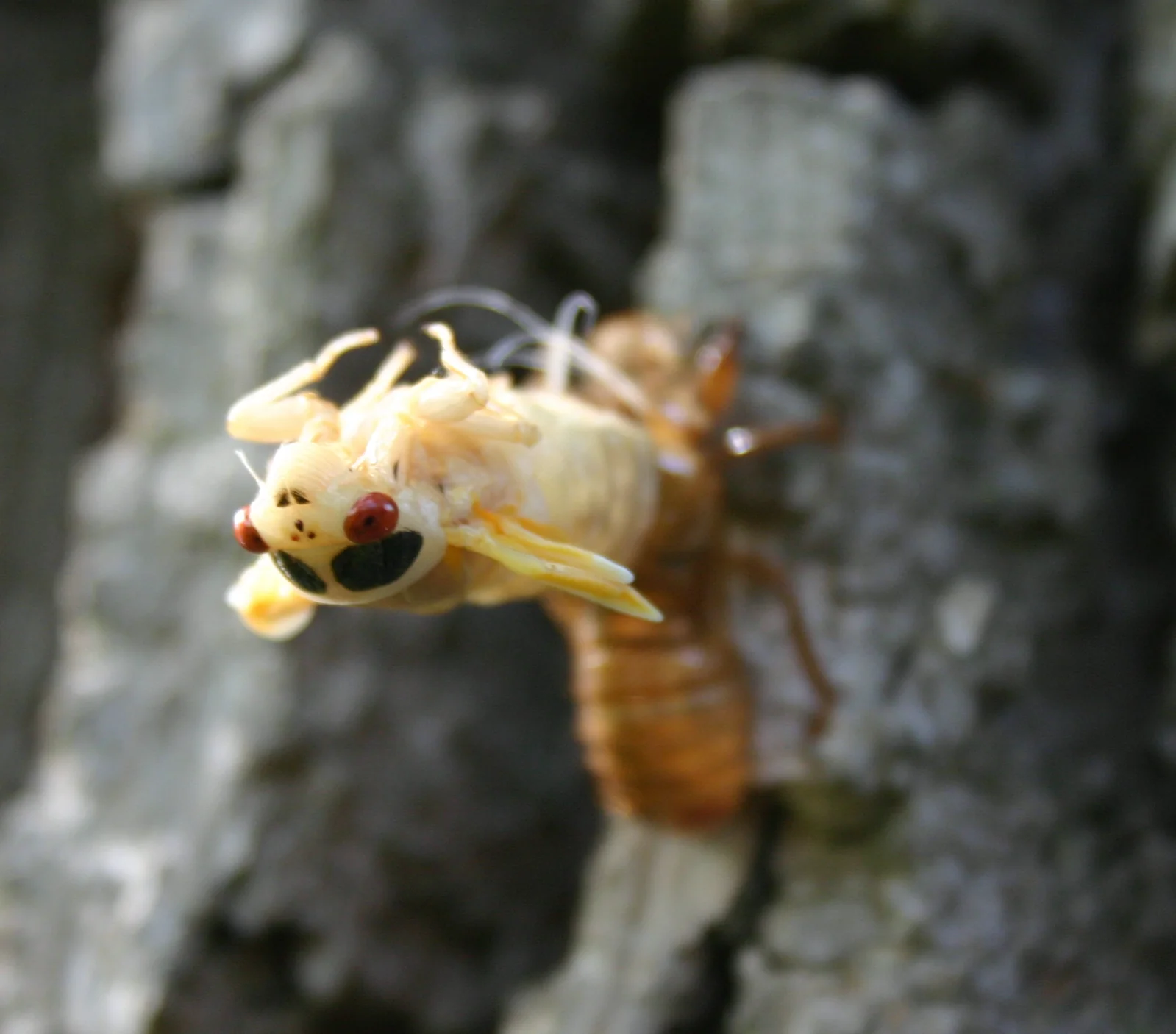
A warm spring evening does not pull every underground or underwater insect into the air at once; it releases only the cohort that has already completed larval or nymphal development and paused at a pre-emergence developmental gate. Beneath eastern North American deciduous forests, Magicicada nymphs feed on xylem fluids for thirteen or seventeen years before waiting near the soil surface in spring. Along the Tisza River in Central Europe, larvae of the giant mayfly Palingenia longicauda burrow in clay riverbanks for three years before transforming into short-lived winged adults across a few synchronized evening hours. Developmental gates assemble the waiting crowd; daily weather then opens the door. [1][2][5]
- Separate multi-month or multi-year larval maturation from the final daily weather trigger that releases winged adults.
- Look for pre-emergence mud turrets or shallow exit holes under trees days before periodical cicadas actually climb out.
- Remember that short-lived adults like Palingenia mayflies spend years feeding as aquatic larvae before their brief winged flight.
Shared cues tighten the final window
Once a cohort is developmentally poised to molt, shared environmental signals align individuals to the same week, night, or hour. For periodical cicadas, soil temperature reaching roughly 18 degrees Celsius at twenty centimeters depth is a well-known threshold, while rainfall timing and soil moisture strongly shape peak daily emergence in urban and woodland habitats by softening soil and aiding eclosion humidity. For aquatic mayflies, stoneflies, and chironomid midges, water temperature degree-days, river discharge, photoperiod, and falling dusk light coordinate when nymphs rise to the surface film. Because different species read different combinations of thermal and moisture cues, one weather rule never fits every hatch. [1][3]
- Log recent rainfall, soil or water temperature, and dusk light levels when documenting the onset of an insect emergence.
- Watch how warm rain softens compacted soil and coincides with peak nightly cicada emergence pulses.
- On rivers and lakes, note water temperature and flow changes alongside twilight timing during mayfly and caddisfly hatches.
Numbers change the odds
Emerging as a soft, pale, flightless teneral adult is one of the most dangerous moments in an insect's life, yet doing so alongside millions of neighbors flips individual survival odds through predator satiation. Birds, mammals, spiders, and fishes can gorge until their crops and stomachs are full, so the per-capita risk of being eaten drops sharply at peak emergence density compared with the stragglers that emerge too early or too late. Simultaneously, packing adult emergence into a tight temporal window guarantees that short-lived males and females—some surviving only hours as winged adults—can locate mates immediately through chorusing or swarming. [2][4]
- Observe how local birds and squirrels feed heavily on early cicadas or mayflies but quickly become satiated during the main pulse.
- Notice that soft, pale newly molted (teneral) insects often climb at dusk so their cuticle hardens before diurnal birds begin hunting.
- Understand 13- and 17-year periodical cicada schedules as evolutionary outcomes of cohort synchrony and predator dynamics, not conscious counting.
The pulse connects land and water food webs
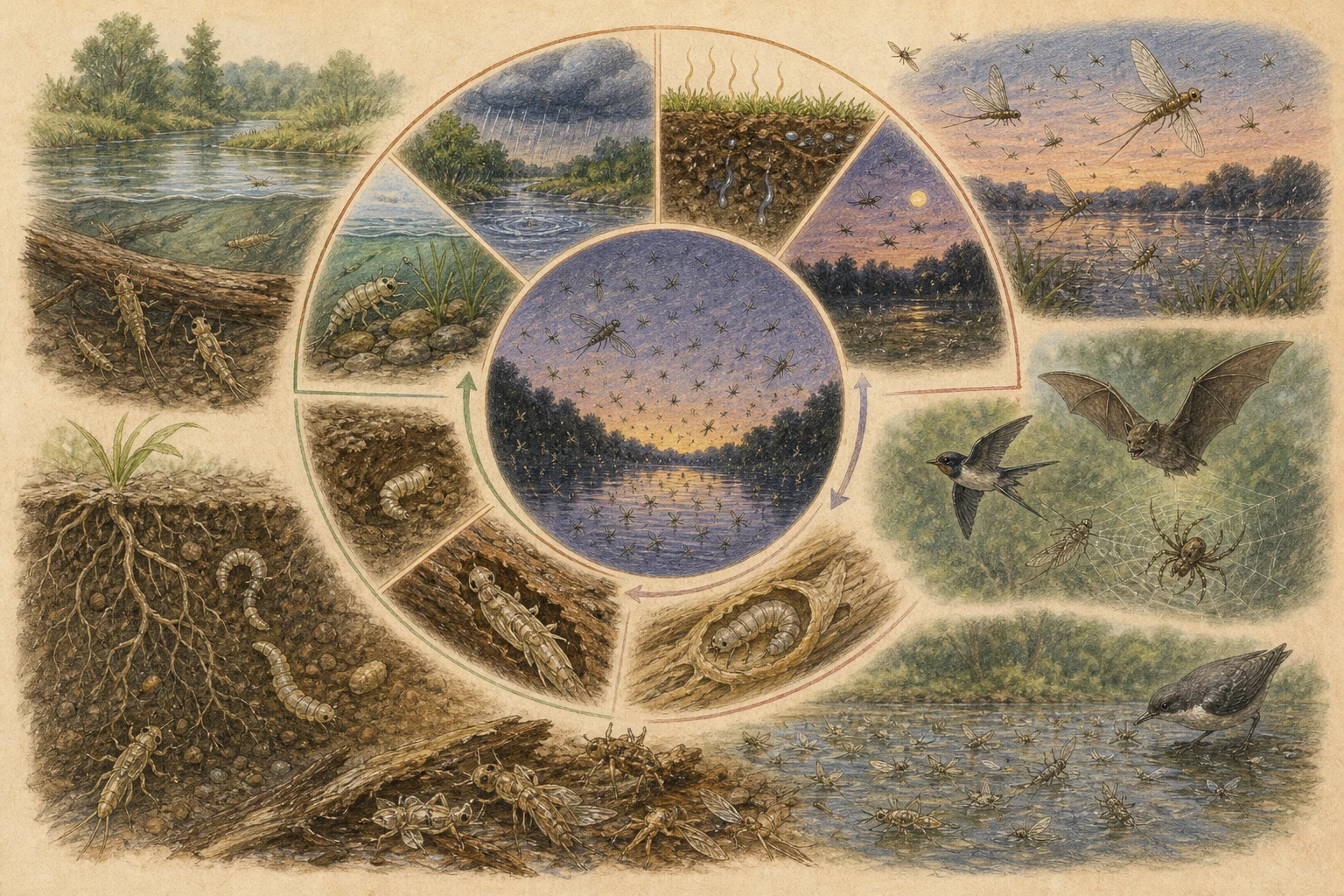
Synchronized insect emergences act as massive ecological subsidies that link subterranean, aquatic, and terrestrial food webs. When aquatic mayflies, stoneflies, and midges rise from streams and lakes, they haul riverine carbon and nitrogen into riparian trees for swallows, warblers, bats, and orb-weaving spiders; when periodical cicadas emerge from forest soil, they temporarily reshape avian foraging, boost nestling growth, and fertilize the litter layer as spent adult bodies decompose. You can document an emergence non-destructively by counting cast nymphal skins (exuviae) on a fixed area of tree trunk or streambank rock each morning to trace the exact start, peak, and tail of the pulse. [3][4]
- Count and clear or photograph shed nymphal skins (exuviae) on defined trunk bands or lakeside rocks to track emergence curves.
- Watch riparian swallows, flycatchers, bats, and shoreline spiders shift their foraging strata when aquatic hatches lift off the water.
- Record first appearance, peak density date, and final stragglers so multi-year phenology records capture the full emergence window.
Related guides
Get Fauna and identify it in the field.
Where this guide comes from
Source-checked editorial guide. Last updated . This guide teaches identification and field skills; it is not a substitute for expert verification when it matters.
- Insects — Rainfall Timing as a Key Driver of Cicada Peak Emergence in Urban Habitats ↗
- U.S. Forest Service — Periodical cicada emergence ↗
- National Park Service — Emerging cicadas ↗
- Smithsonian National Museum of Natural History — Periodical cicadas ↗
- PloS one — Species history masks the effects of human-induced range loss--unexpected genetic diversity in the endangered giant mayfly Palingenia longicauda ↗