How birds navigate during migration
Migration requires both a heading and a way to relate the bird's current position to a destination. Different birds combine inherited programs, learned landmarks, and several sensory cues, with no single mechanism explaining every journey.
Last updated
Separate orientation from navigation
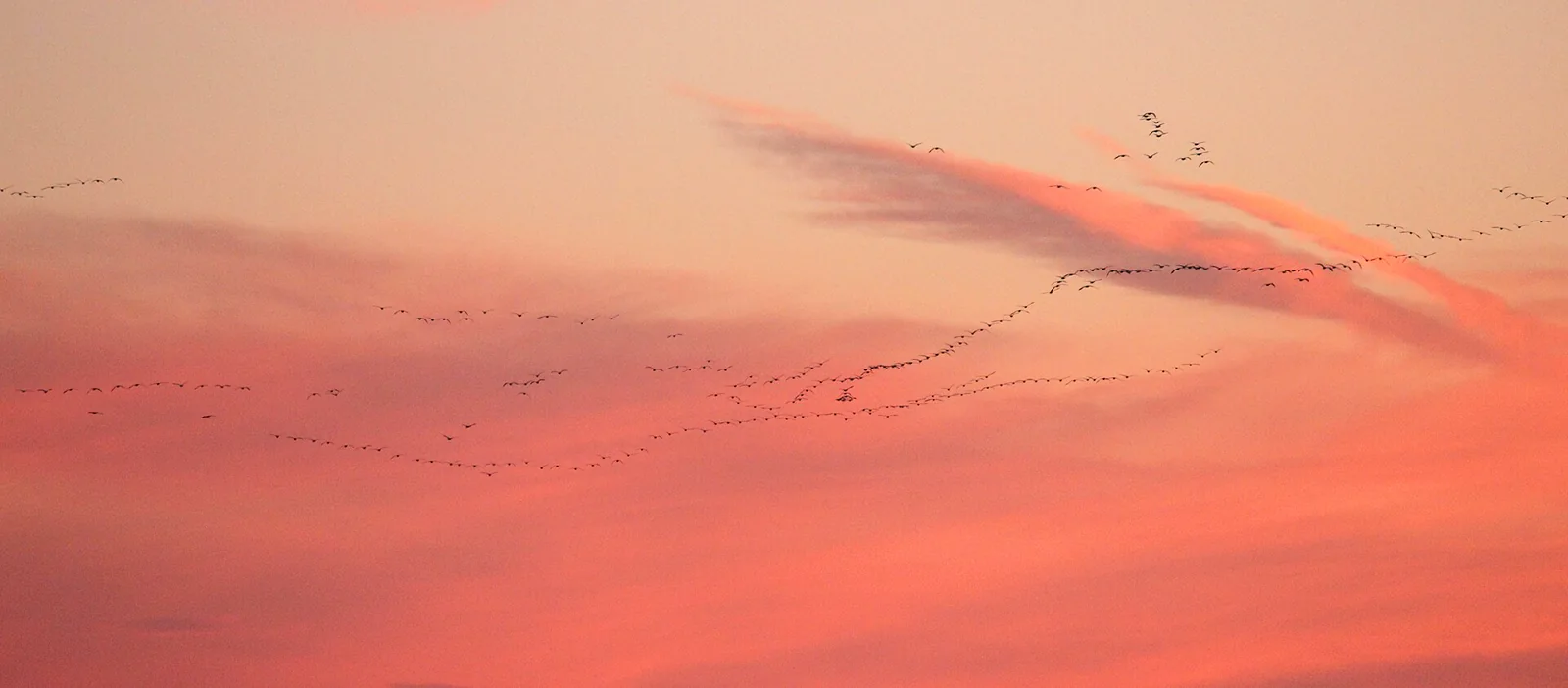
When you watch a skein of snow geese or a solo osprey pressing south in autumn, it helps to separate two distinct behavioral tasks: orientation and true navigation. Orientation means maintaining a consistent compass heading, whereas navigation requires determining current geographic position relative to a specific target destination and adjusting course to reach it. In classic displacement experiments, juvenile songbirds on their first autumn flight often follow an inherited compass bearing and timing program—a vector strategy—while experienced adults that have completed previous seasonal flights can detect a lateral displacement and correct their path toward familiar wintering grounds. [1][2][3]
- Orientation is holding a compass direction; navigation means knowing where you are relative to a goal and correcting for drift.
- First-autumn songbirds often rely on an inherited clock-and-compass vector, while experienced adults can correct for crosswind displacement.
- Field check: note the age ratio in coastal migrant fallouts, where drifted first-year birds often outnumber experienced adults.
Expect several compasses at once
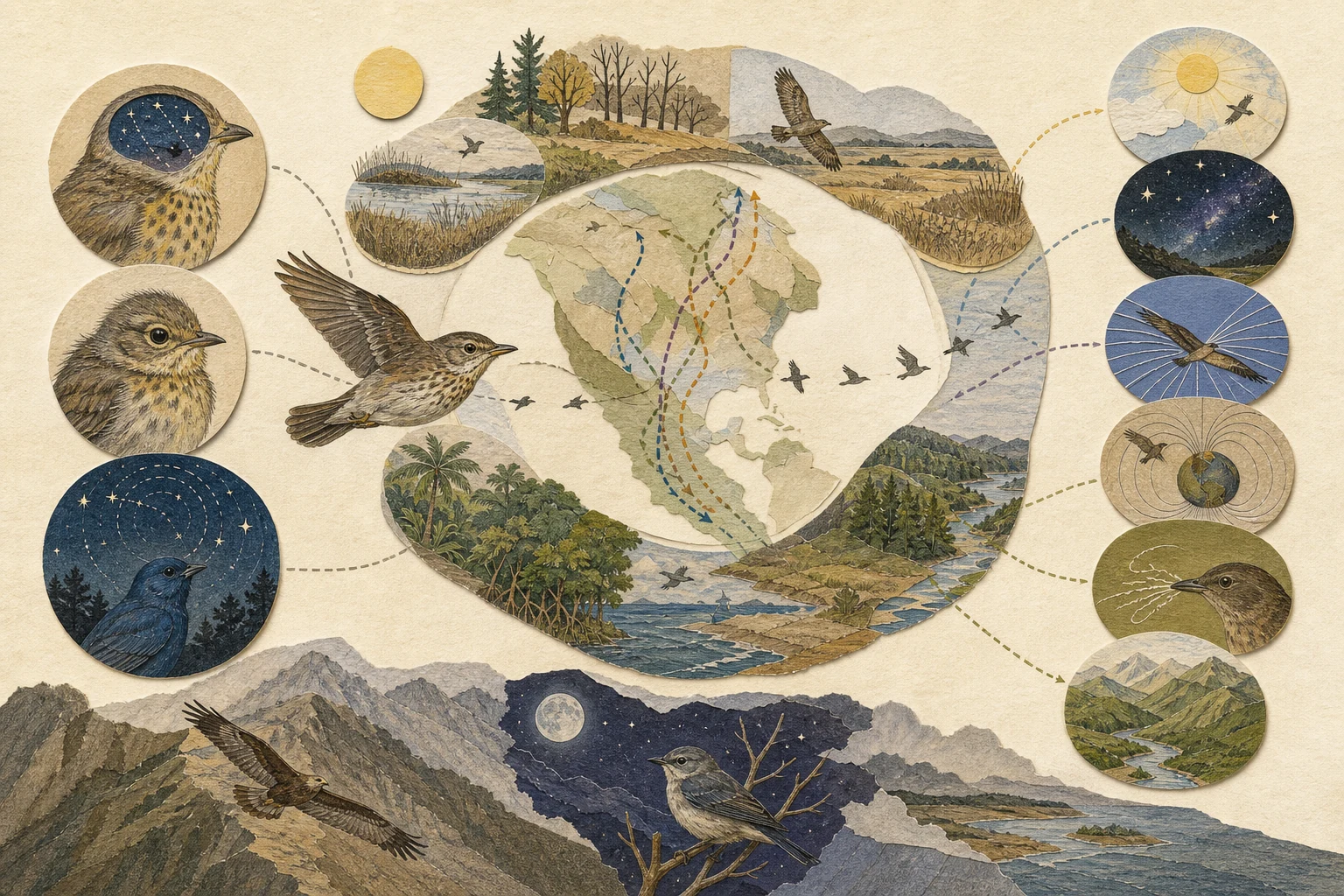
No single sensory mechanism explains how all migratory birds find their way across continents and oceans. Experimental and field studies show that birds draw upon a sun compass compensated by an internal circadian clock, patterns of skylight polarization near dawn and dusk, star rotation around the celestial pole, Earth's geomagnetic inclination, olfactory plumes, and large-scale topographic features such as coastlines, river valleys, and mountain ridges. A broad-winged hawk riding daytime thermals along an Appalachian ridge and a blackpoll warbler flying offshore at night weight these sensory cues differently, and built-in redundancy lets a migrant switch references when overcast skies obscure the sun or stars. [1][2][4][5]
- Daytime migrants use the sun's azimuth and polarized sky light, adjusting for the sun's movement with an internal 24-hour clock.
- Nocturnal songbirds combine star patterns and geomagnetic inclination cues, switching between them when cloud decks form.
- Seabirds and homing pigeons also incorporate airborne odor cues alongside visual landmarks and magnetic information.
Inherited programs meet learning
Young cuckoos and warblers that depart weeks after their parents prove that migratory timing, fat deposition, and initial seasonal headings can be genetically encoded. Yet innate instructions interact continuously with individual and social learning. Classic planetarium experiments demonstrated that young indigo buntings do not inherit a fixed star map; instead, they watch the night sky rotate and learn that the center of rotation—currently near Polaris—marks north, allowing them to orient by stellar geometry later in the season. In cranes, swans, and geese that travel in family flocks, juveniles learn traditional stopover wetlands and mountain passes directly from older birds. [2][3][4]
- Young indigo buntings learn north by watching the night sky rotate around a stationary celestial axis before migrating.
- Waterfowl and cranes travel in mixed-age flocks, passing traditional stopover sites and corridor routes to juveniles socially.
- Geomagnetic storms and weather fronts can disrupt sensory cues and contribute to out-of-range vagrant sightings.
Read routes as flexible corridors
Continental flyway maps—such as the Atlantic, Mississippi, Central, and Pacific flyways—are broad statistical summaries of where many populations concentrate, not rigid aerial highways followed identically by every bird each year. An individual migrant's actual track shifts with tail- and crosswinds, cold fronts, fuel reserves, age, and the real-time availability of mudflats, marshes, or fruiting shrubs at stopover sites. When you observe visible migration in the field, record flight direction, approximate altitude, wind direction, cloud cover, and whether birds are actively powering into a headwind, riding ridge lift, or dropping into cover to refuel. [4][5][6]
- Field check: record compass flight bearing, wind direction, cloud cover, and time of day when logging visible migration.
- Common trap: treating continental flyway diagrams as narrow, fixed tracks rather than broad, weather-shifted corridors.
- Watch how local topography—peninsulas, lake shorelines, and ridgelines—concentrates migrants when winds push them toward an edge.
Related guides
Get Fauna and identify it in the field.
Where this guide comes from
Source-checked editorial guide. Last updated . This guide teaches identification and field skills; it is not a substitute for expert verification when it matters.
- BTO — Bird migration: a masterclass ↗
- Cornell Lab of Ornithology — How birds navigate during migration ↗
- Smithsonian Migratory Bird Center — A stellar migrant ↗
- Cornell Lab of Ornithology — The basics of bird migration ↗
- Cornell Lab of Ornithology — Geomagnetic disturbances and vagrancy ↗
- Cornell Lab of Ornithology — The flyways birds use ↗