Why frogs form breeding choruses
A frog chorus is a breeding aggregation, usually dominated by calling males whose signals advertise species, location, and readiness to mate. Each animal must be heard among neighbors while responding to weather, rivals, potential mates, predators, and parasites.
Last updated
Calls advertise both identity and position
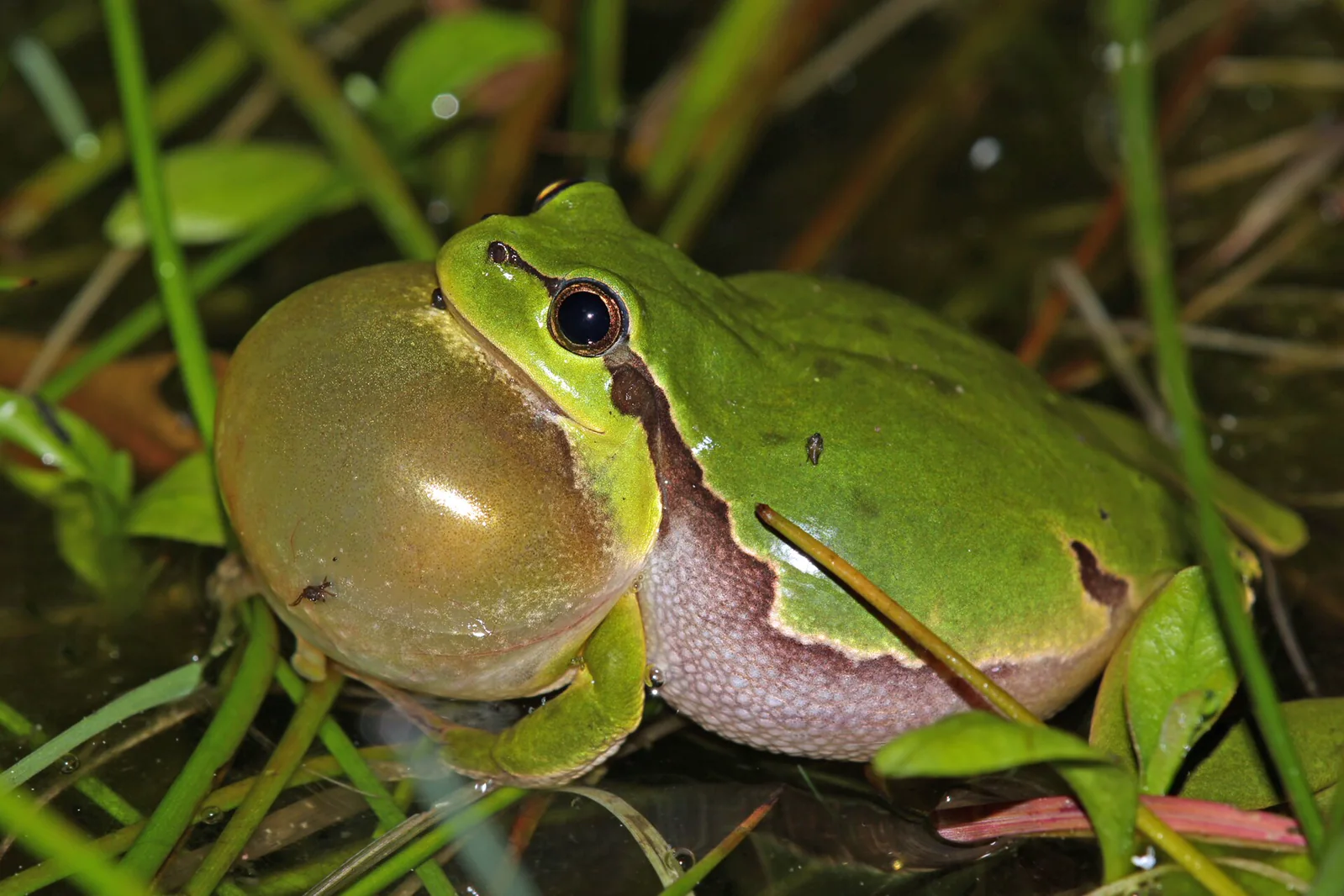
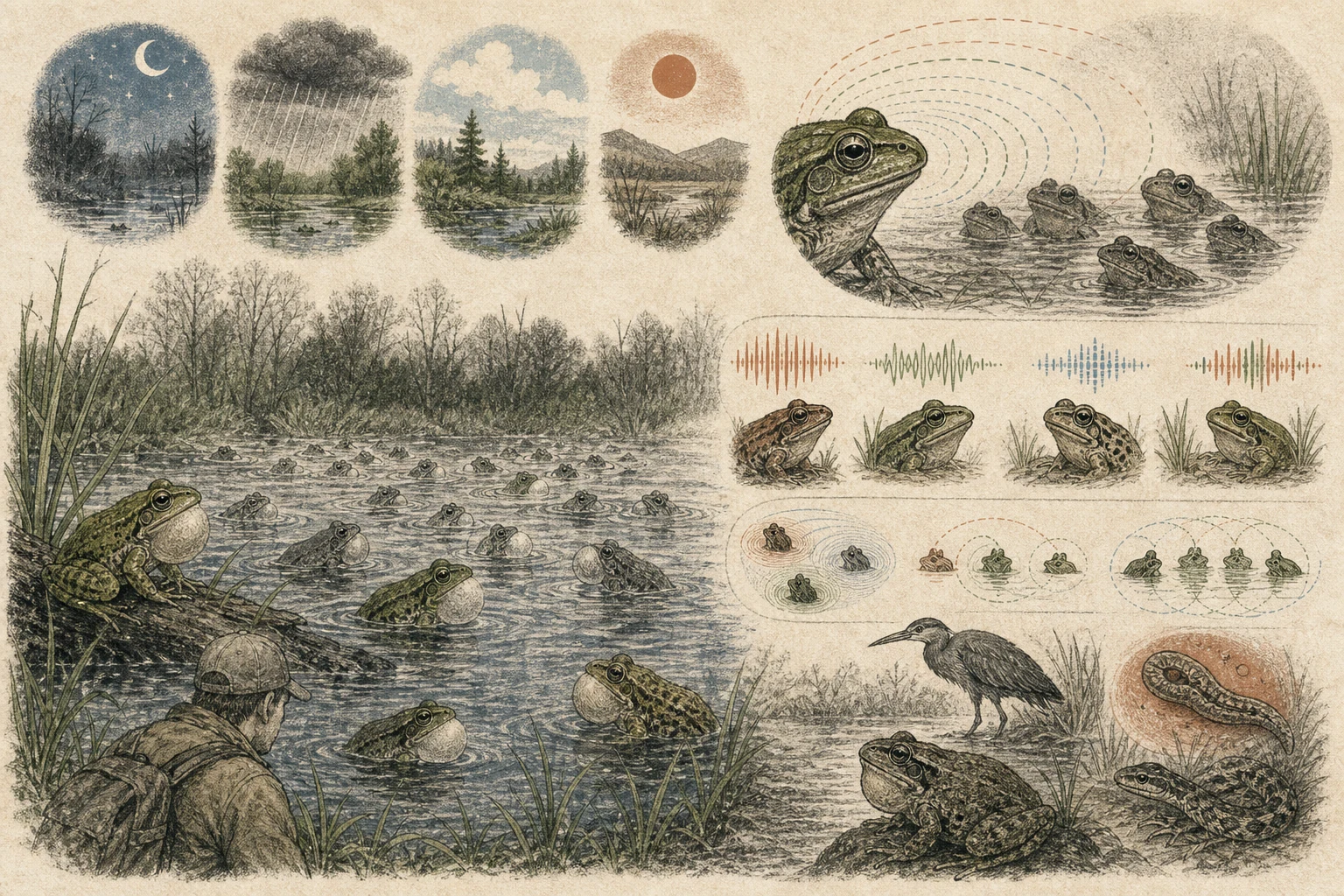
In most frog and toad species, males gather at or beside breeding water and produce species-specific advertisement calls that serve two audiences at once: they guide receptive females toward a mate of the right lineage and warn rival males to keep their distance. Pulse rate, dominant frequency, call duration, and calling effort all carry biological information, alongside visual cues such as an inflated vocal sac in multimodal species. Females do not simply swim toward the loudest section of a marsh; they evaluate individual signal quality and spacing while males defend perches, shift into aggressive encounter calls when encroached upon, or adopt silent satellite tactics near dominant callers. [1][2]
- Advertisement calls broadcast species identity, male location, and readiness to mate
- Females compare individual signal timing, pitch, and stamina rather than just overall pond volume
- Neighboring males use aggressive calls, spacing, or silent satellite postures to contest territories
Weather opens different breeding windows
There is no single calendar night when all amphibians begin to call. Air and water temperature, cumulative rainfall, barometric shifts, hydroperiod, elevation, and photoperiod interact differently for each species. Prolonged breeders maintain calling perches across weeks or months as females arrive asynchronously, whereas explosive breeders converge on temporary pools immediately after heavy rain and complete courtship and spawning within a few intense nights. Even sympatric species sharing the same wetland partition the calendar and the clock, with some peaking right after dusk and others waiting until midnight or cool early-spring evenings. [2][3][4]
- Prolonged breeders call across weeks or months while explosive breeders gather for a few nights after rain
- Air temperature, water temperature, and recent rainfall interact to trigger each species' window
- Sympatric frogs sharing one wetland often peak at different hours of the night or weeks of the season
Neighbors create an acoustic problem
A calling frog has to reach a female's inner ear through a dense wall of competing voices, surface echoes, wind, moving water, and stridulating insects. To keep signals intelligible, frogs partition the acoustic space across frequency, calling height, and time. Co-occurring species often occupy distinct pitch bands or microhabitats from submerged shallows to overhanging shrubs, while neighbors of the same species may alternate notes in tight antiphonal timing to avoid masking the critical opening pulses of their calls. As chorus density rises, an individual frequently adjusts its call rate, duration, or pause intervals in real time. [1][4]
- Co-occurring species reduce acoustic masking by calling at different frequencies, hours, or microhabitats
- Neighboring males often alternate calls milliseconds apart so overlapping notes do not obscure signal structure
- Individual frogs lengthen calls or shift pause intervals as the number of nearby competitors changes
A chorus has benefits, costs, and limits as evidence
Joining a loud aggregation increases the range over which a wetland broadcasts its presence, yet every call consumes substantial metabolic energy and exposes the signaller to acoustic eavesdroppers such as predatory bats, water snakes, and blood-feeding corethrellid midges. Calling near louder heterospecific neighbors can either draw more eavesdroppers or dilute an individual's personal risk. For field observers, hearing a chorus proves only that adult males are active at that hour, not how many females are present or whether eggs will survive, which is why standardized monitoring programs rely on repeated seasonal visits and call-intensity indices. [5][6]
- Vocalizing demands high metabolic effort and attracts acoustically orienting predators and frog-biting midges
- Presence of a loud chorus confirms male calling activity but does not measure total population size or tadpole survival
- Standardized frog surveys score call intensity categories across multiple visits rather than single-night headcounts
Listening to a chorus
Because amphibian choruses respond to immediate thermal and moisture thresholds rather than human calendar dates, plan listening sessions around recent rain and seasonal temperature norms, and expect the acoustic community at a single pond to shift between dusk and midnight. Approach the bank slowly and pause in darkness: disturbance ripples through a chorus as nearest males drop silent, and several quiet minutes are needed before full calling resumes. Log air temperature, recent rainfall, wind force, and start time consistently on every visit, and use standard calling-index categories when voices overlap into a continuous roar. [2][3][4][6]
- Listen from established banks and paths because wading into breeding shallows silences callers and crushes egg masses
- Wait quietly for several minutes after arriving so startled males resume their natural calling rhythm
- One silent visit never proves absence; repeat listens across the season separate weather pauses from empty habitat
Related guides
Get Fauna and identify it in the field.
Where this guide comes from
Source-checked editorial guide. Last updated . This guide teaches identification and field skills; it is not a substitute for expert verification when it matters.
- Journal of comparative physiology. A, Neuroethology, sensory, neural, and behavioral physiology — From uni- to multimodality: towards an integrative view on anuran communication ↗
- BMC ecology — Explosive breeding in tropical anurans: environmental triggers, community composition and acoustic structure ↗
- Oecologia — Environmental factors influencing calling in sympatric anurans ↗
- U.S. Geological Survey — Temporal organization of an anuran acoustic community ↗
- Proceedings. Biological sciences — Collateral damage or a shadow of safety? The effects of signalling heterospecific neighbours on the risks of parasitism and predation ↗
- U.S. Geological Survey — North American Amphibian Monitoring Program ↗