Why birds sing
Birdsong is communication, but it does not carry one universal message. A structured breeding song may advertise a territory or potential mate, while shorter calls can coordinate a pair, hold a flock together, beg for food, or warn of danger.
Last updated
Song and call are working labels
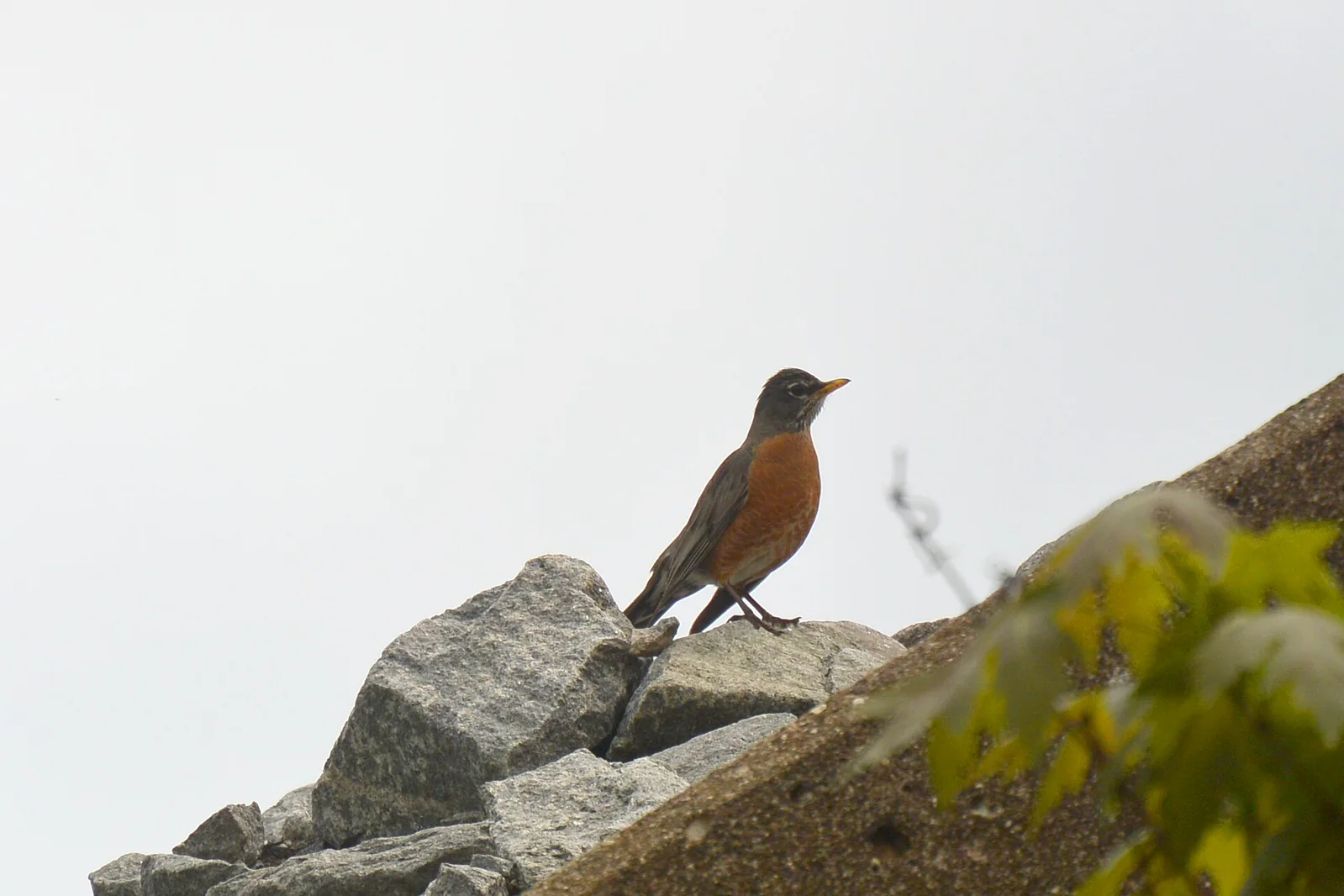
In field ornithology, 'song' and 'call' are practical working categories rather than rigid anatomical rules. Observers generally use 'song' for longer, rhythmically structured vocalizations delivered around territory establishment and courtship—such as the phrase-by-phrase caroling of an American robin or the cascading trill of a winter wren—and 'call' for shorter, simpler notes used year-round to signal alarm, maintain flock contact in dense foliage, coordinate flight, or beg for food. Even so, the boundary blurs constantly: chickadees and tits use brief notes for territorial defense, while non-passerines like loons, owls, and woodpeckers produce long-distance territorial displays of their own. [1][2]
- Songs are typically longer, patterned vocalizations tied to breeding and territory; calls are shorter notes serving everyday coordination and alarm.
- Non-vocal mechanical sounds—such as woodpecker drumming or snipe winnowing—perform the same territorial and courtship functions as song.
- Field check: note what the bird is doing while vocalizing rather than worrying when a vocalization falls between song and call.
Territory and courtship are common functions
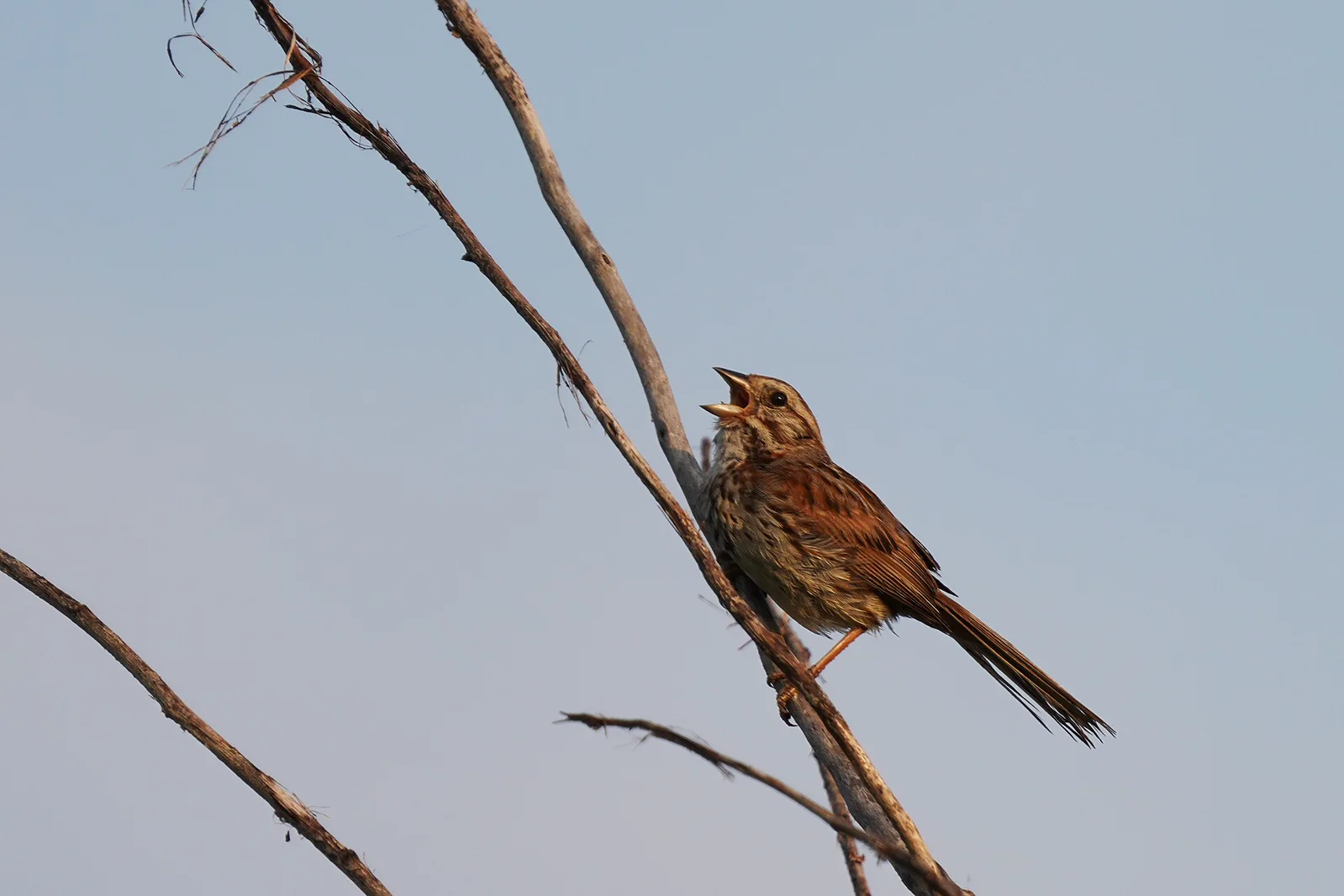
When a song sparrow or European robin climbs to an exposed branch and repeats a loud phrase every few seconds, it is broadcasting to two audiences at once: neighboring rivals and prospective or established mates. Acoustic signals travel through leaves and around tree trunks where visual plumage displays are blocked, allowing territory holders to negotiate boundaries and countersing without exhausting physical fights. Because singing demands time, metabolic energy, and exposure to hawks, the pace, repertoire size, and consistency of a bird's performance can also convey honest information about its physical condition, age, and local territory quality. [1][2][4][5]
- Acoustic territory defense lets neighboring birds advertise occupancy through dense vegetation without constant physical combat.
- Many songbirds switch between song types or match a neighbor's phrase when a boundary dispute heats up.
- Notice perch height: birds often choose exposed high perches for long-range broadcast and lower cover for quiet contact calls.
Listen beyond the familiar male solo
For decades, temperate-zone birders assumed that almost every singing songbird was a territorial male, overlooking how widespread female song actually is across the avian tree of life. Female song is ancestral in oscine songbirds and remains routine not only in tropical pairs that perform tightly synchronized antiphonal duets—such as wrens, bushshrikes, and orioles—but also in familiar temperate species including northern cardinals, house wrens, Baltimore orioles, and European robins (where females defend winter feeding territories with song). In addition, young songbirds learn phrases from nearby adults, producing regional vocal dialects that shift across landscapes. [1][3][4]
- Female song is widespread across songbirds and helps defend territories, coordinate nest care, and maintain pair bonds.
- Common trap: sexing a monomorphic songbird as male solely because you saw or heard it singing.
- Listen for coordinated duets where two mates alternate or overlap phrases so tightly they sound like a single bird.
Use context to interpret a performance
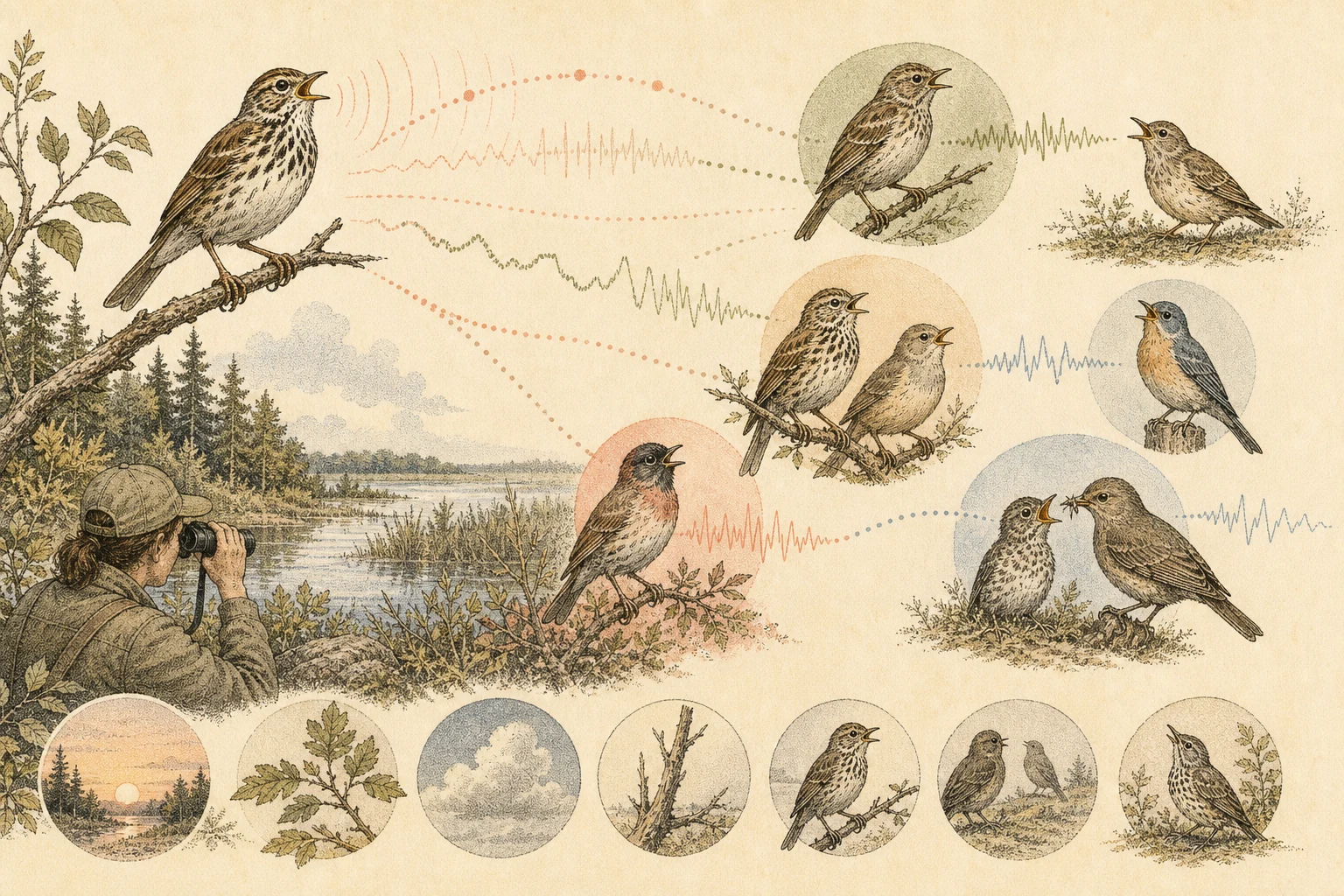
To make sense of a bird vocalization in the field, break the sound into four listener-friendly dimensions—rhythm, pitch movement, tone quality (whistled, buzzy, nasal, or trilled), and repetition pattern—before guessing its social meaning. Pair those acoustic notes with field context: time of day, calendar date, perch exposure, posture (such as wing-quivering or crest-raising), and whether a rival or mate responds nearby. You will notice community-wide rhythms, too: cool, still air and low ambient noise help carry the spring dawn chorus, while late-summer silence often reflects hormonally driven post-breeding molt and stealth rather than birds abandoning the woods. [1][5][6]
- Field check: break an unfamiliar song into rhythm, pitch trend, tone quality, and phrase repetition in your notebook.
- Late-summer quiet in temperate woods usually marks energy-demanding feather molt and finished nesting rather than early departure.
- Record a short voice memo on your phone alongside habitat notes so you can inspect the spectrogram afterward.
Related guides
Get Fauna and identify it in the field.
Where this guide comes from
Source-checked editorial guide. Last updated . This guide teaches identification and field skills; it is not a substitute for expert verification when it matters.