How animals survive drought
Burrows and nocturnality reduce exposure, kidneys and body surfaces conserve water, diet and stored fuels supply some water, and aestivation lowers demand; each strategy trades activity, growth, or reproduction for survival.
Last updated
Avoid the driest place and hour
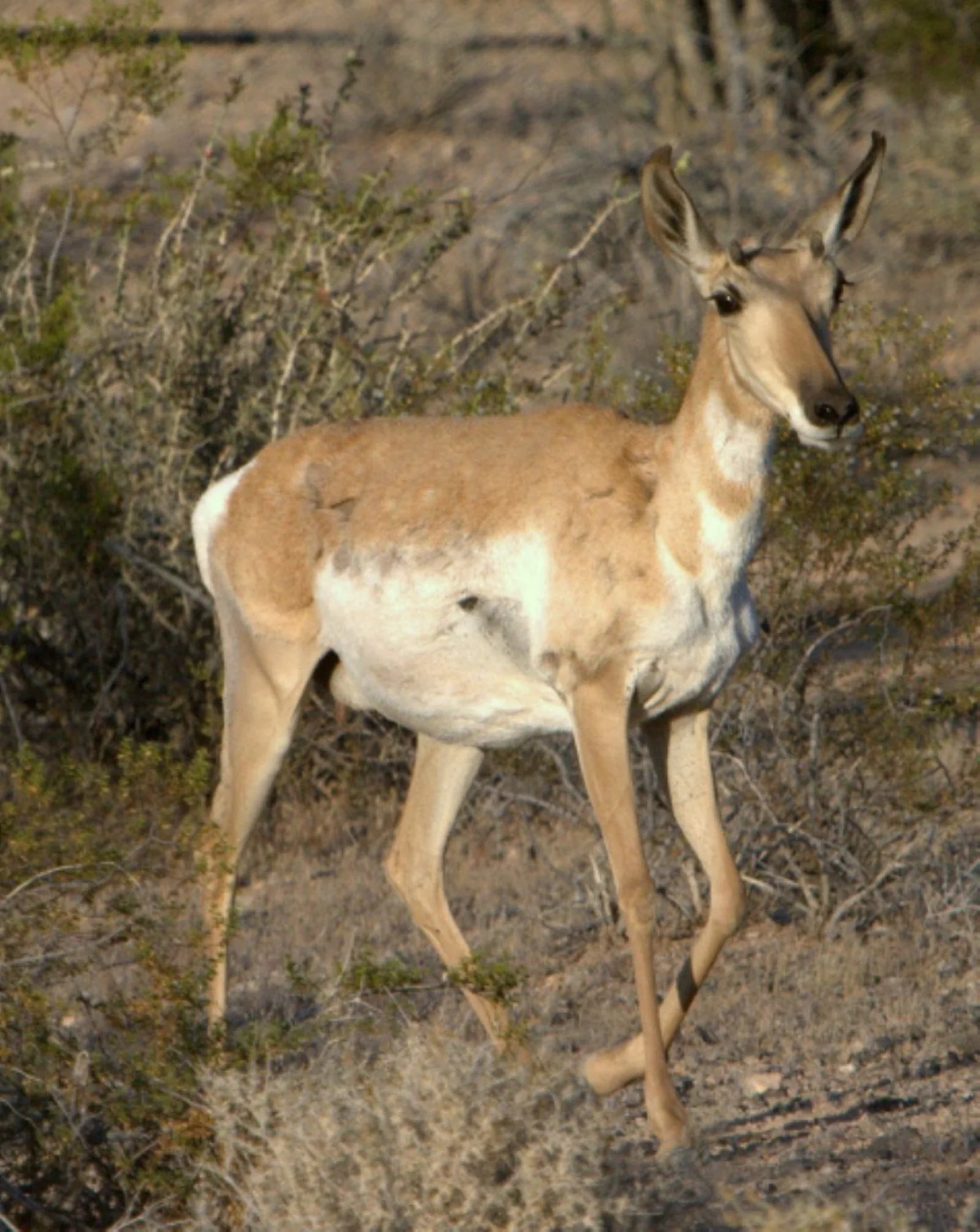
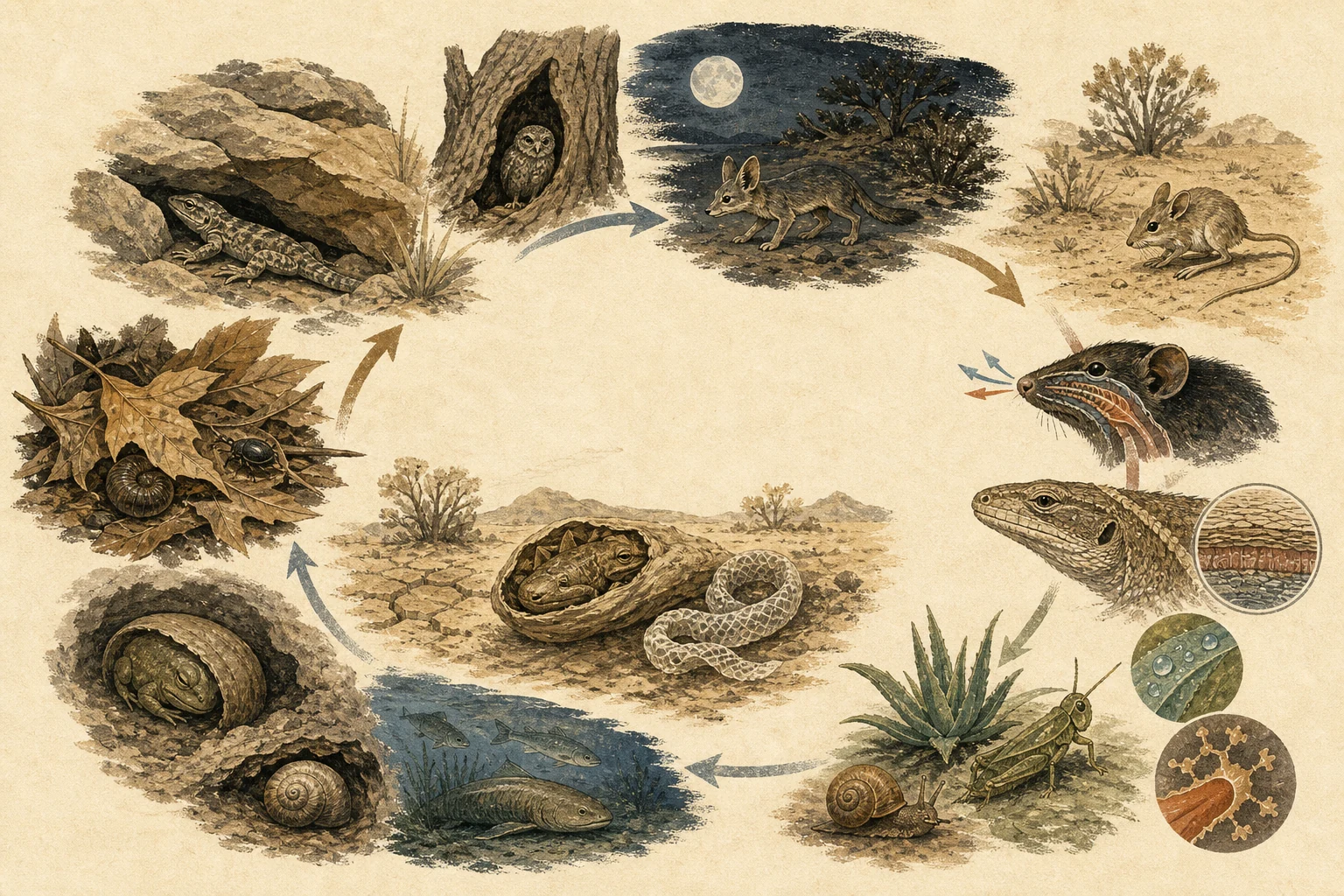
Across parched grasslands, deserts, and drought-stricken woodlands, the first line of defense against dehydration is behavioral hydroregulation—stepping out of dry, hot air before body water evaporates. Pocket mice, tortoises, scorpions, and terrestrial salamanders retreat into underground burrows, deep talus fissures, or rotting logs where soil moisture keeps relative humidity high and temperatures stable. Above ground, desert ungulates such as Sonoran pronghorn bed in shrub shade through midday and shift foraging toward dawn, dusk, or night. Even tiny terrestrial arthropods move mere millimeters from exposed leaf tops into boundary-layer crevices, trading foraging hours for water conservation. [1][2]
- Focus dry-season wildlife searches around dawn, dusk, and night when animals leave humid underground or crevice refuges.
- Recognize that an apparently empty midday desert often holds active mammals, reptiles, and arthropods just tens of centimeters underground.
- Never dig out burrows, roll sun-baked cover rocks, or flush shaded ungulates during extreme heat and drought.
Conserve, acquire, and sometimes store water
When water cannot be found in open pools, physiological and anatomical adaptations tighten every leak in the water budget. Many arid-adapted mammals produce highly concentrated urine and dry fecal pellets while reclaiming exhaled moisture across cool nasal turbinates; birds and reptiles excrete nitrogenous wastes largely as insoluble uric acid pastes that require minimal water; desert insects and arachnids rely on waxy epicuticular hydrocarbons and tightly regulated spiracle opening. Preformed water in succulent cacti, roots, dew, or insect prey—supplemented by metabolic water released during fat and carbohydrate oxidation—sustains some species, while desert tortoises and certain burrowing frogs store dilute water in the urinary bladder for reabsorption. [2][3]
- Notice how desert birds, lizards, and insects obtain preformed moisture from succulent plants, nectar, or invertebrate prey.
- Remember that handling or startling a desert tortoise can cause it to void its bladder, costing the animal its crucial water reserve.
- Avoid assuming metabolic water alone suffices for all wildlife, since breathing to oxidize fuel also costs respiratory moisture.
Dormancy lowers the budget
When drought outlasts daily foraging adjustments, diverse animals enter aestivation—a state of aerobic hypometabolism that slashes energy and water turnover until rain returns. African and South American lungfishes, desert land snails sealed behind calcified epiphragms, and burrowing frogs encased in multi-layered cocoons of shed skin or hardened mucus can depress their metabolic rates to a small fraction of resting levels for months. Aestivation is not passive drying: cells actively coordinate antioxidant defenses, urea or osmolyte accumulation, protein stabilization, and waste management so that organs avoid tissue damage during prolonged immobility and recover rapidly when rainwater finally soaks the refuge. [1][4]
- Look for sealed mucus epiphragms on aestivating land snails attached to shaded stems, cliff crevices, or stones during dry months.
- Understand aestivation as an actively regulated low-metabolism state that conserves both energy stores and body water.
- Leave dry mud cracks, vernal pool basins, and temporary pond beds undisturbed, as lungfishes, amphibians, or invertebrate stages may lie dormant below.
Adaptation does not make drought harmless
Even iconic dryland specialists operate near physiological thresholds, and global reviews show that severe or multi-year droughts frequently depress wildlife survival, body condition, and recruitment across ecosystems. When rains fail repeatedly, plants produce fewer seeds and less succulent foliage, insect prey declines, thermal refuges warm, and shrinking waterholes concentrate herbivores, predators, and waterborne pathogens in the same muddy margins. Birds may skip breeding altogether or abandon clutches, amphibians suffer larval desiccation when ponds dry early, and mammals face starvation alongside dehydration. Field notes that track spring seepage, forage greenness, juvenile ratios, and timing of activity across years help document these real population stresses. [3][4]
- Record the condition of ephemeral pools, seeps, and forage plants alongside animal sightings to capture drought context.
- Watch for demographic signals of drought stress such as absent juvenile cohorts, delayed nesting, or unseasonal movements.
- Keep extra distance from shrinking waterholes and springs so thirsty wildlife is never blocked from limited water access.
Related guides
Get Fauna and identify it in the field.
Where this guide comes from
Source-checked editorial guide. Last updated . This guide teaches identification and field skills; it is not a substitute for expert verification when it matters.
- International journal of molecular sciences — Aestivation in Nature: Physiological Strategies and Evolutionary Adaptations in Hypometabolic States ↗
- Conservation physiology — A user's guide for understanding reptile and amphibian hydroregulation and climate change impacts ↗
- Global change biology — Global Trends in Drought Impacts on Wildlife-A Review ↗
- Annual review of entomology — Dehydration Dynamics in Terrestrial Arthropods: From Water Sensing to Trophic Interactions ↗