A Southern Hemisphere nature calendar
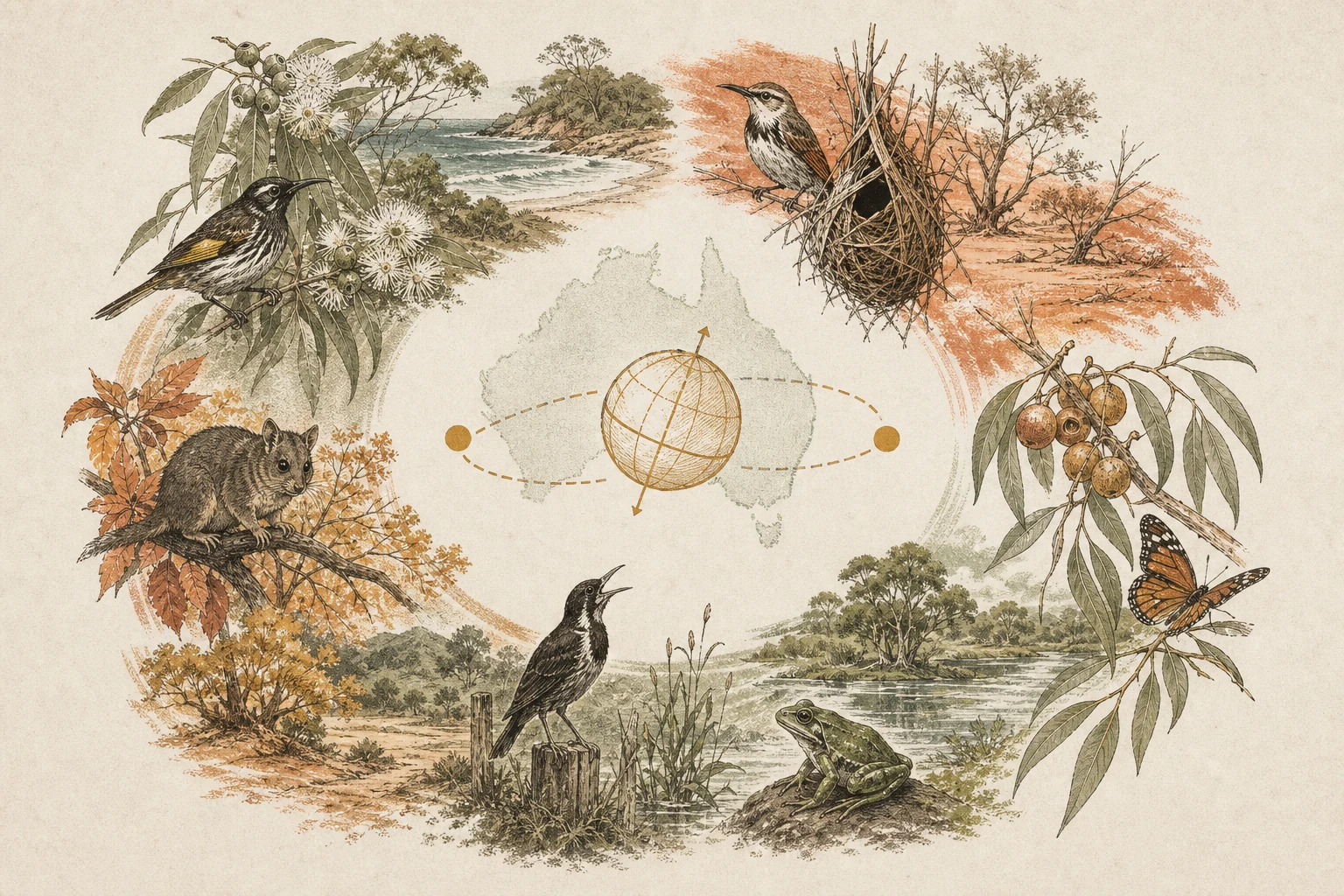
The hemispheres have opposite astronomical seasons, but a useful nature calendar is local. Rain, elevation, latitude, ocean influence, and species can matter more than the four familiar season names.
Last updated
Reverse the astronomy, not every ecological date
Because Earth's axis tilts relative to its orbital plane, the Southern Hemisphere reaches its summer solstice around December 21 and its winter solstice around June 21—six months opposite the Northern Hemisphere. Yet simply adding six months to a European or North American field guide fails across much of the south. Greater ocean-to-land area buffers coastal temperatures, El Niño–Southern Oscillation swings drive multi-year rainfall pulses, and many southern plant and animal lineages respond opportunistically to rain and fire rather than strictly to day length. [1][6]
- Day length peaks around the December solstice and reaches its minimum around the June solstice across the south
- Large southern ocean basins moderate coastal winters while continental interiors experience wider thermal swings
- Many southern plants and animals cue on episodic rainfall or nectar pulses rather than fixed calendar dates
Use the seasonal system that fits the place
A four-season temperate calendar starting on the first of September, December, March, and June works as a convention in southern mid-latitudes, but monsoon wet-and-dry cycles govern tropical northern Australia, Amazonia, and southern Africa. Across Australia and Aotearoa New Zealand, First Nations and Māori ecological calendars recognize five, six, or more local seasons defined by linked shifts in wind, rain, flowering trees, fish runs, and bird calls—such as the Noongar six-season cycle or Māori maramataka and ngā tohu o te taiao indicators. [1][5]
- Match your calendar framework to local climate—temperate four-season, tropical wet-dry, or arid rainfall pulses
- Indigenous seasonal calendars link specific plant blooms, insect emergences, and animal movements to weather shifts
- Treat First Nations and Māori seasonal indicators as place-specific knowledge rooted in their home Country and rohe
Choose events you can observe consistently
Phenology—the study of recurring biological life-cycle stages and their environmental drivers—works best when anchored to a short list of unmistakable local indicator species along a route you walk every week. Programs such as ClimateWatch Australia track specific phases: first open flower, full bloom, end of flowering, ripe fruit or seed drop in plants, and first calls, nest building, or migrant arrival and departure in birds, frogs, and insects. Recording the full span of a phase is far more reliable than logging a single first-sighting date. [2][3][4]
- Pick three to five common local plants, birds, frogs, or insects along a weekly walk for multi-year tracking
- Record start, peak, and end dates of flowering, calling, or nesting rather than a single isolated sighting
- Log negative checks on your regular route so the true onset of a phenophase is bracketed by recent absences
Build a calendar that can change
Pair every biological note with date, exact location, recent rainfall, and temperature, and upload georeferenced photos to regional repositories such as ClimateWatch and the Atlas of Living Australia. Satellite-derived phenology maps from CSIRO show that Southern Hemisphere vegetation growth cycles can be asynchronous even across short distances where elevation, aspect, or rainfall regimes shift. Maintaining a multi-year record at one site reveals both natural interannual variability between wet La Niña and dry El Niño years and longer-term climate-driven shifts in flowering and migration. [2][3][4][6]
- Pair each phenological entry with recent rainfall totals, temperature extremes, and a dated voucher photo
- Neighboring valleys or slopes can flower and leaf out on asynchronous schedules due to aspect and moisture
- Multi-year notes separate short-term El Niño or La Niña rainfall swings from long-term warming trends
Related guides
Get Fauna and identify it in the field.
Where this guide comes from
Source-checked editorial guide. Last updated . This guide teaches identification and field skills; it is not a substitute for expert verification when it matters.
- Australian Bureau of Meteorology — Solstices, equinoxes, and seasons ↗
- ClimateWatch Australia — Introducing the science of phenology ↗
- ClimateWatch Australia — Recording regular observations ↗
- Atlas of Living Australia — ClimateWatch project ↗
- Earth Sciences New Zealand / NIWA — Māori environmental indicators ↗
- CSIRO — Mapping the complexity of Earth's seasons ↗