Why flamingos are pink
A flamingo is not born with an adult pink coat. Food-web carotenoids enter its digestive system, are metabolized into pigment forms, and reach developing feathers; chicks begin gray or white, and adults renew colored plumage during molt as diet and physiology shape the resulting shade.
Last updated
The pigments begin in the food web
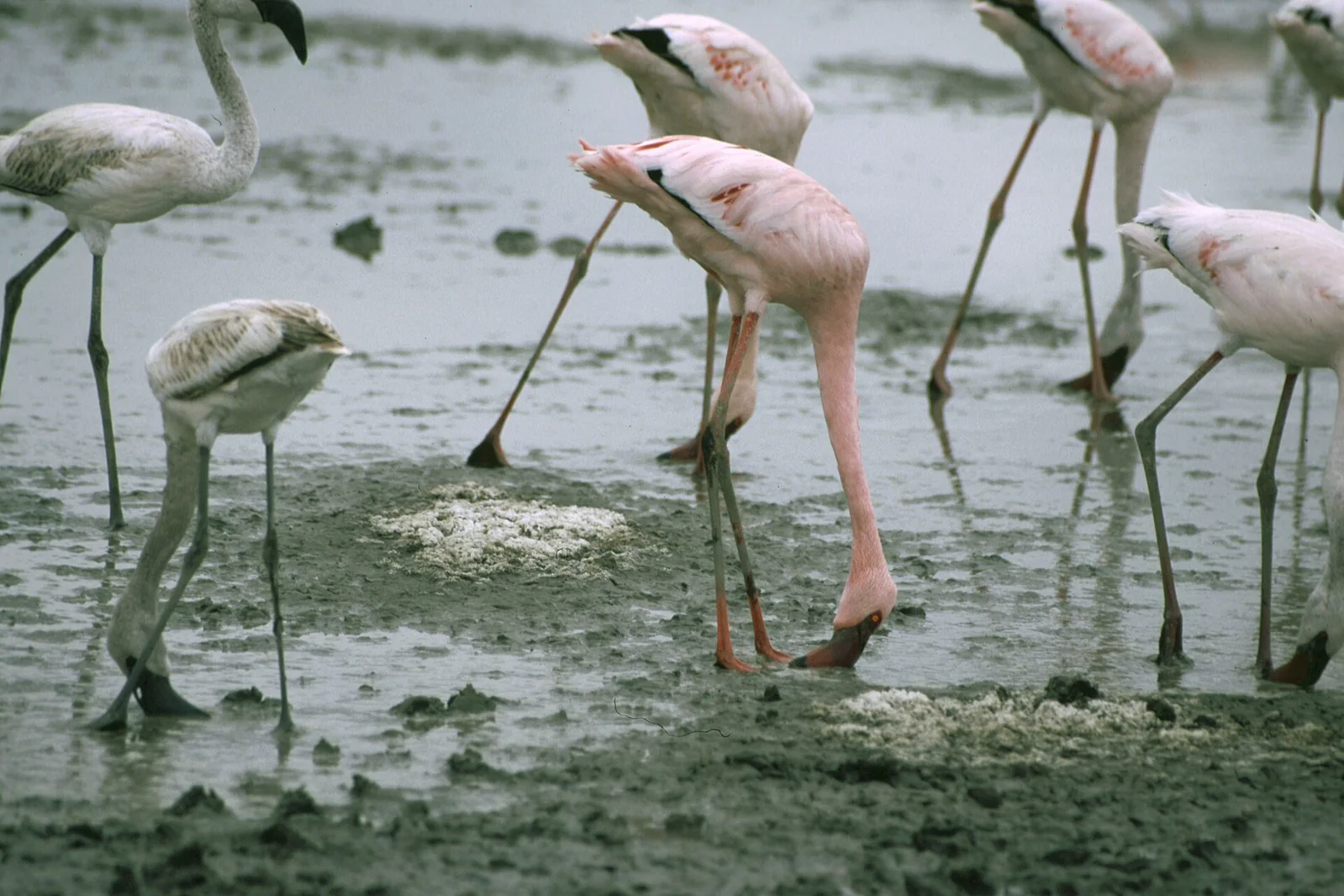
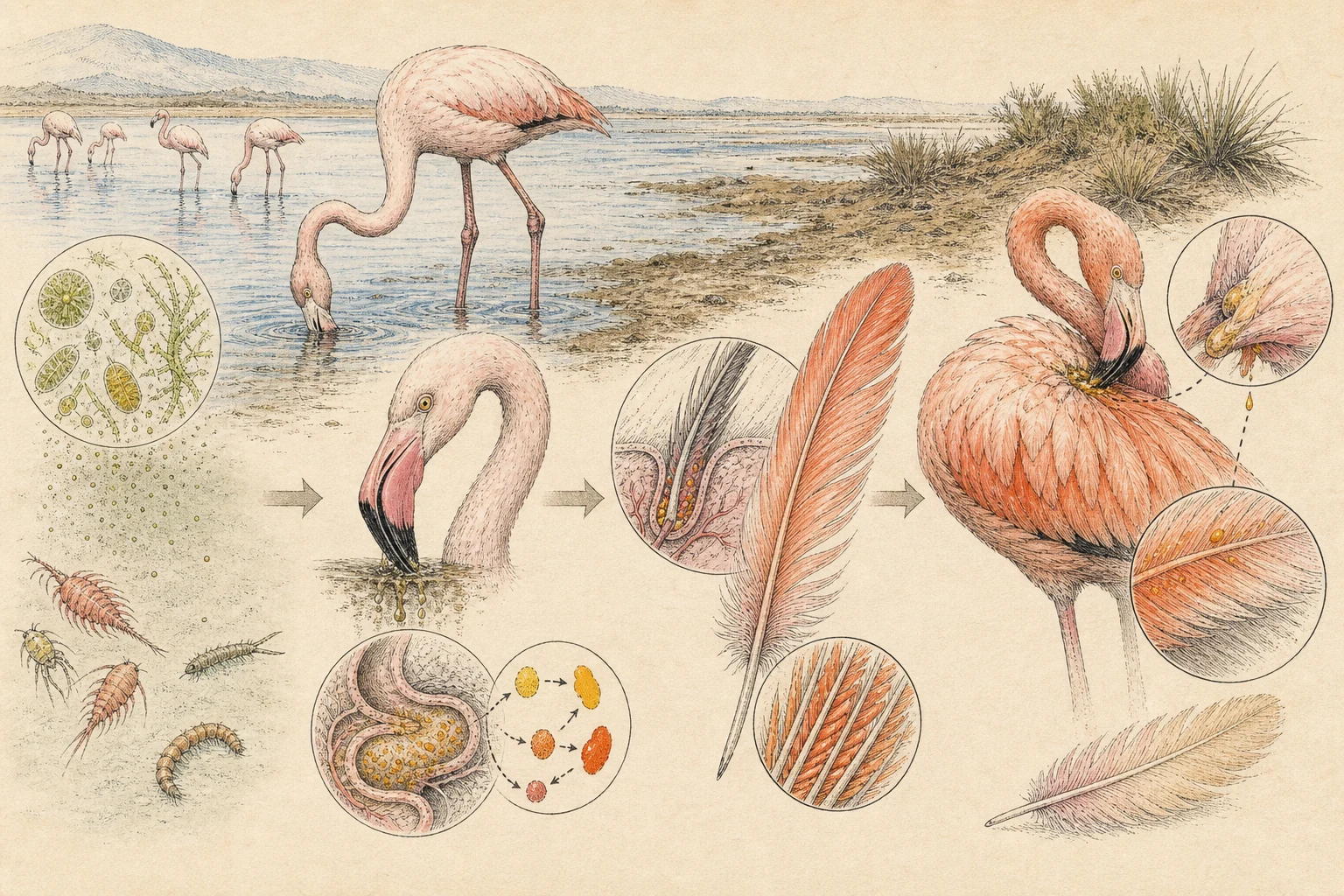
Vertebrates cannot synthesize carotenoid pigments from scratch; every trace of pink, coral, or crimson on a flamingo starts inside photosynthetic cyanobacteria, diatoms, and green algae thriving in shallow hypersaline lakes, alkaline soda pans, and coastal lagoons. Watch a flock of lesser flamingos (Phoeniconaias minor) sweeping their deep-keeled bills upside down through East African soda lakes and you are watching fine bill lamellae filter microscopic Arthrospira (Spirulina) cyanobacteria directly from the water, whereas larger greater flamingos (Phoenicopterus roseus) and American flamingos (Phoenicopterus ruber) stamp muddy bottoms to stir up brine shrimp (Artemia), copepods, amphipods, and insect larvae that have concentrated algal carotenoids. [1][2][4]
- Fine-filtering lesser flamingos harvest carotenoid-rich cyanobacteria and diatoms directly, while larger species filter crustaceans, mollusks, and larvae.
- Flamingos hold their bent bills upside down underwater, using a piston-like muscular tongue to pump water past comb-like lamellae.
- Hypersaline lakes that appear pink from salt-loving microbes supply the algal base of the flamingo pigment chain rather than dyeing feathers externally.
Digestion and metabolism reshape the color
Ingesting yellow beta-carotene, zeaxanthin, or echinenone is only the first biochemical step: once lipid-soluble carotenoids pass through the intestinal wall, hepatic and tissue enzymes oxidize those yellow and orange precursors into deep reddish-orange ketocarotenoids—principally canthaxanthin, astaxanthin, and phoenicoxanthin. High-density lipoproteins then ferry those converted pigments through the bloodstream to bare facial skin, tarsal scales, egg yolks, and developing feather follicles. Classic comparative analyses across all six living flamingo species show that canthaxanthin dominates feather pigments, explaining why sympatric species such as Andean and James's flamingos sharing the same high-altitude salt flat still display distinct leg, bill, and wing-covert colors. [3][4]
- Liver and tissue enzymes oxidize yellow and orange dietary carotenoids into red ketocarotenoids such as canthaxanthin and astaxanthin.
- Absorbed carotenoids color not only plumage and bare leg skin but also blood plasma and the deep orange-red yolks of flamingo eggs.
- Species-specific differences in bill lamellae, prey selection, and pigment metabolism separate pale greater flamingos from deep vermilion American flamingos.
New feathers lock pigment into keratin
Because mature feathers consist of dead, avascular beta-keratin, a flamingo can only embed carotenoid pigment into its plumage while new feathers are actively growing inside blood-rich follicles during molt. Newly hatched flamingo chicks emerge in fluffy white-and-gray natal down with straight bills, gradually acquiring pink tones over their first two to three years as juvenile plumages molt into adult feathers. Conversely, actively breeding parents that channel dietary carotenoids and lipids into crop milk—a bright red, fat-rich secretion produced by the upper digestive tract of both males and females to feed their chick—often look noticeably paler until their next post-breeding molt. [1][2][3]
- Flamingo chicks hatch covered in pale gray-white down and take two to three years of successive molts to reach full adult coloration.
- Both male and female parents feed chicks carotenoid-rich red crop milk secreted from the upper digestive tract, temporarily draining parental pigment stores.
- Detached or sunlit feathers gradually bleach toward white because dead keratin cannot receive fresh pigment until the next molt.
Some flamingos also apply cosmetic color
Field studies of wild greater flamingos (Phoenicopterus roseus) in southern Spain revealed that feathers can also gain color from the outside: during courtship display months, adults secrete concentrated carotenoids in the waxy oils of their uropygial (preen) gland and vigorously rub their cheeks and neck against the gland at the tail base before wiping that crimson oil over their breast, neck, and back feathers. This cosmetic application rapidly boosts plumage redness during synchronized group marching and wing-salute displays, then fades away once pairs settle onto mud-mound nests and reduce cosmetic rubbing. [1][5]
- Breeding greater flamingos rub carotenoid-rich uropygial preen oil onto their neck, breast, and back feathers as seasonal cosmetic color.
- Frequent preen-gland rubbing correlates with synchronized courtship displays and declines once egg incubation begins.
- Apparent plumage intensity in the field reflects built-in molt pigment, solar bleaching, and recent cosmetic preening combined.
Related guides
Get Fauna and identify it in the field.
Where this guide comes from
Source-checked editorial guide. Last updated . This guide teaches identification and field skills; it is not a substitute for expert verification when it matters.