How chameleons change color
Chameleons alter skin color through coordinated pigment cells and structural reflectors under physiological control. The result can carry a social signal or affect heat and camouflage, not simply copy any background on demand.
Last updated
Build color from pigments and structure
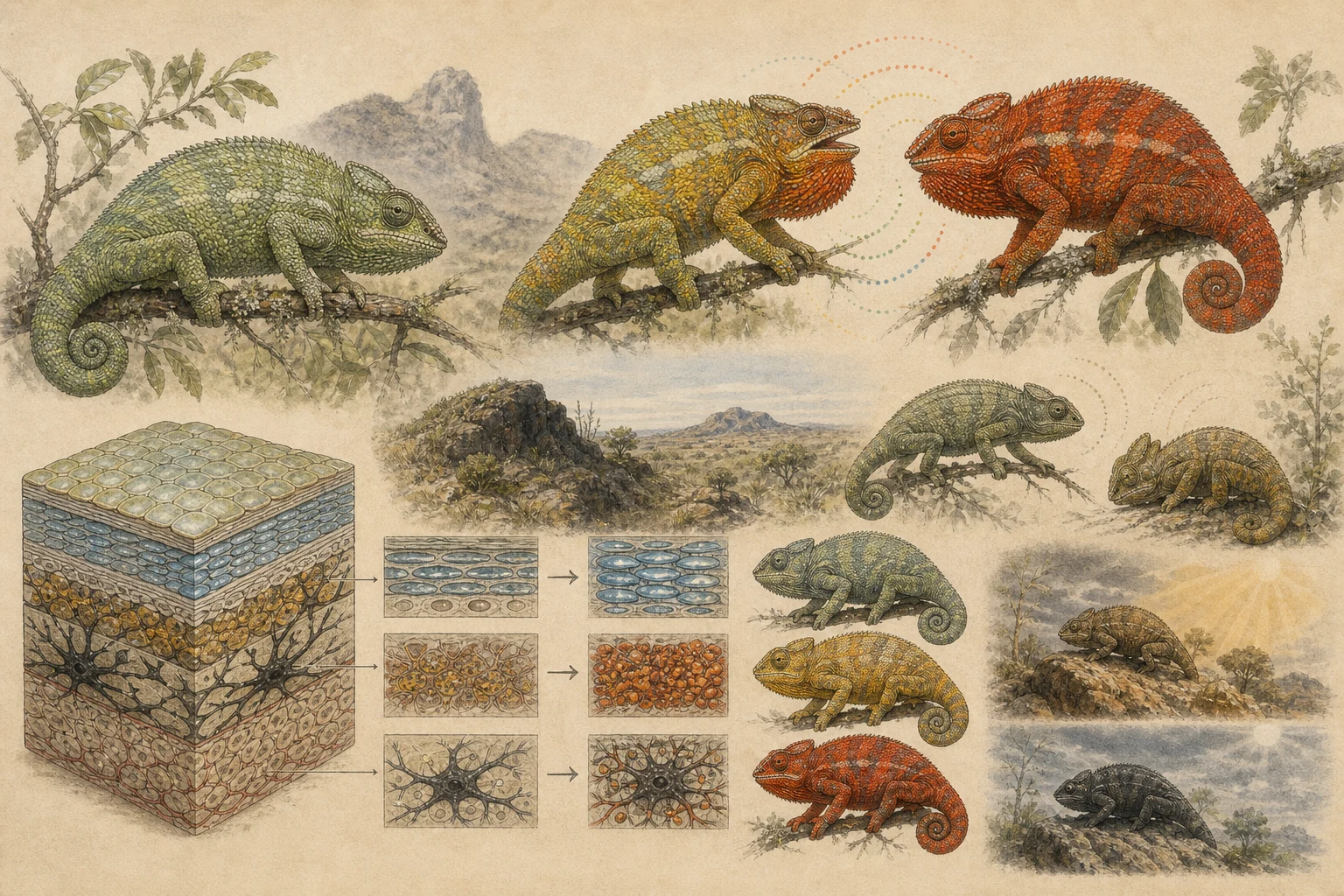
A chameleon's skin is an optical stack rather than a single layer of dye. Upper dermal chromatophores contain yellow or red pigments that absorb selected wavelengths of incoming light, while beneath them lie two distinct tiers of iridophores packed with crystalline guanine platelets. The superficial iridophores act as wavelength-selective structural reflectors, whereas deeper iridophores contain larger, more disordered crystals that reflect broad-spectrum and near-infrared light, and dark melanin-bearing melanophores extend branching processes that can dim or darken the entire stack. Any shift in pigment dispersion or crystal spacing changes how incoming sunlight is filtered and returned to an observer's eye. [1][3]
- Upper pigment cells filter light above two specialized layers of guanine-crystal iridophores
- Deep iridophores reflect substantial near-infrared light, helping moderate solar heat load in dry habitats
- Melanophore pigment dispersion darkens the skin and shifts brightness across all overlying color layers
Tune a photonic lattice
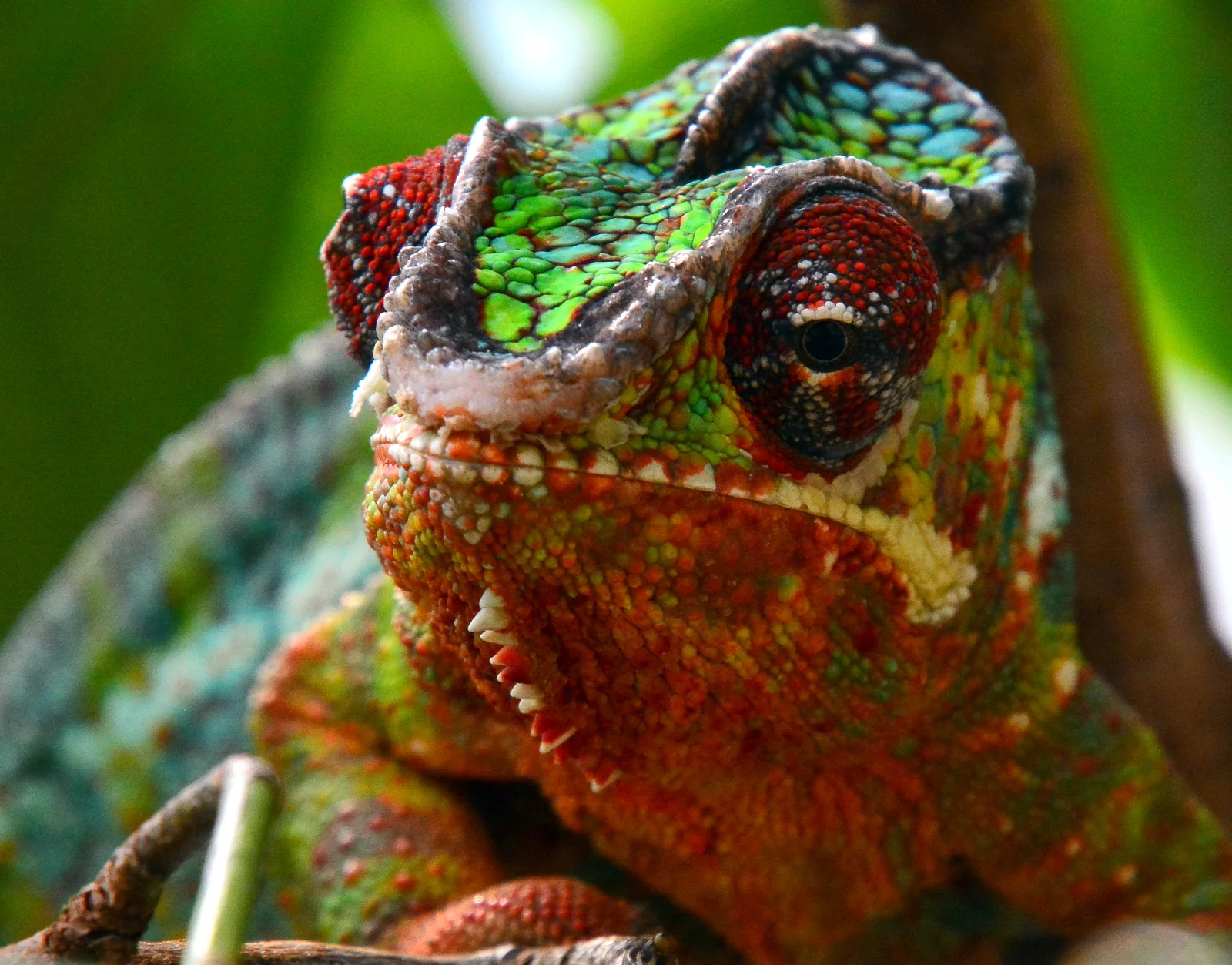
High-resolution microscopy and optical modeling in adult male panther chameleons (Furcifer pardalis) showed that rapid hue shifts come from active tuning of a three-dimensional photonic crystal lattice inside superficial iridophores. When the lizard rests calmly on a shaded perch, guanine nanocrystals sit closely spaced and reflect blue wavelengths; filtered through overlying yellow pigment cells, the skin appears leaf green. During a territorial contest or courtship approach, expanding the spacing between adjacent nanocrystals by roughly thirty percent shifts structural reflection toward longer yellow, orange, and red wavelengths, transforming the flank pattern within a minute or two. [1]
- Calm male panther chameleons pack superficial guanine crystals tightly, reflecting blue light through yellow pigment
- Increasing crystal spacing shifts structural reflection toward longer yellow, orange, and red wavelengths
- This active photonic-lattice mechanism is best documented in panther chameleons and varies across lineages
Send context-dependent signals
Rapid color change in chameleons often serves social communication more intensely than background matching. Comparative studies across southern African dwarf chameleons (Bradypodion) found that species with the greatest capacity for dramatic chromatic shifts evolved primarily under selection for conspicuous social signaling during male contests and courtship rather than to match wider arrays of local vegetation. Even single pattern elements can be tuned to specific receivers: in common chameleons (Chamaeleo chamaeleon), individuals alter the brightness contrast of their lateral white stripe differently on the body side facing a rival or approaching threat versus the opposite hidden flank. [2][4]
- Across dwarf chameleons, the widest color ranges correlate with conspicuous social signaling rather than habitat variety
- Dominant, subordinate, and courting states trigger distinct chromatic and brightness combinations within seconds
- Some chameleons adjust lateral stripe contrast asymmetrically depending on which flank faces a viewer
Avoid the instant-background myth
A chameleon placed on a checkerboard will never reproduce squares, because its skin operates within species-specific anatomical bands, spots, and color palettes rather than sampling arbitrary patterns from the ground. Many species spend most of the day in cryptic greens, browns, or grays that break up their outline among twigs, then darken early in the morning to absorb warmth or flash high-contrast hues briefly during a social interaction before returning to cover. Reading a chameleon's color in the field therefore requires noting time of day, basking posture, nearby conspecifics, and whether an observer's approach triggered a defensive darkening. [2][3][4]
- Skin patterns remain constrained to inherited bars, saddles, and stripes rather than copying arbitrary backgrounds
- Morning darkening commonly accompanies flattened basking postures before the animal warms and brightens
- Sudden high-contrast yellows, reds, or black spotting usually signal rivalry, courtship, or acute defensive stress
Related guides
Get Fauna and identify it in the field.
Where this guide comes from
Source-checked editorial guide. Last updated . This guide teaches identification and field skills; it is not a substitute for expert verification when it matters.
- Nature Communications — Photonic Crystals Cause Active Colour Change in Chameleons ↗
- PLoS biology — Selection for social signalling drives the evolution of chameleon colour change ↗
- Philosophical transactions of the Royal Society of London. Series B, Biological sciences — Camouflage, communication and thermoregulation: lessons from colour changing organisms ↗
- Royal Society open science — The contextual separation of lateral white line patterns in chameleons ↗