How owls hear prey
A prey sound reaches the two ears at slightly different times and intensities. Neural circuits preserve and compare those disparities, while the facial ruff and, in some owls, vertically offset ear openings add direction-dependent filtering that helps estimate horizontal and vertical position.
Last updated
Two ears turn one sound into directional differences
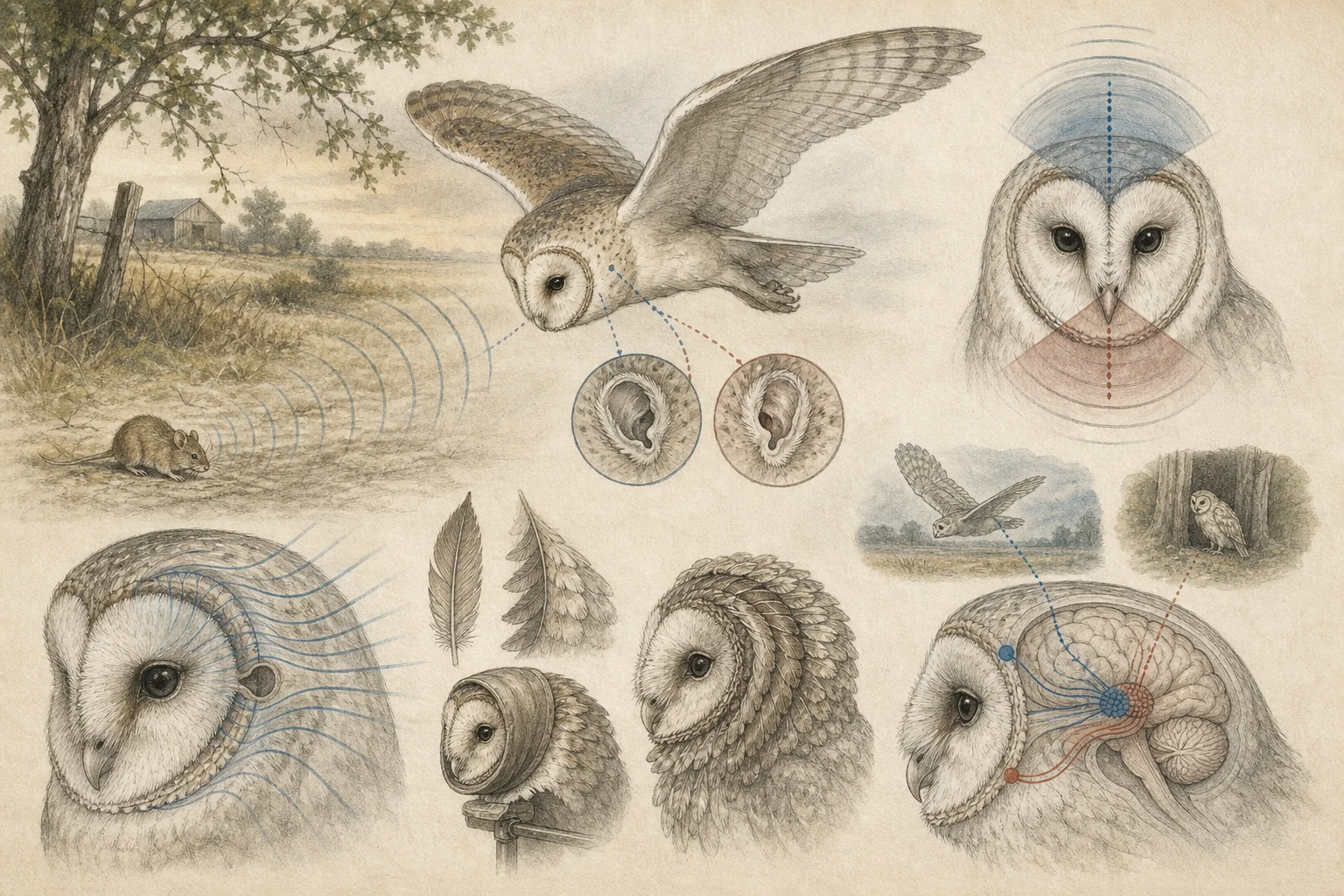
When a meadow vole or wood mouse rustles dry grass in darkness, the sound wave reaches the owl's nearer ear tens of microseconds before the farther ear and registers slightly louder on that side because the skull shadows high frequencies. In the barn owl (Tyto alba), specialized brainstem nuclei split the incoming auditory nerve signal into two parallel channels: one measures interaural time differences (ITDs) with microsecond precision to compute horizontal azimuth (left versus right), while the other compares interaural level differences (ILDs) across high-frequency bands. Rather than forming an active sonar echo like a bat, the owl extracts passive binaural disparities from the brief, broadband crackle of a moving prey item. [1][3]
- Interaural time differences measured in tens of microseconds tell a hunting owl where a rustle sits along the horizontal left-right plane.
- Broadband, multi-frequency rustling and scratching sounds give the owl's auditory brainstem far richer localization cues than pure single-pitch tones.
- Unlike echolocating bats, owls listen passively to prey-generated noise while flying on specialized, sound-suppressing wing feathers.
Asymmetry can add a vertical axis
In mammals and symmetric-eared birds, both ears sit at the same height on the skull, so any sound source directly in front has identical time and level differences regardless of whether it lies high in a tree or down in grass. Barn owls, boreal owls (Aegolius funereus), northern saw-whet owls, and long-eared owls solve that vertical ambiguity through directional ear asymmetry: the left and right ear openings—or the skull bones themselves in Aegolius—sit at different vertical heights and tilt at different angles behind movable pre-aural skin flaps. High-frequency sounds above the horizon register louder in the upward-tilted ear, while sounds on the ground register louder in the downward-tilted ear, separating elevation from azimuth simultaneously. [1][3]
- Vertically offset ear openings make interaural loudness differences vary with elevation while timing differences continue to track horizontal angle.
- In barn owls, the left ear opening sits higher on the head and tilts downward, while the right ear sits lower and tilts upward.
- Vertical ear asymmetry evolved independently across several nocturnal owl lineages, whereas diurnal or crepuscular owls often have symmetric ears.
The facial ruff is an acoustic structure
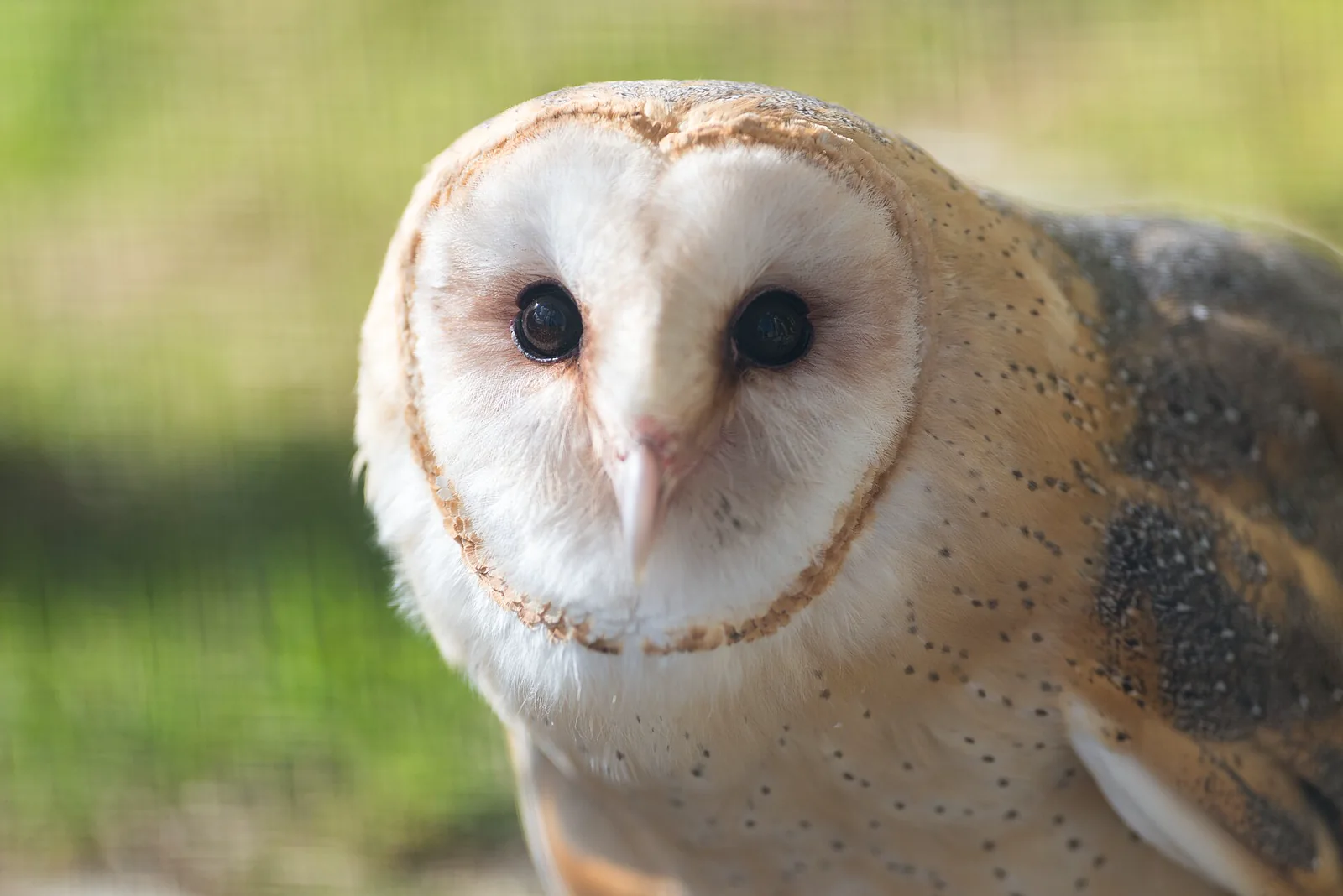
The heart-shaped or circular facial disc of an owl is far more than a visual mask. Beneath the loose, acoustically transparent auricular feathers around the eyes lies a dense, parabolic wall of stiff, tightly packed ruff feathers anchored into movable skin folds around the ear openings. Acoustic measurements and virtual ruff-removal experiments on barn owls show that this feathered trough acts like a pair of directional satellite dishes and external pinnae: it amplifies high-frequency rustles between 3 and 9 kilohertz, sharpens directional sensitivity directly ahead of the beak, and generates steep vertical intensity gradients between the two ears. [2][3]
- Open-vaned auricular feathers across the face let sound pass through with minimal damping to the dense, reflective ruff feathers behind them.
- Experimental removal or smoothing of the facial ruff sharply degrades an owl's ability to pinpoint vertical elevation.
- Facial muscles can subtly flex the pre-aural skin flaps and ruff contour as an owl switches from perching scan to final strike.
The brain calibrates a map with behavior and vision
Inside the barn owl's midbrain (the inferior colliculus and optic tectum), timing and level pathways converge onto space-specific neurons that fire only when a sound comes from a single receptive field in both azimuth and elevation, forming a topographic neural map of auditory space aligned with the visual map. Classic prism-goggle experiments showed that juvenile owls recalibrate this auditory-visual alignment through real-world hunting feedback. Watch a hunting owl on a fencepost and you will see that neural computation in action: a sudden head snap locks its gaze and facial disc directly onto the rustle, centering the prey in the zone of highest binaural resolution before the bird launches a silent glide and swings its talons forward at the last instant. [1][3][4]
- Midbrain space-specific neurons combine interaural timing and level cues into a unified two-dimensional map of space aligned with vision.
- Rapid head turns center the target sound straight ahead of the beak, where binaural time and level resolution is sharpest.
- Great gray owls and barn owls can plunge talons-first through snow crusts or dense meadow thatch onto voles they never saw.
Related guides
Get Fauna and identify it in the field.
Where this guide comes from
Source-checked editorial guide. Last updated . This guide teaches identification and field skills; it is not a substitute for expert verification when it matters.
- Barn Owl Trust (UK) — Barn owl facts ↗
- PloS one — Improvements of sound localization abilities by the facial ruff of the barn owl (Tyto alba) as demonstrated by virtual ruff removal ↗
- Brain, behavior and evolution — Sound Localization Strategies in Three Predators ↗
- ILAR journal — Auditory processing, plasticity, and learning in the barn owl ↗