How birds build nests
Nest building combines species-typical tendencies with local decisions and, in many birds, experience. A builder may scrape substrate, excavate, stack, weave, knot, plaster, or mold materials while repeatedly testing the structure against support, temperature, rain, predators, and parasites.
Last updated
A nest is usually reproductive infrastructure
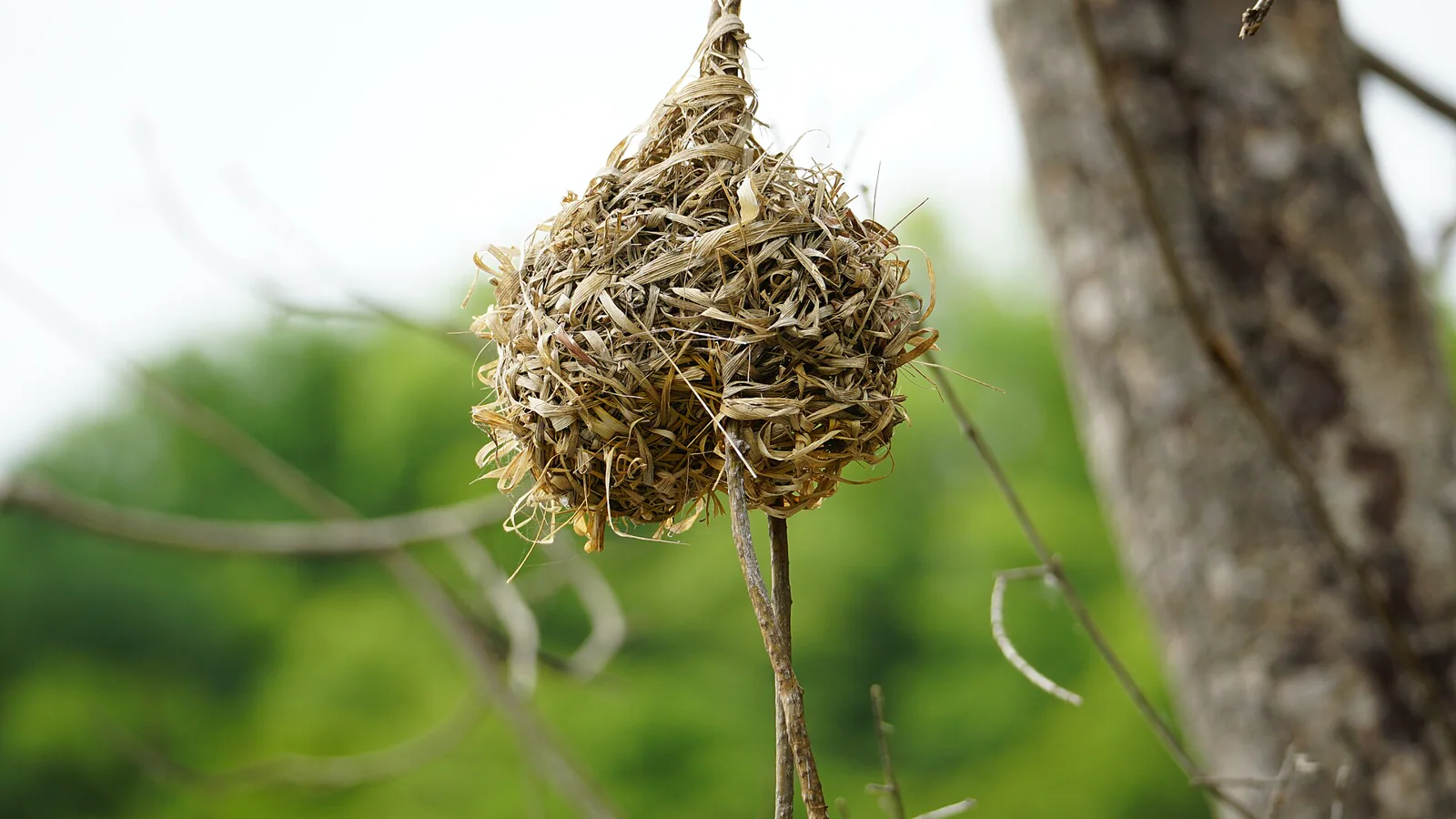
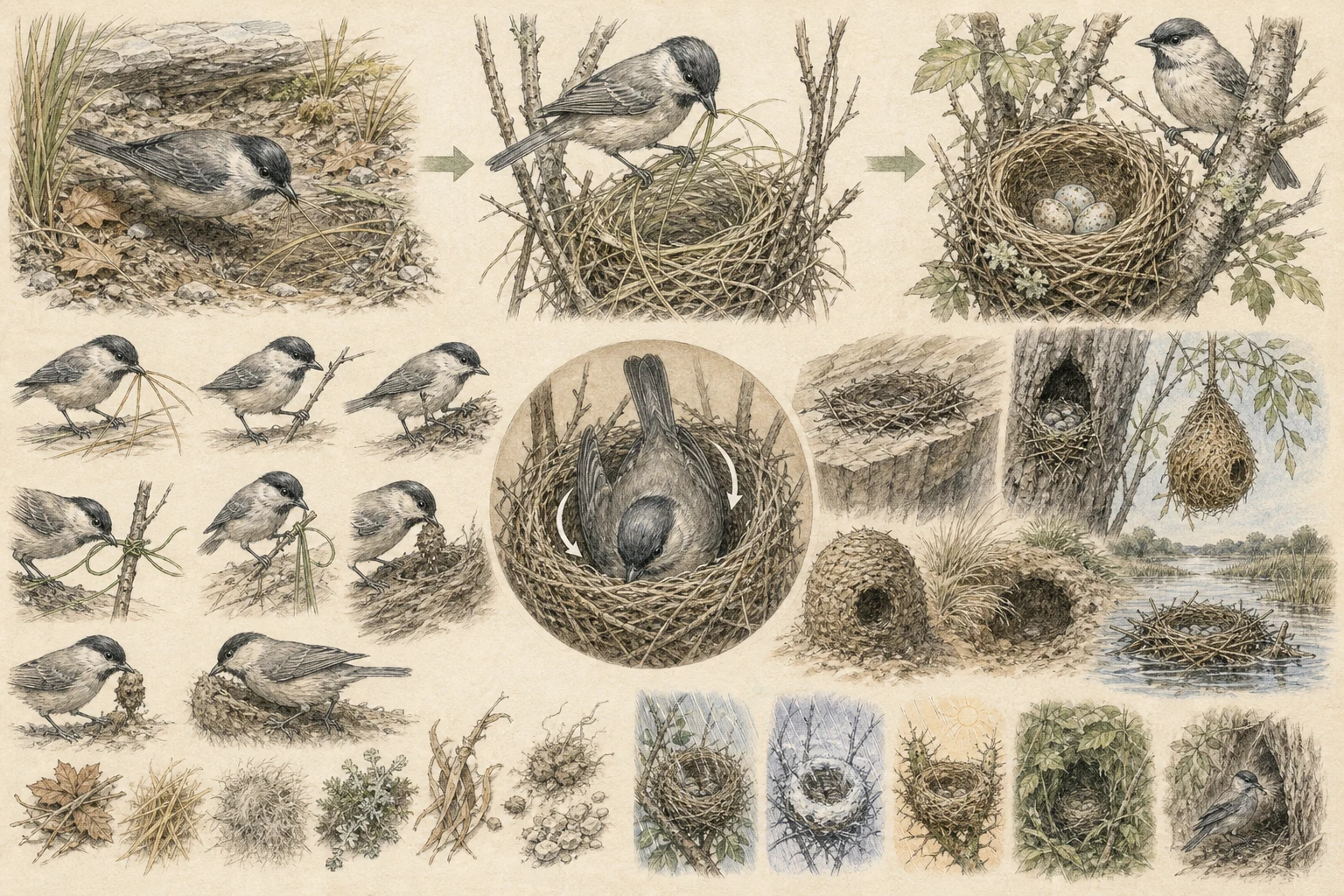
People often picture a bird's nest as a permanent bedroom, yet for the vast majority of species a nest is temporary seasonal infrastructure built solely to hold eggs, conserve heat during incubation, and shelter developing chicks until fledging. Across avian orders, architecture spans a dramatic spectrum: peregrine falcons and common murres lay directly on bare cliff ledges; killdeer and terns press shallow pebble-lined scrapes into open gravel; woodpeckers chisel raw wood cavities that secondary cavity nesters like bluebirds and chickadees later line; grebes anchor floating aquatic-weed rafts; megapodes heap fermenting compost mounds; and Old World weavers (Ploceidae) knot suspended grass chambers. [1][2][3]
- Most birds abandon their nests as soon as the brood fledges rather than sleeping in them year-round.
- Avian nest architecture spans unlined cliff ledges, ground scrapes, excavated tree cavities, mud retorts, and woven hanging pouches.
- Secondary cavity nesters such as wrens, titmice, and wood ducks rely on holes excavated by woodpeckers or formed by heartwood decay.
Bills, feet, and bodies become building tools
Without hands, a nesting bird turns its bill, feet, breast, and wings into a coordinated construction toolkit. Watch an American robin (Turdus migratorius) or barn swallow at work and you will see it ferry mouthfuls of wet mud and rootlets in its bill, smear and vibrate the mud against a branch or beam, and then climb inside to kick backward with its feet while pressing its breast firmly against the rim, rotating incrementally to mold a symmetrical hemisphere. Tailorbirds (Orthotomus) pierce living green leaf margins with sharp bills and draw spider silk or plant fiber through the holes like sewing thread, while hummingbirds bind stretchy spiderweb around lichen-covered cups that expand as nestlings grow. [2][3][5]
- Cup-nesting songbirds mold the interior bowl by pressing down with the breast and kicking backward while rotating inside the rim.
- Spider silk, sticky caterpillar webbing, mud pellets, and viscous salivary gland secretions act as natural binders and adhesives.
- Village and baya weavers use their bills and feet to tie true hitches and slip knots with torn strips of green grass or palm frond.
Instinct and learning cooperate
A first-year male village weaver (Ploceus cucullatus) or a hand-reared zebra finch (Taeniopygia guttata) still attempts its species-typical nest form, demonstrating strong innate motor templates for selecting and manipulating material. Yet detailed behavioral experiments and multi-year field tracking show that nest building is refined by physical cognition and individual experience. In laboratory trials given flexible versus stiff string or varying twig lengths, zebra finches rapidly learned which mechanical properties produced a stable platform and adjusted their material preferences on subsequent builds; in the wild, older weaverbirds weave tighter, sleeker hanging nests and drop fewer grass strips than novices. [3][4][5]
- Innate motor patterns set the basic architectural blueprint—scrape, cup, dome, or woven pendant—for each bird lineage.
- Controlled experiments with zebra finches show builders learn the stiffness and length of materials and adjust future choices.
- Experienced adult weavers build tighter, more symmetrical nests in less time than first-season males.
Every design balances several pressures
No single nest design maximizes every survival goal at once. A thick-walled, down-lined cup or roofed dome cuts conductive and convective heat loss in cold montane springs, allowing an incubating parent to spend less metabolic energy warming eggs, yet that same deep insulation can overheat chicks in hot lowland sun or harbor higher densities of blood-feeding blowfly larvae, fleas, and mites. Similarly, hanging a woven pouch from the outermost twig tip of an acacia over water thwarts climbing snakes and arboreal mammals, but exposes the clutch to fierce wind shear and rain soaking. Builders continually trade structural cost, microclimate, and concealment against local predator suites. [1][3][5]
- Thick walls of moss, hair, and feathers reduce parental incubation costs in cold climates but can harbor heavier ectoparasite loads.
- Suspending nests from thin outer branch tips over water deters climbing snakes and monkeys while increasing wind exposure.
- Within the same species, populations at higher latitudes or elevations typically build deeper, better-insulated nest cups than lowland populations.
Reading a nest from a distance
When you spot an active or post-season nest through binoculars, classify its structural category and attachment method before trying to guess the species. Note whether it is a ground scrape, a platform of coarse sticks, an open cup saddled atop a horizontal limb or slung like a hammock in a forked twig, a mud gourd plastered under an eave, or an enclosed dome with a side entrance. Next, inspect the outer structural shell versus the inner cup lining—coarse twigs, strips of grapevine bark, green moss, gray spider silk, mud, horsehair, or pale thistledown—and check for synthetic baling twine, fishing monofilament, or plastic strips that urban and agricultural birds frequently weave in. [1][2][3][5]
- Record how a cup nest attaches to vegetation: saddled on top of a branch, wedged in an upright crotch, or suspended by its rim in a fork.
- Distinguish the outer load-bearing frame (twigs, grass stems, mud) from the fine thermal lining (feathers, mammal hair, plant down).
- Inspect from a respectful distance with binoculars and check old winter nests for discarded fishing line or plastic twine hazards.
Related guides
Get Fauna and identify it in the field.
Where this guide comes from
Source-checked editorial guide. Last updated . This guide teaches identification and field skills; it is not a substitute for expert verification when it matters.
- Natural History Museum — Why birds nest ↗
- Smithsonian Gardens — Habitat: Nests ↗
- Ecology and evolution — The design and function of birds' nests ↗
- Proceedings. Biological sciences — Physical cognition: birds learn the structural efficacy of nest material ↗
- Philosophical transactions of the Royal Society of London. Series B, Biological sciences — Variation in nest-building behaviour in birds: a multi-species approach ↗