How woodpeckers handle impact
High-speed studies challenge the popular image of a sponge-like skull cushioning every strike. A woodpecker's head behaves largely as a rigid hammer that transfers energy into wood; small scale, straight alignment, short contact, and precisely coordinated motion help keep tissue loading within workable bounds.
Last updated
A peck is a whole-body motor sequence
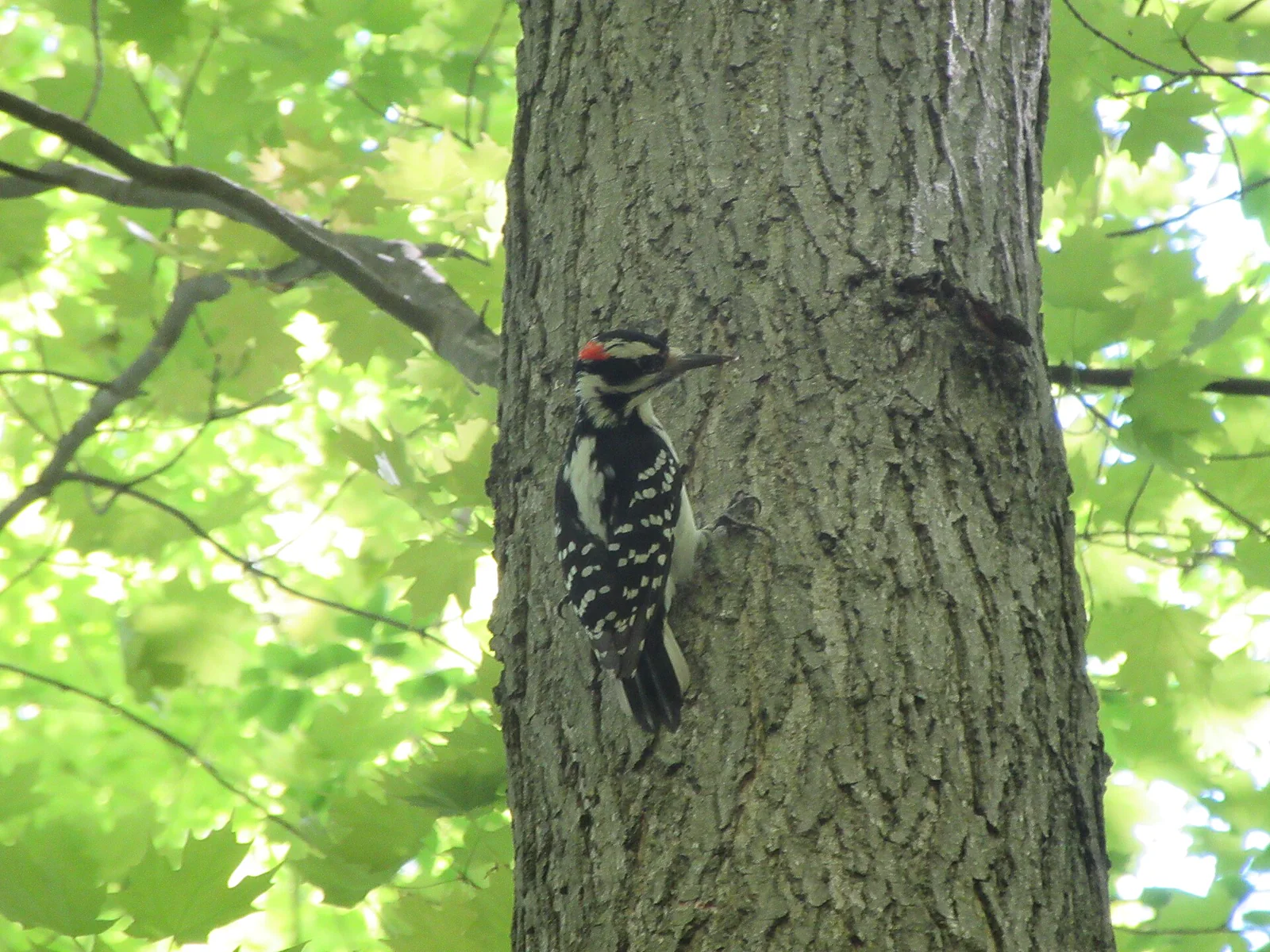
Watch a hairy woodpecker (Dryobates villosus) or pileated woodpecker (Dryocopus pileatus) excavating a nest cavity or chiseling after wood-boring beetle larvae, and the blow clearly starts at the feet and tail rather than the neck alone. Zygodactyl toes—two pointing forward, two backward—lock onto rough bark while stiffened rectrices press against the trunk as a third tripod leg. Electromyography and high-speed video show that powerful hip flexors, abdominal muscles, and neck protractors fire in a millisecond-precise sequence timed with forceful exhalations, driving the head along a linear trajectory while the thick nictitating membrane snaps shut just before impact to shield the eye from flying wood chips. [2][4]
- Zygodactyl feet and stiff, downward-propped tail feathers form a stable tripod brace against vertical tree trunks.
- Hip, trunk, neck, and respiratory muscles contract in synchronized bursts that power each forward strike and stabilize rebound.
- A translucent nictitating membrane closes milliseconds before bill contact to protect the cornea from wood splinters.
The head works more like a hammer than a helmet
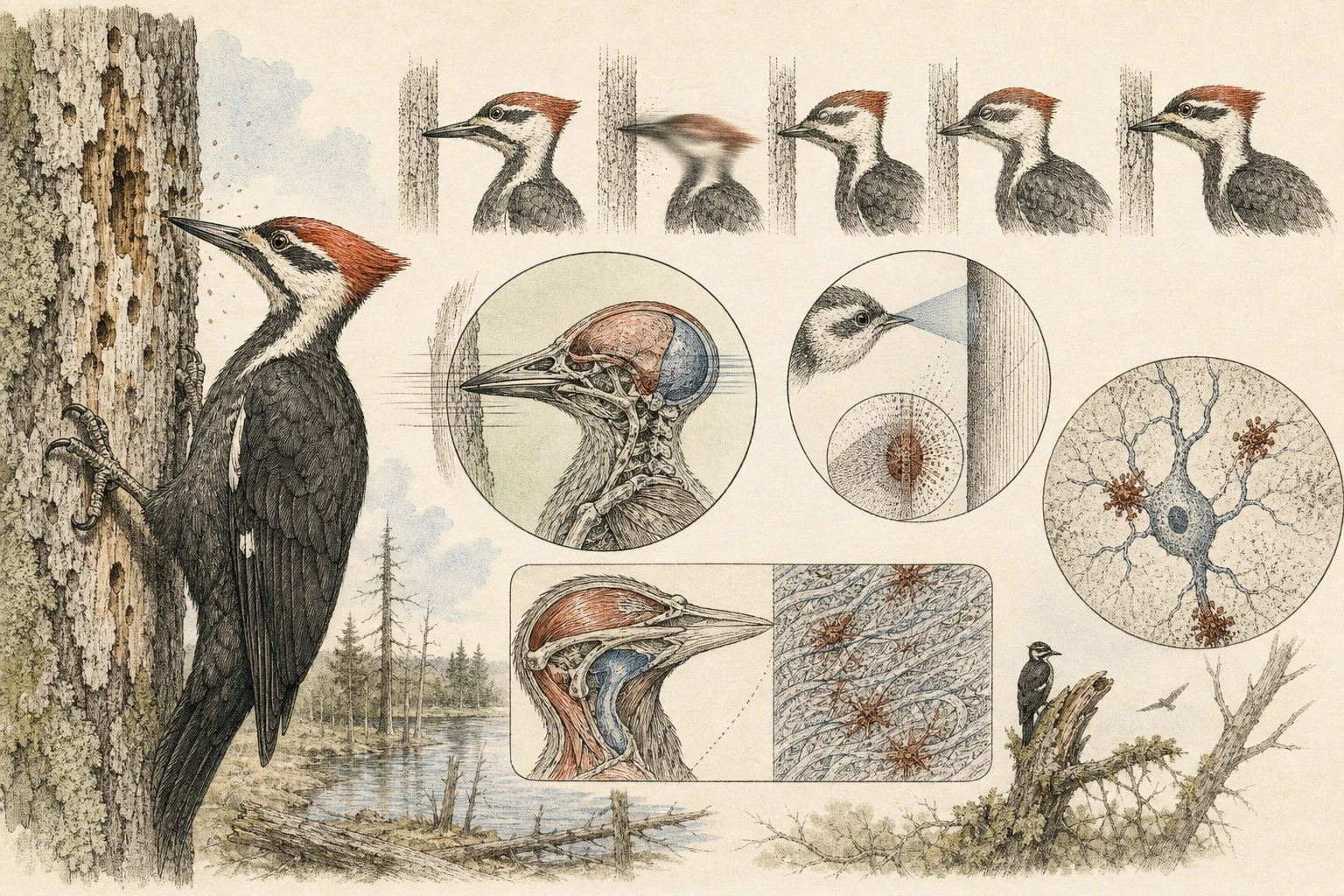
For decades, popular natural history accounts claimed that spongy cranial bone at the base of a woodpecker's upper bill and the long, sling-like hyoid apparatus acted as shock absorbers that cushioned the brain from impact. High-speed video tracking of free-pecking black woodpeckers (Dryocopus martius), great spotted woodpeckers (Dendrocopos major), and pileated woodpeckers refuted that hypothesis: points on the beak and the braincase decelerate together as a stiff, unified hammer. Physics explains why—any kinetic energy dissipated inside a squishy skull pad would be subtracted from the energy fracturing wood fibers, forcing the bird to strike far harder to chisel the same hole. [1][2]
- High-speed tracking of multiple woodpecker species shows the bill and braincase decelerate together as a rigid hammer.
- Absorbing kinetic energy between the bill tip and skull would waste mechanical work and make wood excavation far less efficient.
- The elongated hyoid bone and its muscles support the protrusible tongue and stabilize the throat rather than acting as a cranial seatbelt.
Small scale and short duration change the risk
Although a drumming or chiseling woodpecker's head experiences decelerations of 200 to 400 g—numbers that sound catastrophic next to human sports concussion thresholds around 90 to 100 g—scaling physics protects the bird's brain. Because a woodpecker's brain has a tiny cross-sectional area and mass (roughly 1,000 times smaller than a human brain) and fits snugly inside the cranial vault with very little cerebrospinal fluid space, the actual intracranial pressure and shear strain generated during a brief 0.5- to 2-millisecond linear strike stay well below the threshold required to tear axons. A woodpecker would have to strike wood at roughly twice its normal speed or hit a metal surface to reach human-equivalent brain stress. [1][2]
- Intracranial pressure scales with brain size and mass, so a tiny woodpecker brain experiences only a fraction of the stress a human brain would at the same g-force.
- Straight, linear strikes minimize the rotational acceleration and shear strain that cause most traumatic axonal injuries.
- Brief contact duration (around one millisecond) and minimal cerebrospinal fluid slosh further limit mechanical deformation of brain tissue.
Resistance is not proven immunity
Histological comparisons of museum brain tissue from downy woodpeckers (Dryobates pubescens) and non-pecking red-winged blackbirds detected focal accumulations of phosphorylated tau protein in woodpecker frontal cortex and brainstem tracts. However, neurobiologists caution that phosphorylated tau in wild birds may reflect an adaptive cytoskeletal stabilization or reversible physiological state rather than pathological neurodegenerative disease, especially since woodpeckers thrive and forage into old age in the wild. What protects a pecking bird is the whole evolved package—small brain geometry, linear strike control, wood compliance, and muscular bracing—which is why mimicking a single skull feature cannot magically concussion-proof a large human helmet. [3][4]
- Focal tau protein staining has been documented in woodpecker brain specimens, but its functional or pathological significance remains unresolved.
- Woodpeckers calibrate strike velocity and angle to the wood substrate, avoiding the uncontrolled off-axis impacts seen in human accidents.
- No single anatomical feature acts as a transferable anti-concussion device when scaled up to human head dimensions.
Related guides
Get Fauna and identify it in the field.
Where this guide comes from
Source-checked editorial guide. Last updated . This guide teaches identification and field skills; it is not a substitute for expert verification when it matters.
- Current Biology — Woodpeckers minimize cranial shock absorption ↗
- Frontiers in bioengineering and biotechnology — Biomechanical Analysis of Woodpecker Response During Pecking Using a Two-Dimensional Computational Model ↗
- PloS one — Tau accumulations in the brains of woodpeckers ↗
- Brown University — Woodpecker drilling physiology ↗