Why bats roost in colonies
A communal roost can reduce heat loss, create a warm nursery, connect familiar partners, and provide social cues about shelter or food. Those gains come with crowding, competition, parasites, and disease transmission, so bats change group size and roosts as conditions shift.
Last updated
One word covers very different gatherings
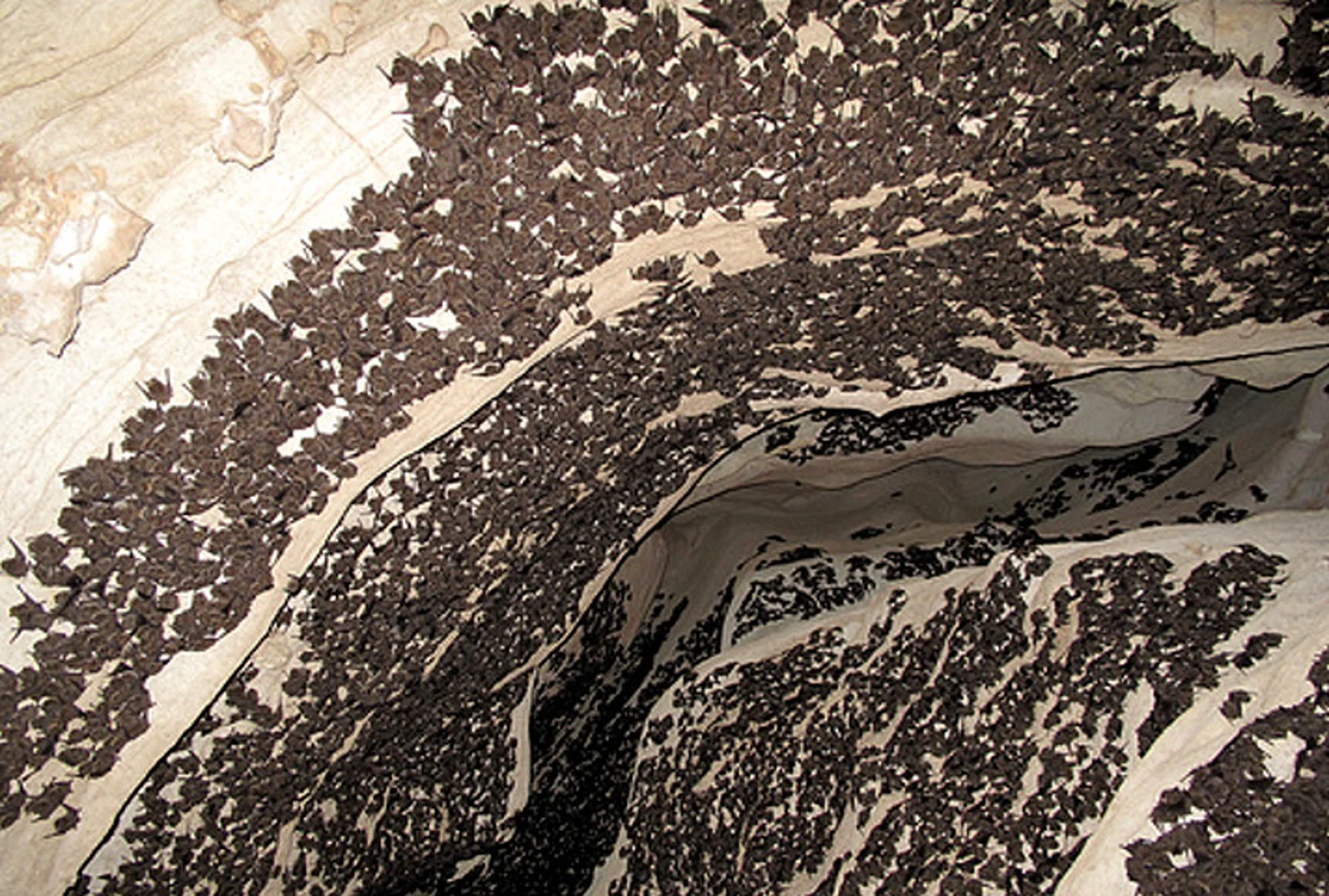
Biologists use the word colony for bat aggregations that serve very different seasonal and social purposes. In temperate zones, warm early-summer attics, bridges, and hollow trees host maternity colonies where pregnant and nursing females—such as little brown bats (Myotis lucifugus) or soprano pipistrelles (Pipistrellus pygmaeus)—gather to raise pups while adult males roost singly or in small bachelor groups under loose bark. Come autumn, mixed-sex swarming sites and cold, humid limestone caves or abandoned mines draw wintering hibernacula of gray bats (Myotis grisescens) or Indiana bats. Meanwhile, tropical tent-making bats and hoary bats roost in tiny groups or completely alone among foliage. [1][3]
- Summer maternity colonies consist mostly of reproductive females and pups, whereas adult males often roost alone or in small bachelor clusters.
- Winter hibernacula gather mixed-sex populations into caves and mines with stable, cool temperatures and high humidity.
- Many foliage-roosting species, such as hoary and red bats, spend much of the year hanging singly among leaves rather than in caves.
Shared warmth can save energy
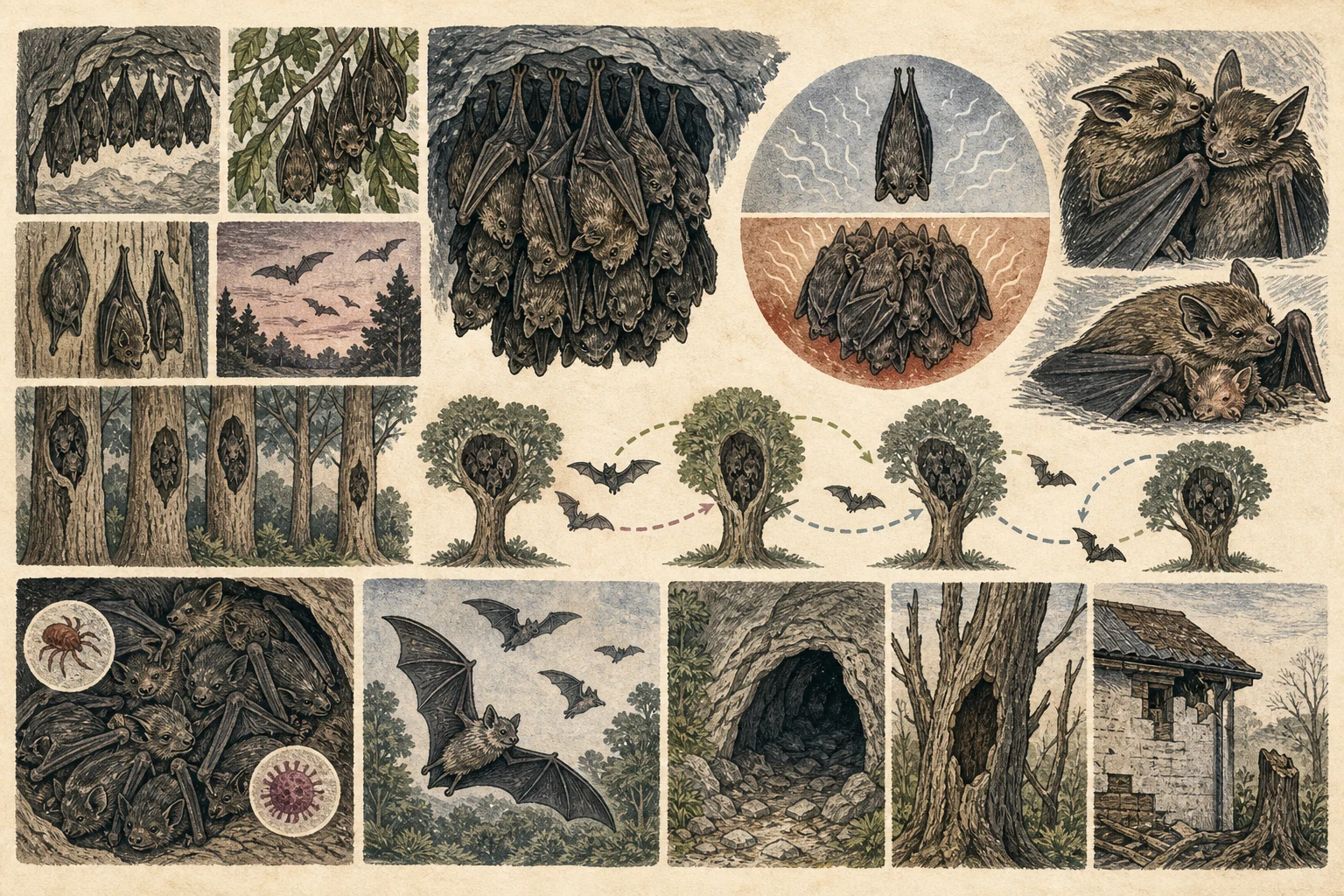
Because bats are small mammals with large, thin wing membranes and a high surface-area-to-volume ratio, they lose body heat rapidly when roosting in cool air. Packing together into tight ceiling clusters sharply reduces each individual's exposed surface area and warms the microclimate inside a tree cavity or rock crevice. Field respirometry and temperature-telemetry studies show that reproductive females use social thermoregulation to stay normothermic at lower metabolic cost, which accelerates fetal growth and milk production, while also dropping into shallow torpor on cold, rainy days and passively rewarming as neighbors warm up before dusk emergence. [2][4][5]
- Tight clustering reduces exposed body surface area and warms the immediate roost cavity, cutting metabolic heat loss.
- Warm maternity roosts accelerate embryonic development and juvenile forearm growth during short temperate summers.
- Bats flexibly combine social huddling with daily torpor when cold or wet weather suppresses flying insect prey.
Colonies also carry relationships and information
Even when forest-dwelling bats—such as Bechstein's bats, big brown bats, or New Zealand long-tailed bats—change tree cavities every few days, PIT-tag readers and radio-tracking reveal that they belong to structured fission-fusion societies. A single social colony spreads across a network of dozens of snags within a woodland patch, splitting into small subgroups on some days and coalescing into larger clusters on others while maintaining non-random, multi-year associations with familiar females and maternal kin. Within these shared roosts, bats exchange vocal and olfactory cues, groom one another, and transfer social information about newly located hollow trees or productive foraging patches. [1][4]
- Tree-roosting forest bats often form fission-fusion societies that split across multiple cavities and recombine over days.
- Long-term banding and PIT-tag studies show females maintain preferred roosting partnerships across multiple years.
- Emerging dusk streams at a single tree hole often represent only one subgroup of a larger woodland colony network.
Crowding has costs, and the shelter can be scarce
Living belly-to-back in dark cavities carries real biological liabilities: ectoparasites such as wingless bat flies, mites, ticks, and bat bugs move easily between touching hosts, and dense winter clustering facilitates transmission of pathogens such as Pseudogymnoascus destructans, the cold-loving fungus behind white-nose syndrome. Frequent roost switching among tree holes helps forest bats interrupt parasite life cycles and abandon soiled cavities, whereas cave-obligate species like the gray bat depend on a tiny fraction of karst caves that trap the exact thermal profile required for summer rearing or winter hibernation—making cave disturbance or timber removal a severe population bottleneck. [1][3][5]
- Frequent switching among tree cavities helps forest bats reduce heavy loads of bat bugs, mites, and parasitic bat flies.
- Dense contact in cold, humid winter hibernacula can facilitate fungal and viral transmission across clustered individuals.
- Only a small percentage of caves and veteran hollow trees offer the microclimate stability required by maternity or hibernating colonies.
Related guides
Get Fauna and identify it in the field.
Where this guide comes from
Source-checked editorial guide. Last updated . This guide teaches identification and field skills; it is not a substitute for expert verification when it matters.
- Sociality in Bats — Sociality, Parasites, and Pathogens in Bats ↗
- Die Naturwissenschaften — Communally breeding bats use physiological and behavioural adjustments to optimise daily energy expenditure ↗
- U.S. Geological Survey — Monitoring trends in bat populations of the United States and territories ↗
- Ecology and evolution — Sociality influences thermoregulation and roost switching in a forest bat using ephemeral roosts ↗
- Bat Conservation Trust (UK) — Where do bats live? ↗