How animals see in low light
Scarce photons are the central problem: anatomy can admit more light, rods and photopigments capture it, reflective layers offer a second pass, and neural circuits combine signals across space or time while accepting blur and noise.
Last updated
First gather as many photons as possible
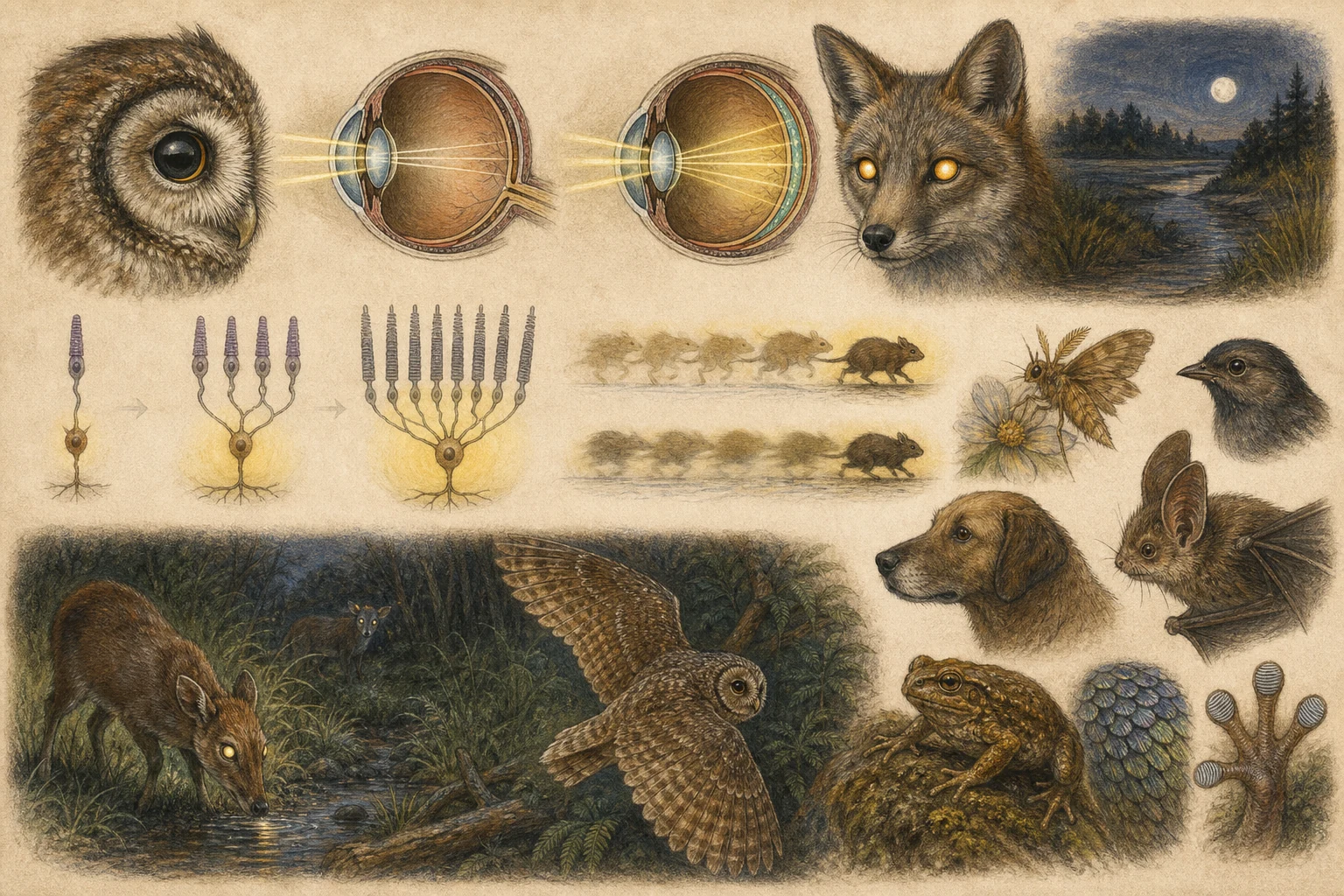
Under starlight or dense forest canopy, photons arrive so sparsely that visual systems face a fundamental signal-to-noise problem before any brain processing begins. Nocturnal and crepuscular animals first improve photon catch through optical geometry: wide dilating pupils, large front lenses, and short focal lengths relative to aperture (a low f-number) project a brighter image onto the retina. In vertebrates such as owls, tarsiers, and nocturnal mammals, rod photoreceptors packed with rhodopsin dominate the retina; in nocturnal moths, beetles, and crustaceans, refracting or reflecting superposition compound eyes funnel light from hundreds of surface facets onto single deep rhabdoms, multiplying brightness over standard daytime apposition eyes. [1][2]
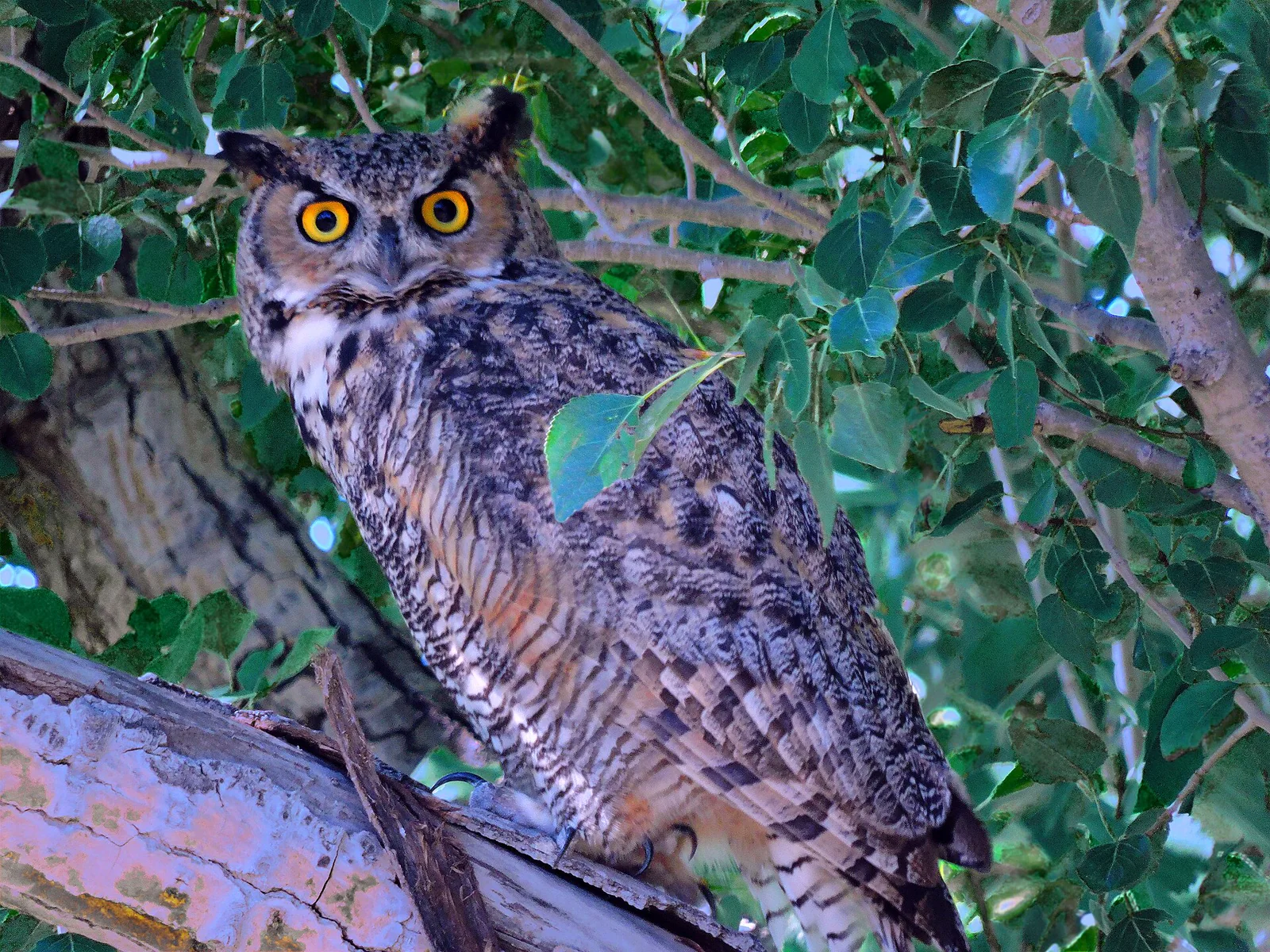
- Notice the large corneal diameters and wide pupil apertures of owls, nightjars, geckos, and nocturnal mammals.
- Remember that nocturnal insects often use superposition compound eyes that pool light across many lens facets onto deep receptors.
- Recognize that optical light-gathering always requires some ambient starlight, moonlight, or twilight; no eye sees in absolute zero-photon darkness.
Some eyes give light a second chance
Many nocturnal vertebrates—including felids, canids, ungulates, crocodilians, sharks, and aardvarks—line the back of the eye with a tapetum lucidum, a biological retroreflector built from subwavelength multilayer gratings or ordered arrays of riboflavin, zinc-cysteine, guanine, or collagen fibrils. Photons that slip past the photoreceptor outer segments on their first pass strike this mirror and bounce back through the retina for a second chance at absorption. The unabsorbed remainder exits the pupil as the familiar eyeshine seen in a headlamp beam. Because reflected light scatters slightly and eyeshine hue shifts with viewing angle, age, and light source, never use eyeshine color alone to claim a species identification. [2][3]
- Understand eyeshine as unabsorbed light reflecting back out of the pupil from a retroreflective tapetum lucidum behind the retina.
- Note that many capable nocturnal hunters—including owls and several nocturnal rodents and primates—lack a tapetum lucidum altogether.
- Use dim, brief red or low-lumen indirect light at night rather than sweeping bright white beams into dark-adapted eyes.
The nervous system pools weak evidence
Even after optics and tapetal reflection maximize photon capture, individual photoreceptors under starlight register only occasional quantum hits amidst thermal receptor noise. To pull a reliable image out of that static, retinal bipolar and ganglion cells—and their insect lamina counterparts—sum signals across space and time. Spatial summation pools inputs from wider neighborhoods of photoreceptors into single output channels, turning dim grain into a detectable shape at the price of fine spatial acuity. Temporal summation integrates photon arrivals over longer millisecond windows, boosting contrast for stationary landmarks while making fast-moving targets blur like a long-exposure camera frame. [1][4]
- Spatial pooling combines neighboring receptors to make dim shapes visible while trading away razor-sharp detail.
- Temporal pooling lengthens integration time like a slow camera shutter, helping slow-moving nocturnal insects navigate under canopy.
- Notice how owls and nightjars perch motionless to scan and listen, letting long visual integration and acute hearing work together.
Dim vision is not one monochrome world
Because human vision switches from color-sensitive cones to single-channel rods at dusk, we easily assume the night world is grayscale for every animal. Yet comparative studies show remarkable diversity: nocturnal helmet geckos, elephant hawkmoths, carpenter bees, and frogs discriminate flower and object colors under dim moonlight or starlight where humans are completely color-blind, whereas other nocturnal mammals such as the aardvark have rod-dominated retinas with reduced cone classes and lean heavily on olfaction and hearing. Moreover, the spectral color of night light itself shifts between blue-rich twilight, open moonlight, and green-filtered forest canopy, shaping how different eyes perform. [3][4]
- Remember that hawkmoths, nocturnal bees, and geckos can distinguish flower and prey colors in dim light where human eyes see only gray.
- Watch how nocturnal mammals such as aardvarks, badgers, and shrews pair low-acuity dim vision with constant nose-to-ground olfaction and whisker touch.
- Consider the ambient light spectrum—twilight blue, open moonlight, or canopy shade—when observing crepuscular and nocturnal behavior.
Related guides
Get Fauna and identify it in the field.
Where this guide comes from
Source-checked editorial guide. Last updated . This guide teaches identification and field skills; it is not a substitute for expert verification when it matters.
- Anatomia, histologia, embryologia — Adaptations of the Vertebrate Retina to Low-Light Conditions: A Review ↗
- Journal of biophotonics — Multilayer subwavelength gratings or sandwiches with periodic structure shape light reflection in the tapetum lucidum of taxonomically diverse vertebrate animals ↗
- PloS one — Eye features and retinal photoreceptors of the nocturnal aardvark (Orycteropus afer, Tubulidentata) ↗
- Philosophical transactions of the Royal Society of London. Series B, Biological sciences — The remarkable visual capacities of nocturnal insects: vision at the limits with small eyes and tiny brains ↗