Using a hand lens in the field
A simple hand lens reveals mineral grains, leaf surfaces, moss structures, lichen growth forms, bark, and tiny signs. The useful skill is not magnification alone, but finding focus and describing what another observer could verify.
Last updated
Choose a useful lens and learn its distance
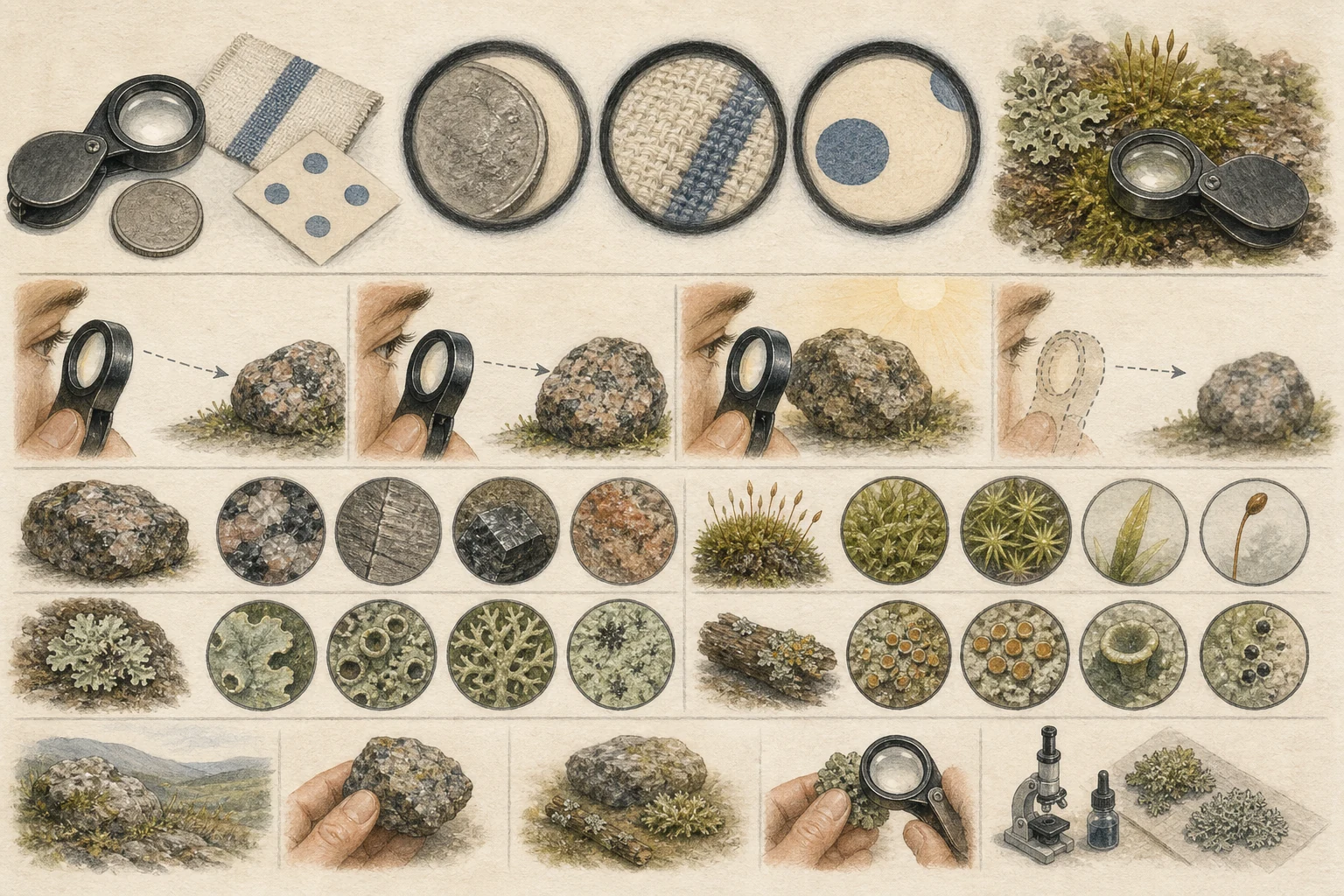
In optical design, higher magnification always trades away working distance and field of view. A 20× loupe forces you to hold the glass almost touching a wet moss cushion and shows only a pinhole slice of leaf, whereas a folding 10× hand lens—the standard field tool for geologists, botanists, and lichenologists—gives a bright, distortion-free view at roughly one inch (2.5 centimeters) from the subject. Wear the lens on a lanyard around your neck so it is immediately reachable whenever you kneel beside a rock, log, or flower. [1][2]
- A folding 10× lens is a versatile starting point.
- Keep the glass clean and protected between uses.
- Practice before relying on the lens for an identification.
Keep the lens near your eye
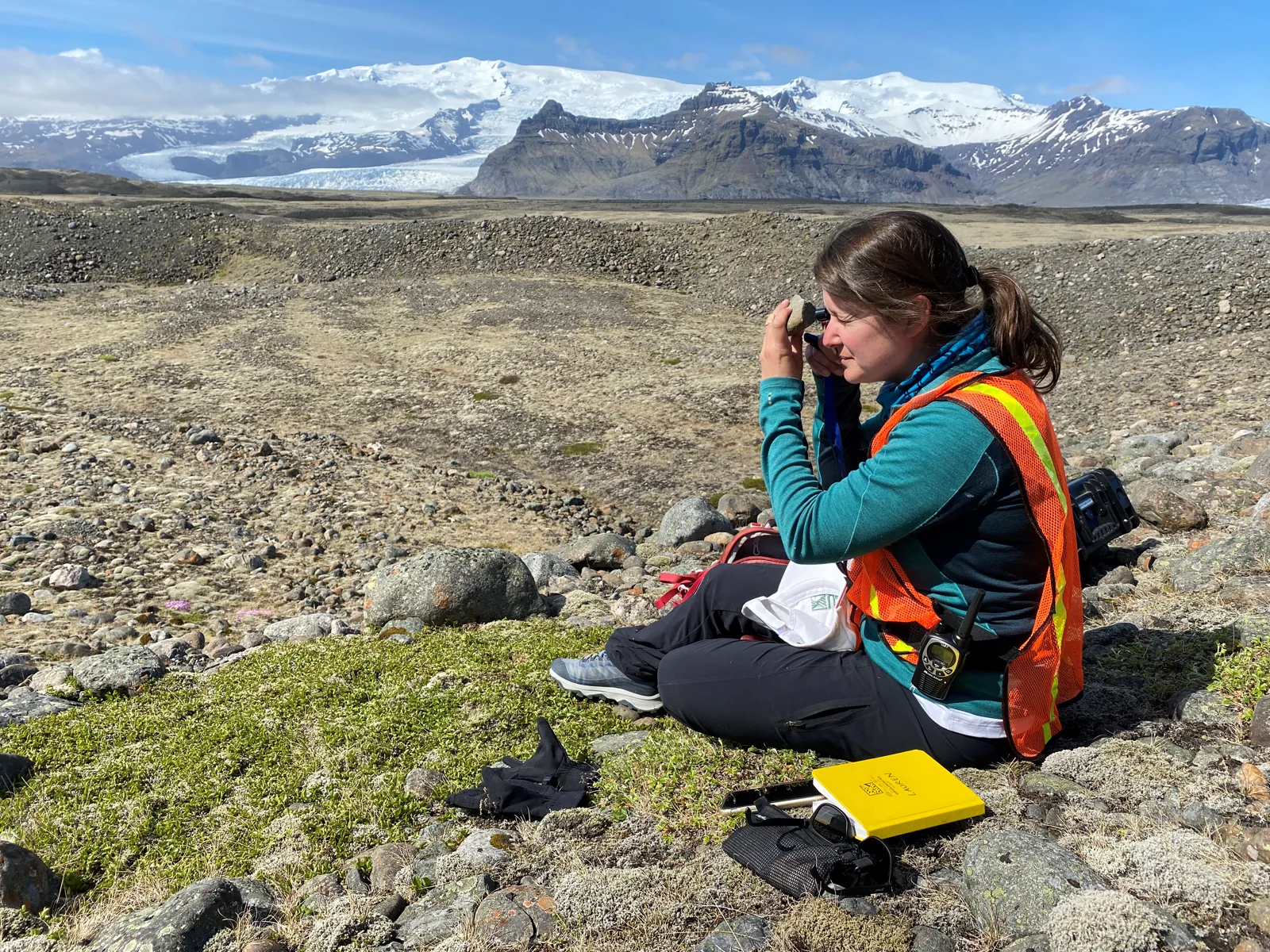
First-time users almost always hold a hand lens at arm's length like a cartoon detective glass, which shrinks the visible image and makes steady focus nearly impossible. Instead, anchor the metal housing against your cheekbone or thumb right in front of your eye, then lean your head smoothly toward the tree bark or boulder—or bring a loose leaf or pebble up toward your face—until the surface snaps into crisp relief at the lens's fixed focal plane. Pivot your shoulders so natural daylight rakes across the specimen without your hat or head casting a shadow over it. [2]
- Start with the subject just beyond focus, then move slowly closer.
- Use both eyes open if that feels comfortable and reduces strain.
- Shade glare without blocking all of the light.
Describe characters that repeat
Once the miniature landscape is in focus, look for structural characters that repeat across several individuals rather than a single blemish or broken edge. On a rock sample, check mineral grain boundaries, crystal cleavage planes, and metallic versus vitreous luster; on a lichen thallus, check whether it forms flat leafy lobes (foliose), shrubby branches (fruticose), or a tight crust (crustose), and whether tiny powdery soredia, peg-like isidia, or cup-shaped apothecia dot the surface; on a moss, look for a central leaf midrib (costa) and the shape of the spore capsule. [1][3][4][5]
- Sketch the field of view and label scale when possible.
- Compare several examples on the same substrate.
- Photograph the whole organism or rock after the close view.
Know what magnification cannot settle
A 10× lens opens up an extraordinary world of fern sporangia, spider eye arrangements, insect wing venation, and lichen fruiting bodies, but it also teaches humility about field limits. Many crustose lichens, bryophytes, and fungi can only be separated to species by compound-microscope spore measurements or chemical spot tests in a herbarium. Examine living cushions in place without scraping slow-growing lichens off boulders or peeling bark from standing trees, and record honest genus- or growth-form notes when microscopic traits remain out of reach. [3][4][5]
- Separate observation from interpretation in your notes.
- Use 'unknown moss' or another broad label when key characters are unavailable.
- Leave fragile moss, lichen, bark, and microhabitat intact.
Related guides
Get Fauna and identify it in the field.
Where this guide comes from
Source-checked editorial guide. Last updated . This guide teaches identification and field skills; it is not a substitute for expert verification when it matters.