Keeping a field journal
A field journal is not an art project and it is not a diary. It is a lens that forces you to look at something long enough to notice it.
Last updated
The four that make an entry usable
The Wildlife Trusts put the essentials plainly: date, time, weather, location, and behavior, recorded alongside whatever you sketch. It sounds like bookkeeping, and it is — but they are what let a note from two years ago mean something. An undated drawing of a bird is a drawing. The same drawing with a date, a place, and a line about what it was doing is an observation. [1][2][3]
- Date and time — the spine of everything you'll do with it later
- Location, specific enough that you could stand there again
- Weather, which can help explain activity
- What it was actually doing, not just what it was
Words, pictures, and numbers
The naturalist John Muir Laws frames journaling as three tools rather than one: write it, draw it, and count or measure it. Each catches what the others miss — a sketch pins down a shape you have no word for, a number turns an impression into something you can compare, and a sentence carries the thing you noticed that has no shape at all. [1][2]
- How many? How far? How long did it stay?
- Draw the thing you can't name — the shape is the question
- Write the question down too; unanswered questions are the good part
The drawing is not the point
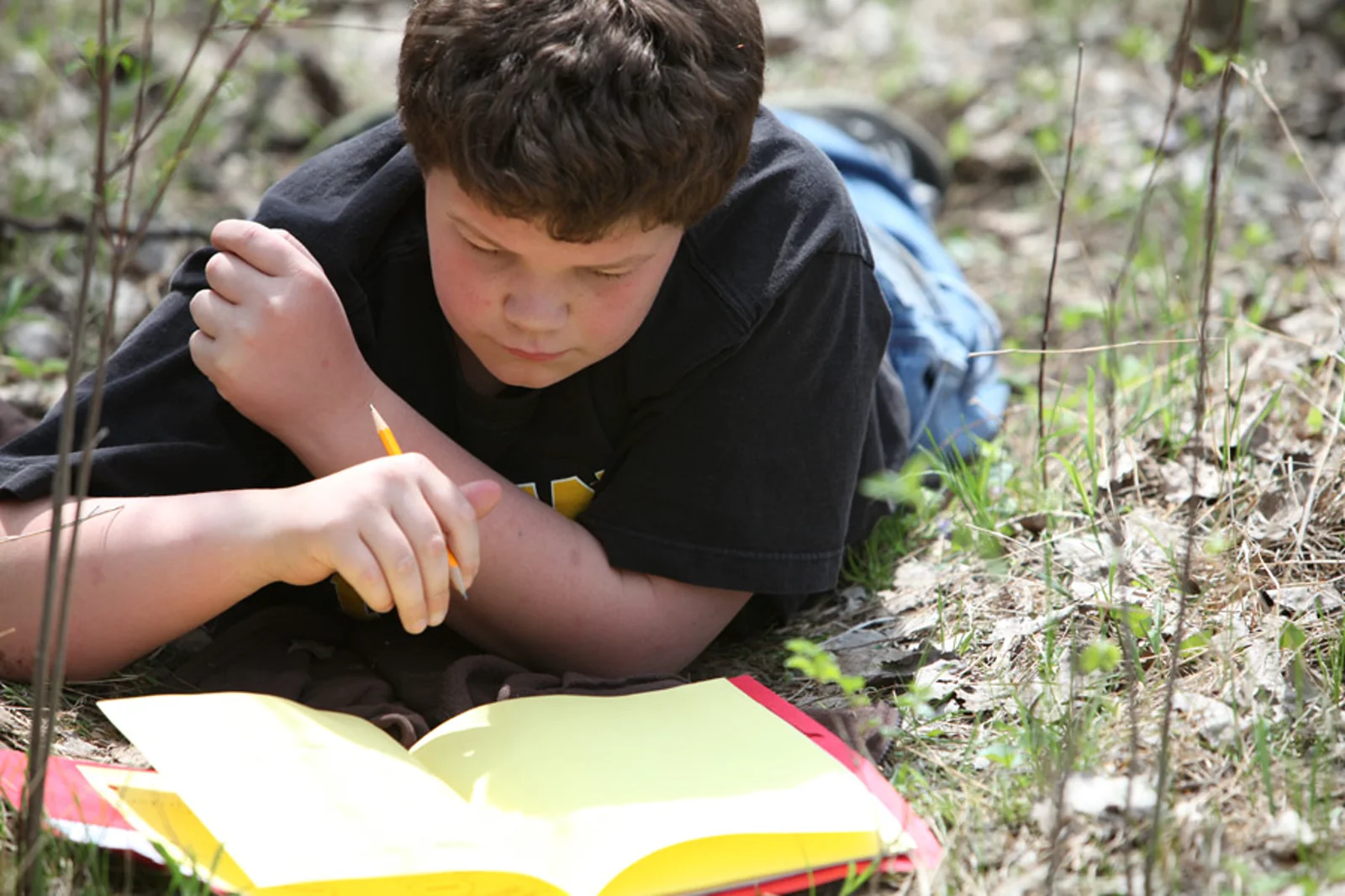
This stops more people than anything else. Laws is explicit about it: do not focus on trying to make pretty pictures. The drawing is a way of looking — it forces you to answer questions the eye would happily skip, like where the wing actually joins or how long the bill really is against the head. Surrey Wildlife Trust says the same in fewer words: sketches can be simple. Nobody is marking it. [1][2][3]
- Use quick diagrams with arrows and written labels for colors and proportions rather than shading a finished portrait
- Draw enlarged callouts of a bill tip, leaf margin, or track pad beside a rough body outline
- Keep your pencil moving while watching or immediately after so memory does not smooth away real details
Little and often, in one place you can return to
Repeated visits to a familiar patch reveal seasonal changes that a one-off expedition to a famous reserve cannot. Choose a neighborhood park, pond margin, wooded path, or backyard corner small and convenient enough that you will actually return week after week, logging ten-minute entries that build into a continuous local timeline. [1][2][3][4][6]
- Pick a patch within ten minutes of home or work so weather or a busy schedule does not stop you
- Set a modest goal—such as three observations and one question per walk—so the habit sticks
- Review last year's entries for the same week before heading out to see what is arriving early or late
Why the boring entries matter most
Britain's Nature's Calendar includes phenology records dating to 1736, among them deliberate long-running observations by naturalists. Researchers compare historical and modern records to study changes in seasonal timing. Your note need not have an immediate use to become valuable later — but record it accurately enough that someone else can interpret it. [5][7]
- Log ordinary backyard dominants like robins, dandelions, and bumblebees alongside rare sightings
- Write legibly and define any personal abbreviations so future readers can interpret the page
- Include negative notes when a regular wintering flock or spring chorus has not yet appeared
Related guides
Get Fauna and identify it in the field.
Where this guide comes from
Source-checked editorial guide. Last updated . This guide teaches identification and field skills; it is not a substitute for expert verification when it matters.
- The Wildlife Trusts — How to start a nature journal ↗
- Surrey Wildlife Trust — Nature journaling ↗
- John Muir Laws — How to get started with Nature Journaling ↗
- John Muir Laws — Nature Journaling: Get started and grow! ↗
- Woodland Trust & UK Centre for Ecology & Hydrology — Nature's Calendar ↗
- Nature Canada — Nature Journaling ↗
- Nature's Calendar — Research using historical records ↗