Using a dichotomous key
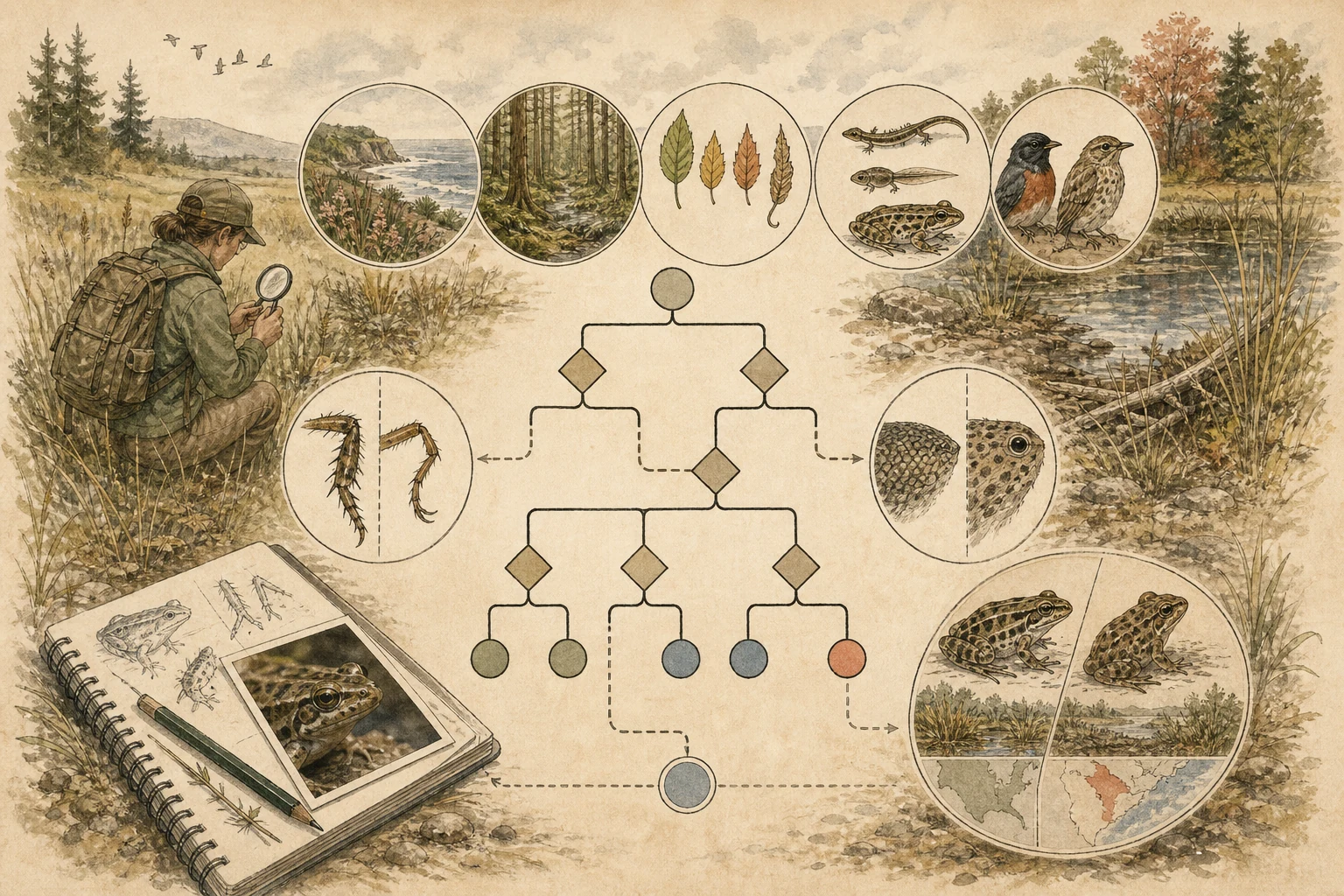
A dichotomous key narrows a defined set of possibilities through paired statements called couplets. It can produce a strong identification only when the specimen belongs within the key's scope and the user can observe the characters each choice requires.
Last updated
Choose the right universe first
Picture browsing fails whenever dozens of regional oaks, sedges, or solitary bees look nearly identical in a single portrait—and that is where a dichotomous key shines. Before reading the first line of a key, however, verify that your organism actually belongs inside the universe the author built. Check the key's title and introduction for its exact geographic boundary, taxonomic group, life stage (such as adult versus nymph, or summer foliage versus winter twigs), and whether ornamental or introduced species are included. Trying to key a planted street tree in a wild-forest flora will lead you smoothly to a wrong native name. [2][3][4]
- Field check: confirm that your location, habitat, taxon group, and life stage match the scope stated in the key's introduction.
- Common trap: using a native-wildflower or forest-tree key on an escaped garden cultivar or landscaped city park planting.
- If a plant lacks flowers or fruit, choose a vegetative key built around leaf, bud, and bark characters rather than guessing missing floral parts.
Read each couplet as a pair
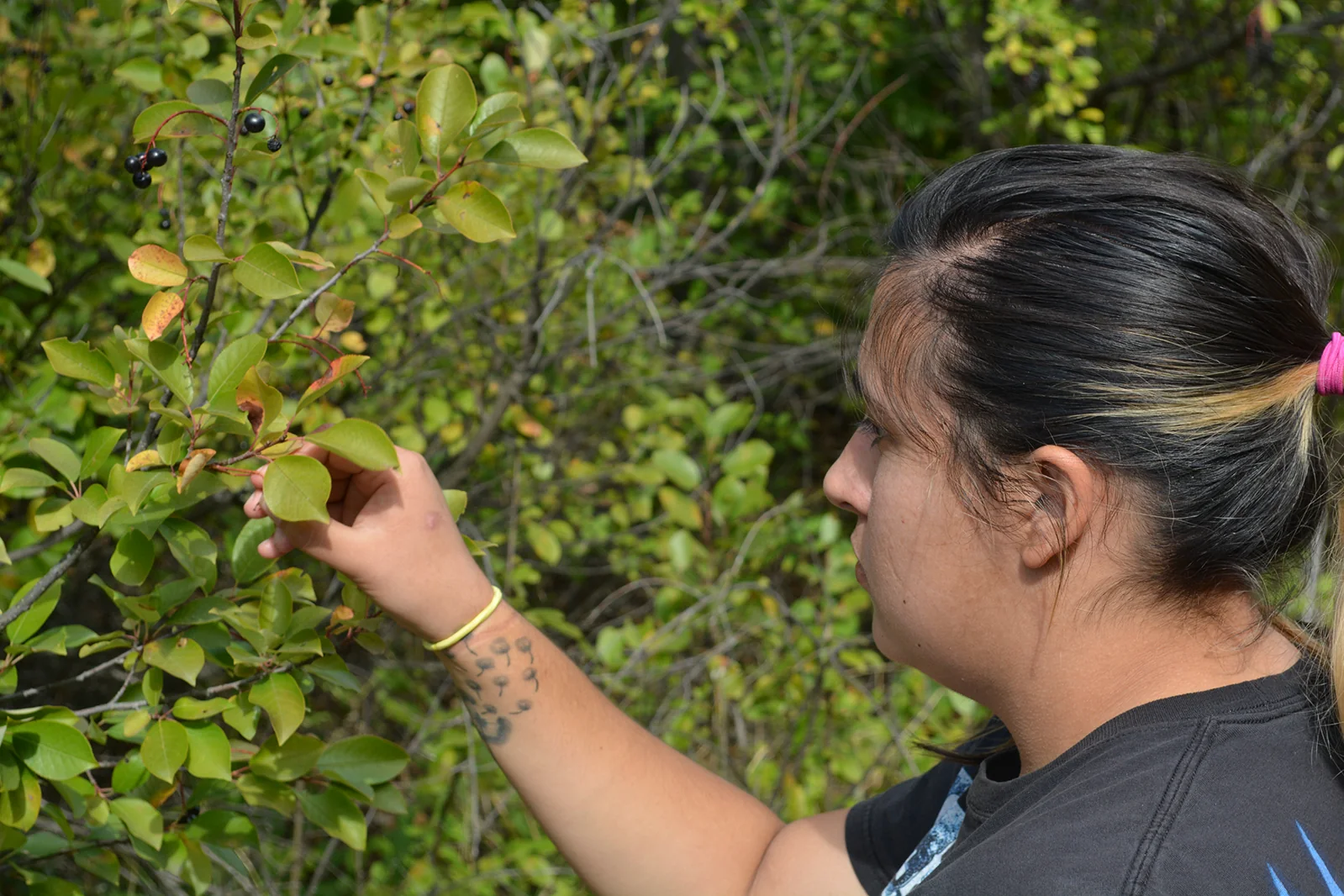
A dichotomous key works as a branching road map made of numbered pairs of contrasting statements called couplets (either indented or bracketed as 1a/1b). At every step, read both leads from start to finish before making a decision, because the first lead may sound plausible until the second lead reveals a much sharper match. Keep a millimeter ruler and a 10x hand lens ready: keys rely on concrete, observable structures—such as opposite versus alternate leaf nodes, compound versus simple blades, or the exact number of tarsal segments—rather than vague impressions. Whenever a botanical or anatomical term is unfamiliar, check the illustrated glossary first. [1][2][3]
- Always read both halves of a couplet completely before choosing a branch, even if the first statement seems to fit.
- Examine several leaves or nodes along a branch—a single chewed or shaded leaf can hide true opposite arrangement or toothing.
- Carry a millimeter scale and hand lens so you can measure hair length, sepal size, or bud scales instead of estimating by eye.
Keep a reversible trail
Even experienced field botanists and entomologists hit couplets where a character is borderline, weathered, or missing on the organism in front of them. Instead of trusting memory, jot the sequence of couplet numbers and letters you chose (for example: 1a → 3b → 7a → 8b) in your field notebook, and mark any step where you hesitated with a question mark. If you reach a subsequent couplet where neither lead fits—say, both options call for red berries when your shrub has dry capsules—stop immediately, return to your last flagged fork, and follow the alternative branch. [2][4][5]
- Write down your step-by-step couplet path (1b → 4a → 9b) in your field notes so you can backtrack without starting over.
- When a character is ambiguous, follow both branches a few steps forward to see which pathway continues to match the whole organism.
- Photograph the specific anatomical feature that decided each major fork so you can review your path at home.
Treat the endpoint as a hypothesis
Arriving at a species name at the end of a key is not the end of the identification process—because a dichotomous key will always funnel you to some name on its list, even if your organism is an unkeyed hybrid or outside the key's coverage. Test the resulting name against a complete species description, diagnostic reference photographs or herbarium scans, habitat notes, flowering or flight season, and county range maps. If the full description contradicts multiple characters on your plant or insect, step back to genus or family level and record the discrepancy honestly in your notes. [2][3][4]
- Field check: verify your keyed name against a full written species description, range map, and verified reference images.
- Remember that a key forces every specimen into its included list—an out-of-range vagrant or hybrid will still land on a name.
- When floral or microscopic characters required by the final couplet are absent, record the identification at genus level and note why.
Related guides
Get Fauna and identify it in the field.
Where this guide comes from
Source-checked editorial guide. Last updated . This guide teaches identification and field skills; it is not a substitute for expert verification when it matters.