The insect decline, explained
Reports of collapsing insect numbers have alarmed the public, and many studies do show real declines in abundance and diversity—especially in well-studied regions—driven by habitat loss, pesticides, climate change, and light pollution. The picture is uneven and the data imperfect, but the stakes are high because insects underpin pollination, decomposition, and food webs.
Last updated
What the evidence shows
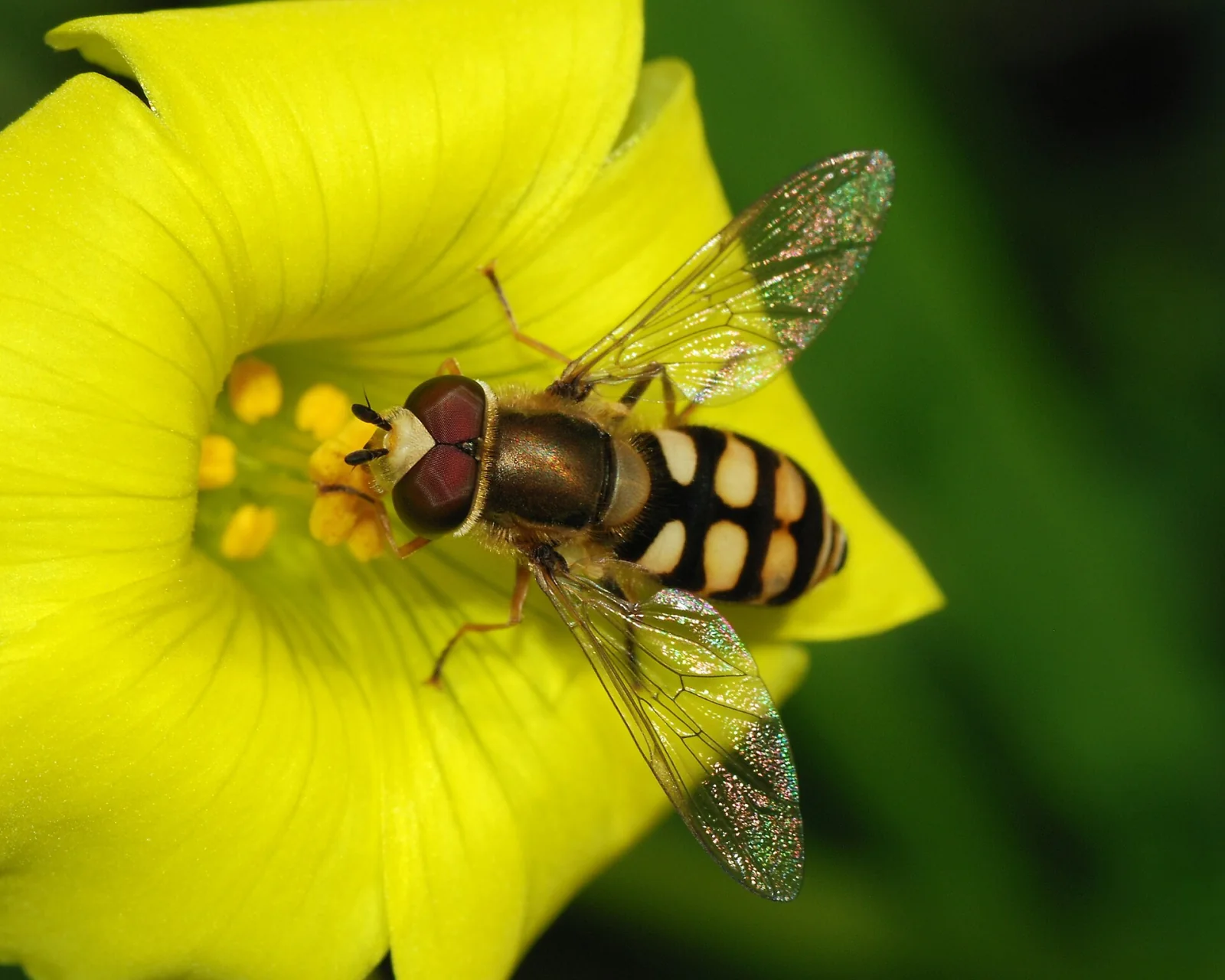
Multi-decade monitoring datasets from Europe and North America have documented steep contractions in flying-insect biomass and species richness—averaging roughly 1 to 2 percent loss per year across several long-running Malaise-trap, butterfly, wild-bee, and macro-moth surveys. At the same time, entomologists emphasize that trends are heterogeneous: specialist species restricted to nutrient-poor grasslands, bogs, and old-growth forests are falling fastest, some freshwater insects have rebounded where clean-water laws cut river pollution, and vast tropical regions still lack multi-decade baseline counts. [1][2]
- Long-term European and North American datasets show average declines of 1% to 2% per year in many terrestrial insect groups
- Habitat specialists in grasslands and woodlands are declining far more steeply than adaptable generalist species
- Global monitoring remains geographically skewed, with major data gaps across tropical Africa, Asia, and South America
Several drivers acting together
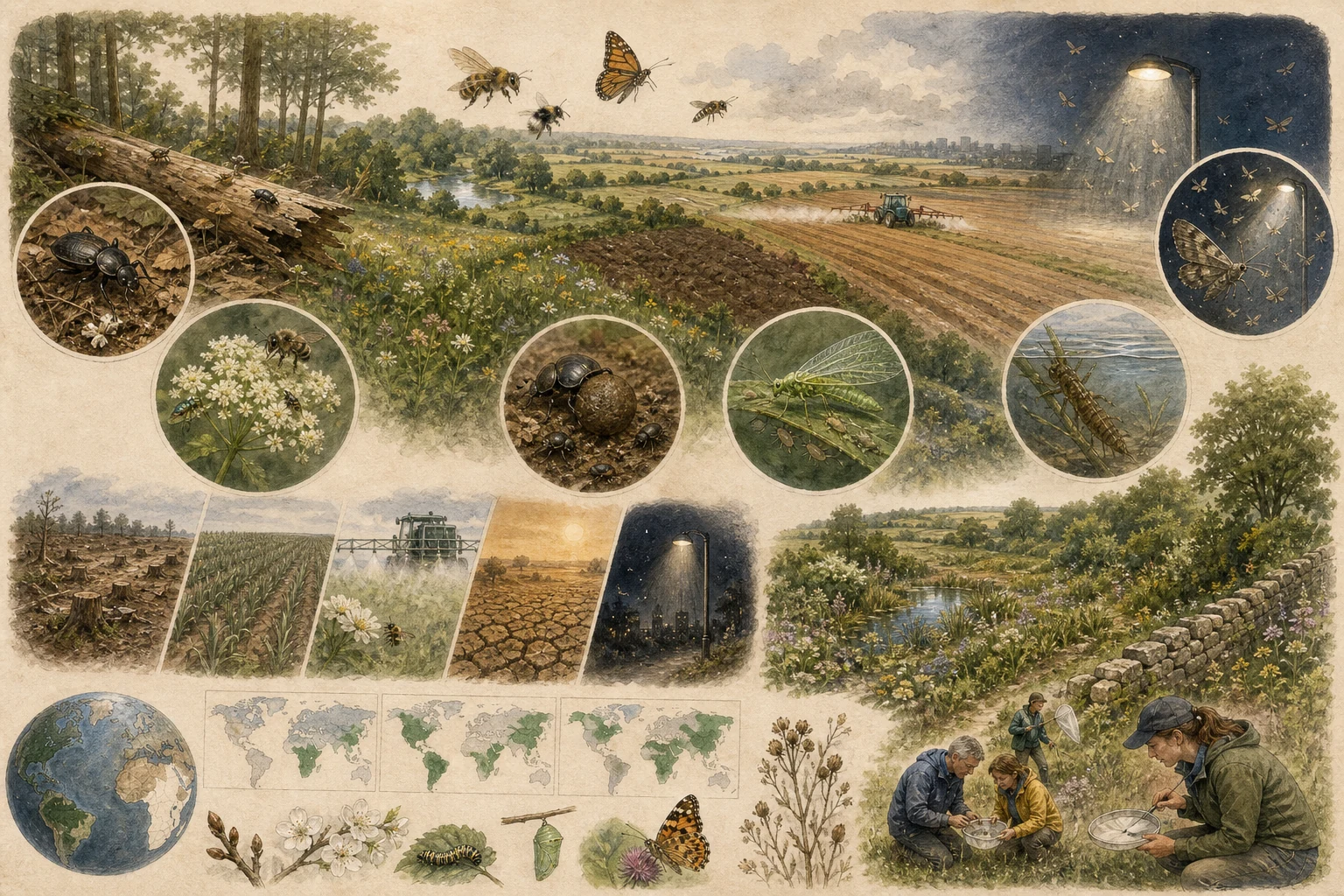
Entomologists describe the pattern as 'death by a thousand cuts' because multiple anthropogenic stressors act simultaneously across landscapes. Agricultural intensification replaces diverse hedgerows and floral margins with large monocultures, systemic insecticides and broad-spectrum herbicides poison non-target insects or eliminate larval host plants, nitrogen deposition from fertilizers favors rank grasses over wildflowers, artificial light at night traps nocturnal fliers, and climate extremes—such as prolonged droughts and unseasonable heatwaves—desynchronize insect emergence from host blooms. [2][3]
- Habitat conversion, monoculture farming, and loss of hedgerows and wetlands are the primary drivers of insect loss
- Pesticides, synthetic fertilizer runoff, and artificial night lighting compound habitat fragmentation across landscapes
- Climate-driven droughts, fires, and phenological mismatches hit cold-adapted and narrow-range species hardest
Why insects matter so much
Insects make up the majority of described animal species and drive the foundational energetics of terrestrial and freshwater ecosystems. Wild bees, flies, butterflies, moths, and beetles pollinate roughly 80 percent of wild flowering plant species and about three-quarters of leading global food crops. Meanwhile, dung beetles, carrion beetles, termites, and fly larvae recycle dead organic matter and lock nutrients into soil, while caterpillars, mayflies, and midges supply the irreplaceable protein required by 96 percent of terrestrial North American birds to rear their chicks. [3][4]
- Wild insects pollinate roughly 80% of wild flowering plants and 75% of the world's main food crop types
- Decomposer beetles, flies, and termites recycle dung, carrion, and dead wood to maintain soil fertility
- Insect larvae and adults form the essential protein base for songbirds, bats, amphibians, and freshwater fish
What helps, and what we still need to know
Reversing local insect losses is entirely feasible because insects have short generation times and respond rapidly when habitat quality improves. Restoring native wildflower strips, hedgerows, and farm ponds, adopting integrated pest management that cuts prophylactic pesticide spraying, shielding outdoor lighting, and leaving deadwood and leaf litter in gardens all boost local populations within a few seasons. Equally vital is expanding standardized community-science monitoring—such as butterfly transects, bumblebee walks, and moth trapping—so conservationists can track recovery accurately. [4][5]
- Insects have fast generation times and rebound quickly when native host plants and chemical-free refuges are restored
- Retaining deadwood, leaf litter, and unmown field margins protects vulnerable egg, larval, and pupal stages
- Standardized volunteer surveys like butterfly transects and pollinator counts fill critical long-term monitoring gaps
Related guides
Get Fauna and identify it in the field.
Where this guide comes from
Source-checked editorial guide. Last updated . This guide teaches identification and field skills; it is not a substitute for expert verification when it matters.
- Xerces Society — Insect conservation ↗
- Proceedings of the National Academy of Sciences — Insect decline in the Anthropocene ↗
- Proceedings of the National Academy of Sciences of the United States of America — Insect decline in the Anthropocene: Death by a thousand cuts ↗
- Natural History Museum — Understanding the causes of insect decline ↗
- United States Geological Survey — Science for pollinator conservation ↗