Joining a global bird count
Mass bird counts like the Great Backyard Bird Count and Big Garden Birdwatch let anyone contribute a snapshot that, multiplied across thousands of people, becomes real science. Taking part well means following each project's simple standard method, counting honestly, and understanding how those pooled observations track birds through time.
Last updated
Many watchers, one dataset
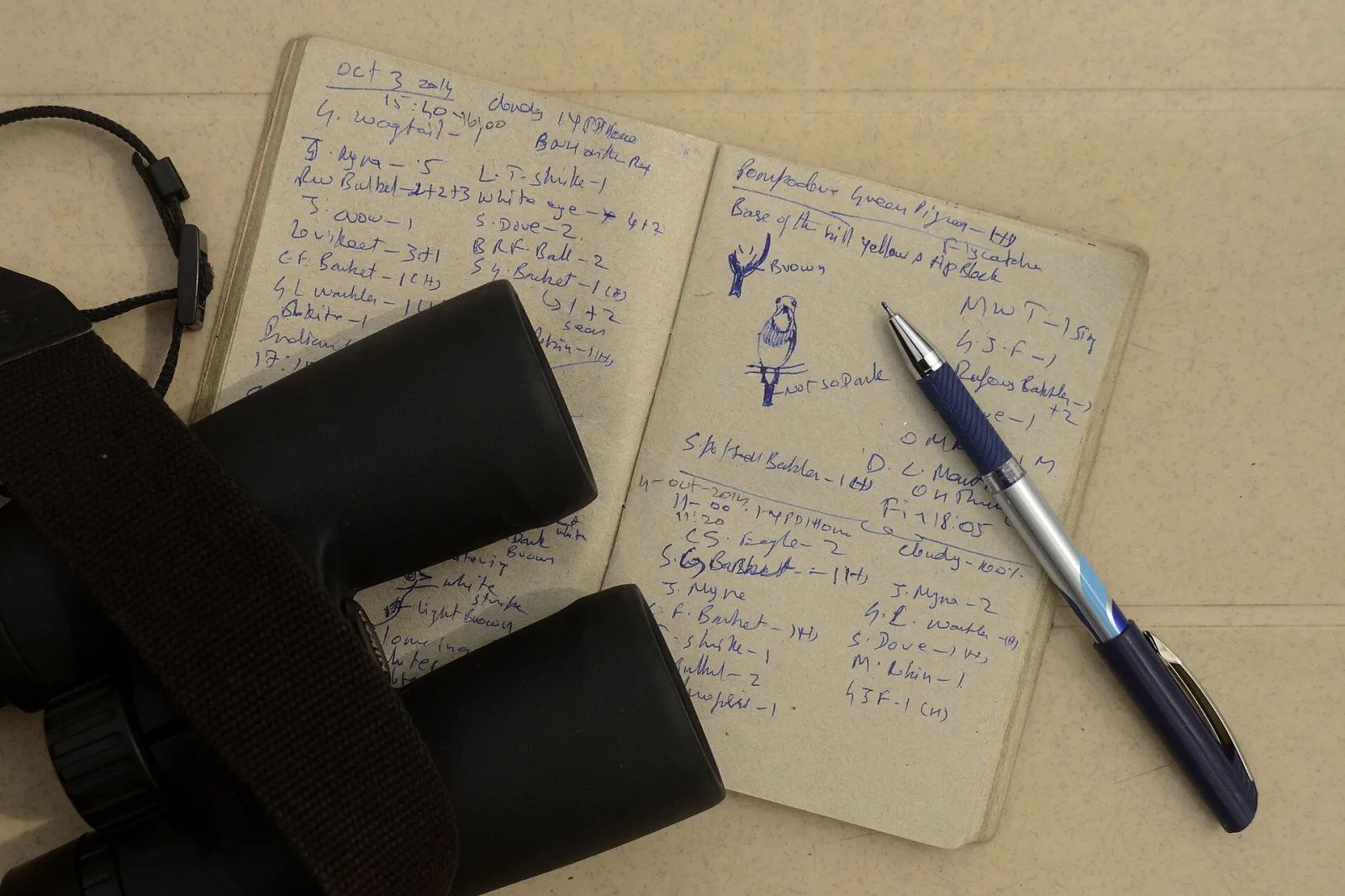
No team of professional ornithologists could simultaneously survey every backyard, urban park, wetland, and farm hedgerow across continents. Synchronized public bird counts bridge that spatial gap by mobilizing hundreds of thousands of volunteer observers during fixed calendar windows—from February's four-day Great Backyard Bird Count and Britain's January Big Garden Birdwatch to Audubon's hemisphere-wide Christmas Bird Count circles, which have run continuously since 1900. Pooled together, these individual checklists create a high-resolution continental snapshot of avian abundance. [1][2]
- Synchronized mass counts capture continental bird distributions at scales no professional team could sample alone
- Major annual events include the Great Backyard Bird Count, Big Garden Birdwatch, and Christmas Bird Count
- Every submitted checklist—even from a quiet balcony or urban courtyard—adds spatial coverage to the map
Standard methods make counts comparable
Citizen-science observations become statistically comparable across decades only when participants follow clear, standardized sampling protocols. Stationary garden counts such as the RSPB Big Garden Birdwatch ask observers to watch a single patch for exactly one hour and record the maximum number of individuals of each species visible at any single moment—preventing the same blue tit or chickadee from being tallied ten times as it shuttles to a feeder. Traveling and point counts on eBird similarly require exact start times, durations, and distances walked. [2][3]
- Recording the maximum number of individuals seen at one moment prevents double-counting birds at feeders
- Logging exact watch duration, start time, and travel distance lets analysts standardize for observer effort
- Following the protocol consistently matters far more to researchers than finding rare or unusual species
Why the data are useful
When millions of standardized checklists are combined with satellite habitat maps and weather radar, quantitative ecologists can model population trajectories, winter irruptions of boreal finches, early spring arrival shifts driven by warming temperatures, and steep losses among farmland and grassland birds. Reporting a 'complete checklist'—confirming that you listed every species you were able to identify rather than only highlights—is especially valuable because it allows statisticians to infer true species absences alongside detections. [3][4]
- Multi-year count datasets reveal long-term population declines, range shifts, and winter finch irruptions
- Submitting complete checklists of all identified species allows models to infer true absences as well as presences
- Zero-bird counts or modest lists of common species are just as scientifically informative as high-count checklists
How to take part well
Preparing for a count takes only a few minutes: choose your project, create a free account on its portal or mobile app (such as eBird), and review the field marks of the ten to twenty common species typical of your neighborhood in that season. Watch quietly for the minimum required window—usually 15 minutes for the Great Backyard Bird Count or 60 minutes for a garden watch—leave unconfirmed birds off your final tally, and attach photos or audio clips if an unexpected species appears. [4][5]
- Study the 10 to 20 most likely local species beforehand so you can separate common lookalikes quickly
- Watch for the full minimum time window—typically 15 to 60 minutes—from a stationary spot or defined route
- Leave uncertain identifications off your tally and attach photos or audio notes for any unusual sightings
Related guides
Get Fauna and identify it in the field.
Where this guide comes from
Source-checked editorial guide. Last updated . This guide teaches identification and field skills; it is not a substitute for expert verification when it matters.