How bird-song ID apps work
Sound-identification apps have opened birding to millions by naming songs in real time. Under the hood they convert audio into a spectrogram and use machine-learning models trained on labeled recordings to suggest species. Understanding that pipeline—and its limits—turns an app from a magic oracle into a genuinely useful learning and recording tool.
Last updated
Sound becomes a picture
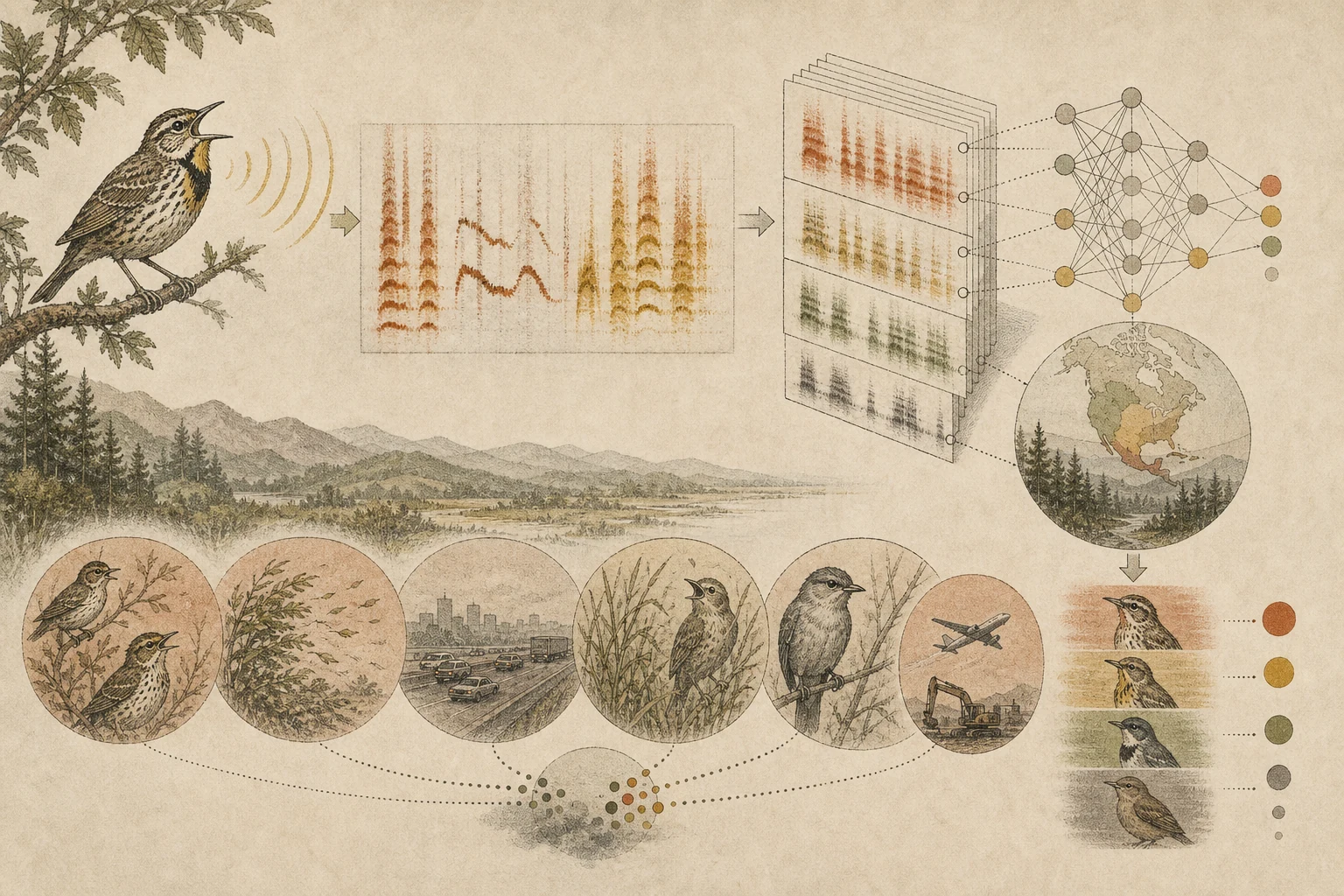
When you hold up a phone microphone in the field, a sound-identification app does not compare raw audio waveforms directly. Instead, it slices incoming sound into short time windows and runs a Fourier transform to generate a spectrogram—a two-dimensional graph plotting time on the horizontal axis, pitch (frequency in kilohertz) on the vertical axis, and loudness as brightness or color. Clear whistles appear as smooth horizontal or sloping lines, trills as rapid vertical pickets, and harsh scolds as broad vertical smears. [1][2]
- Apps convert microphone audio into a spectrogram plotting frequency against time and amplitude
- Whistles, trills, buzzes, and harmonic overtones each create distinct geometric shapes on the spectrogram
- Turning sound into a visual image allows computer-vision neural networks to classify acoustic patterns
Models trained on labeled songs
Once the spectrogram image is rendered, deep convolutional neural networks—such as those powering the Cornell Lab of Ornithology's Merlin Sound ID and BirdNET—scan the image for diagnostic visual features. These models are trained on millions of expert-labeled bird recordings archived in public bioacoustic repositories like the Macaulay Library and Xeno-canto. By training across thousands of examples per species, the classifier learns to recognize both stereotyped territorial songs and short flight or contact calls across regional dialects. [2][3]
- Convolutional neural networks treat spectrograms as images and scan them for species-specific acoustic features
- Training datasets rely on millions of labeled field recordings in the Macaulay Library and Xeno-canto
- Broad training coverage helps models recognize varied song types, call notes, and regional vocal dialects
Context narrows the guess
Acoustic similarity alone can confuse vocal lookalikes across continents, so modern apps combine acoustic scores with spatiotemporal priors derived from citizen-science databases like eBird. Using your phone's GPS coordinates and calendar date, the app filters or weights candidate species by local range and weekly occurrence frequency. A common resident warbler singing in May is prioritized over an out-of-range vagrant with a nearly identical trill—though that same geographic filter means a genuine rarity may be suppressed unless you inspect the spectrogram. [3][4]
- GPS location and calendar date filter candidate matches using local eBird range and seasonal frequency data
- Spatiotemporal weighting prevents common local singers from being misidentified as distant lookalike species
- Out-of-range vagrants or unseasonal migrants may be down-ranked by location filters and require manual review
Treat suggestions as hints
Even the best bioacoustic models are probabilistic hypotheses, not infallible proof. Vocal mimics such as northern mockingbirds, European starlings, and jay species regularly fool classifiers, as do chipmunks, treefrogs, squeaky gates, wind buffeting, and overlapping dawn choruses. Best field practice is to use the live highlight on the app's spectrogram to isolate the singer, track down the bird visually or verify the cut against reference recordings, and never log a rare species on a checklist from an unverified app flash alone. [1][4][5]
- Avian mimics like starlings, mockingbirds, and jays—as well as frogs and squirrels—can trigger false positives
- Always verify unexpected or rare sound suggestions visually or by comparing your recording to reference cuts
- Uploading clean, visually confirmed audio recordings to eBird or Xeno-canto directly improves future model training
Related guides
Get Fauna and identify it in the field.
Where this guide comes from
Source-checked editorial guide. Last updated . This guide teaches identification and field skills; it is not a substitute for expert verification when it matters.