Photographing fungi for identification
Fungal identification depends on structures that a top-down mushroom portrait conceals. Record the whole fruiting body, cap surface, underside, stem and base, substrate, nearby age stages, and field context without tasting or harvesting it.
Last updated
Begin with place and growth pattern
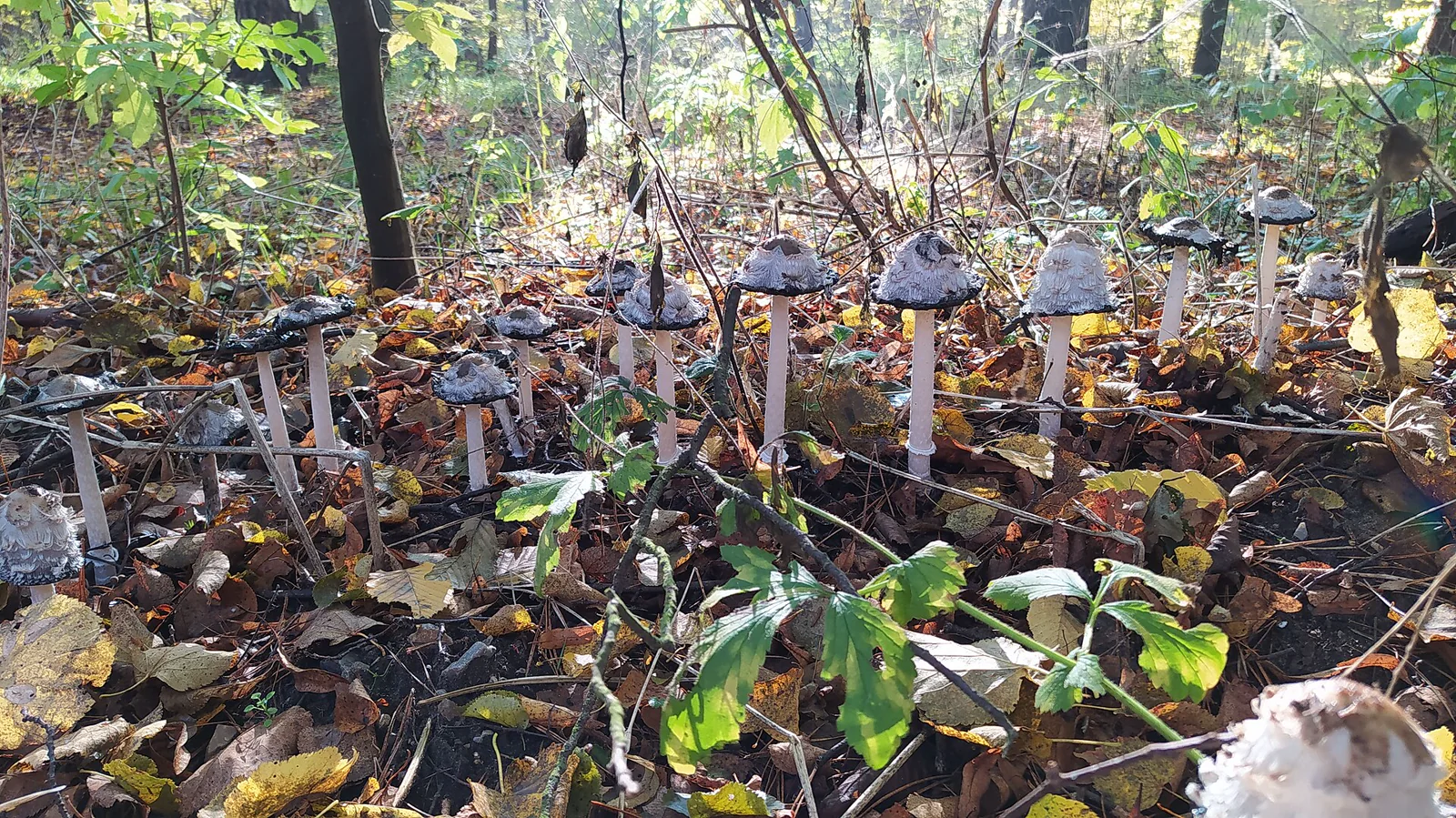
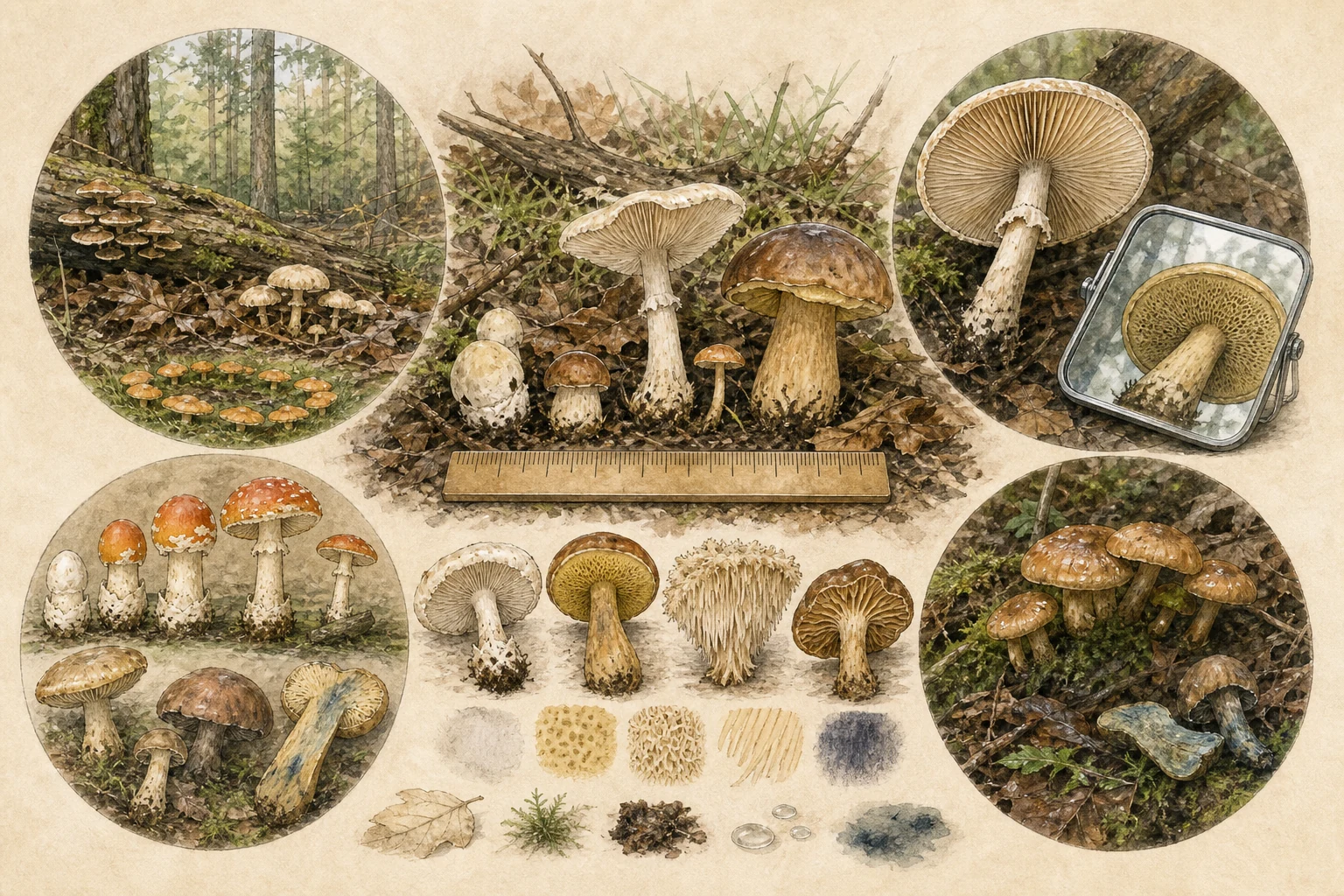
Many fungi are tied to specific partner trees or decay stages, so start by photographing the fruiting bodies undisturbed in their surroundings. Frame wide enough to show whether the mushrooms emerge singly from mossy soil, burst in dense fused clusters from a rotting hardwood stump, form overlapping brackets on standing conifer bark, or trace a fairy ring in pasture grass. Include nearby leaves, needles, cones, and bark in your habitat notes so mycologists can tell whether the forest floor holds oak, beech, birch, or pine without guessing. [1][2][5]
- Capture an undisturbed wide shot showing whether fruiting bodies grow singly, in troops, or in fused clusters.
- Document the exact substrate—mineral soil, leaf litter, dung, living bark, or decaying conifer or hardwood.
- Photograph surrounding tree bark, fallen leaves, and cones to establish potential mycorrhizal or host partners.
Reveal the underside and full stem
A top-down shot of a brown mushroom cap leaves out the most decisive macroscopic traits in mycology. Set your phone or camera directly on the ground angled upward, or slide a pocket mirror beneath the cap, to show whether the fertile underside bears blade-like gills, spongy pores, hanging spines, shallow ridges, or a smooth surface. Make sure the frame clearly shows how gills or pores meet the stem—whether they run down it (decurrent), attach squarely, or stop free of the stalk—along with any ring, cobwebby cortina, reticulated stem netting, or basal cup. [1][2][3]
- Use a ground-level camera angle or small pocket mirror to photograph gills, pores, teeth, or ridges in place.
- Show clearly how the underside structures attach to or remain free from the upper stem.
- Capture the full stem profile down to the substrate to document rings, netting, scales, or a basal volva.
Record variation and scale
Mushrooms change dramatically as they expand and weather: a young button with an inrolled margin and intact partial veil can look like a different species from a flat, rain-washed cap two days later. Whenever a colony includes several developmental stages, frame young buttons and mature fruiting bodies side by side to show how cap shape, gill color, and veil remnants evolve. Place a small ruler next to the stem for scale, and note whether natural breaks or snail bites exude milky latex, stain blue or red, or carry a distinct anise, radish, or farinaceous odor—never tasting any wild fungus. [1][2][3]
- Include both young buttons and fully expanded caps when multiple growth stages occur in the same troop.
- Place a millimeter scale beside the fruiting body and photograph in diffused natural shade to preserve true color.
- Note any natural bruising color changes, milky latex droplets, cap stickiness, or noticeable scent without tasting.
Preserve evidence, not certainty
Keep your original, uncropped photographs and avoid heavy color filters or saturation boosts that turn subtle lilac or olive gill tints into generic brown. Even with textbook photographs of the cap, gills, stem base, and host tree, hundreds of macrofungi—especially among Russula, Cortinarius, Inocybe, and crust fungi—cannot be named to species without a spore print, chemical reagents, or microscopic measurement of spores and cystidia. Submitting a well-documented observation at genus or section level is rigorous mycological practice, and no online identification or photo comparison should ever be used to judge edibility. [3][4][5]
- Avoid saturation boosts or warm color filters that distort subtle diagnostic tones on gills, caps, and stems.
- Leave the identification at genus or complex level when species separation requires microscopy or spore prints.
- Never rely on field photographs or online comments to decide whether a wild mushroom is safe to eat.
Related guides
Get Fauna and identify it in the field.
Where this guide comes from
Source-checked editorial guide. Last updated . This guide teaches identification and field skills; it is not a substitute for expert verification when it matters.