How fungi release spores
A mushroom is one kind of reproductive structure made by a larger fungus. Depending on the lineage, microscopic spores may be actively discharged, released through openings, exposed by decay or impact, carried in air or water, or moved after an animal eats a fruiting body.
Last updated
Separate the fungus from its fruiting body
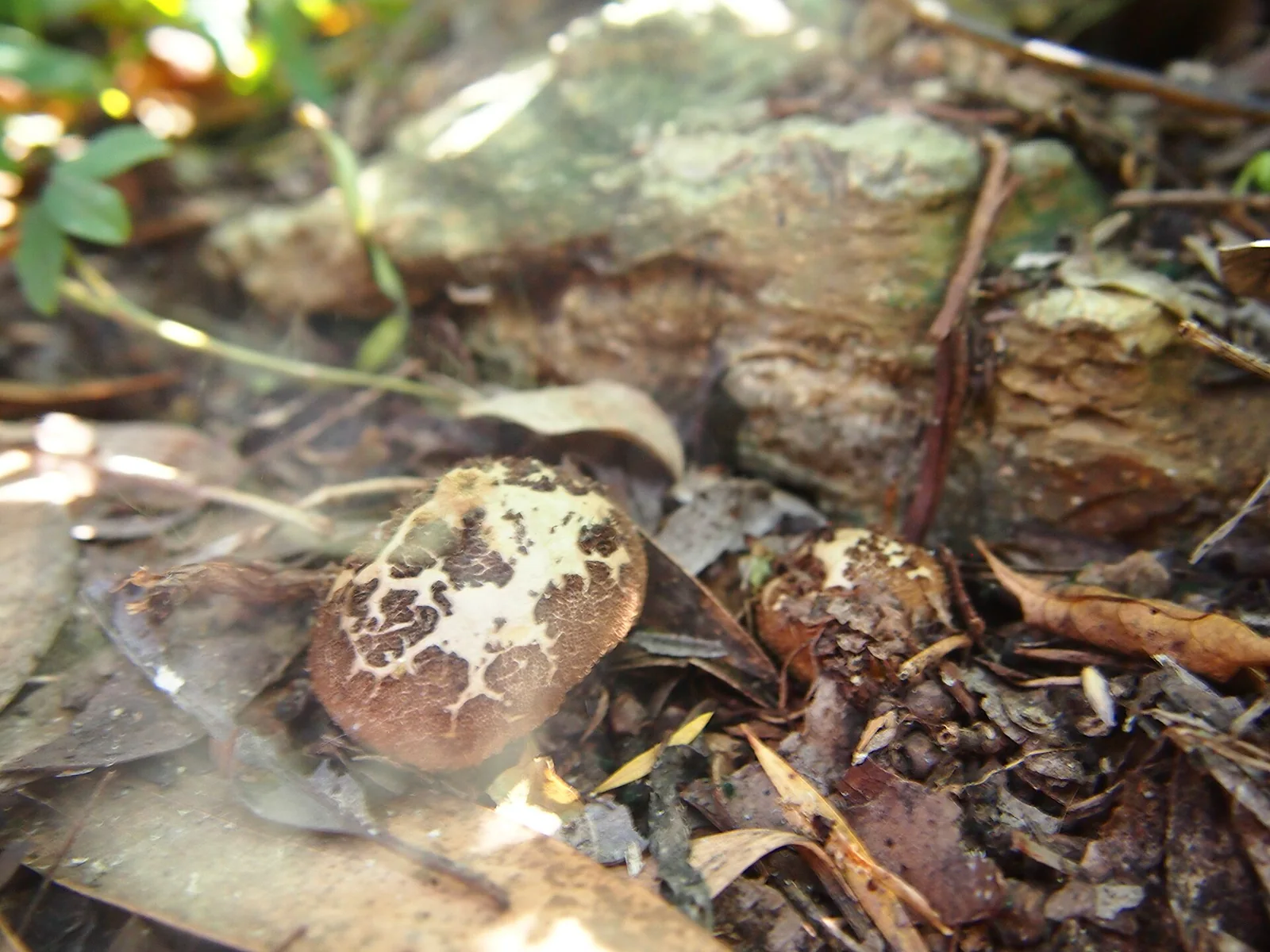
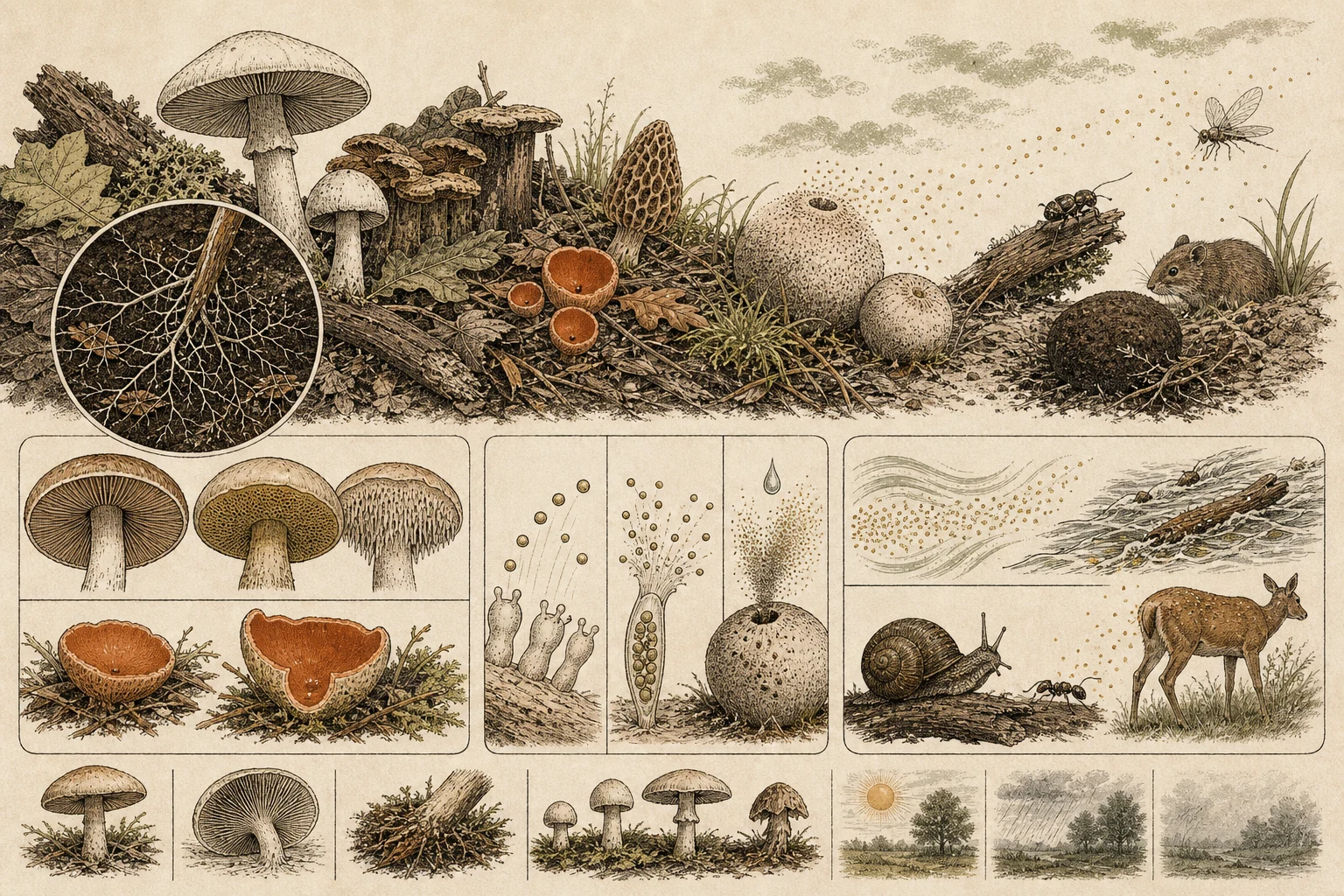
When you spot a cluster of chanterelles on a mossy bank or a bracket of turkey-tail shelving off a fallen oak log, you are looking at the temporary reproductive structure of a much larger organism. For most of the year, a filamentous fungus lives hidden inside soil, leaf litter, rotting heartwood, or partnered with living tree roots as a branching web of microscopic threads called hyphae, which together form the mycelium. A mushroom is comparable to an apple on an orchard tree—built when temperature and moisture align to produce and disperse spores—so seeing or removing a single cap neither reveals nor removes the full underground mycelium. [2][3][5]
- The visible mushroom is a temporary spore-bearing fruiting body; the main fungal body (mycelium) lives inside soil, litter, or wood.
- Absence of visible mushrooms during dry weather does not mean a mycorrhizal or wood-decay fungus is absent from the site.
- Field check: note the exact substrate—living roots, conifer duff, or dead hardwood—because the hidden mycelium feeds there.
Find the spore-bearing surface
To understand how a fungus releases its spores, inspect where the fertile spore-producing layer (the hymenium) is arranged on the fruiting body. In gilled mushrooms like agarics and chanterelles, the fertile layer coats radiating blades or forked folds beneath the cap; in boletes and polypores like turkey-tail, it lines thousands of vertical microscopic tubes that open downward as tiny pores; in tooth fungi, it covers hanging spines; and in cup fungi and morels, it lines the exposed upper bowl or pitted surface. Each architecture packs an enormous fertile surface area into a compact structure while keeping the spore-launch zone sheltered or oriented toward air currents. [1][2][5]
- Field check: use a small pocket mirror or low camera angle to check whether the underside has gills, pores, teeth, or a smooth surface.
- Gills, tubes, and spines multiply the surface area available to mature millions of microscopic spores under a single cap.
- Cup fungi and earthstars orient their fertile surfaces upward so rising eddies or raindrops launch spores into the air.
Release can be active or assisted
Fungal spores do not simply fall out of a mushroom by gravity alone; different lineages employ remarkable physical mechanisms to launch or puff them into moving air. In gilled and pored basidiomycetes, microscopic surface-tension droplets fuse on the spore base and catapult each ballistospore horizontally across the narrow air space between gills or inside a tube before gravity lets it drift down into the breeze below the cap. Cup fungi (ascomycetes) build turgor pressure inside microscopic sacs that fire spores upward in synchronized puffs, whereas mature puffballs and earthstars act as bellows that jet dry spore clouds through an apical pore when struck by raindrops. [1][4][5]
- Gilled and pored mushrooms catapult spores a fraction of a millimeter horizontally before they drop clear of the cap into air currents.
- Cup fungi often release visible, smoke-like clouds of spores from pressurized microscopic sacs when warmed by a sunbeam or draft.
- Puffballs rely on external impacts—such as falling raindrops or passing feet—to compress the flexible wall and puff spores out.
Follow dispersal without tasting or squeezing
Once spores clear the fruiting body, wind is only one of several transport pathways. Rain splash and forest runoff move many wood- and litter-inhabiting spores, carrion flies and beetles track foul-smelling stinkhorn slime coated with spores, and forest mammals—such as flying squirrels, voles, and wild pigs—dig up aromatic underground truffles and false truffles, dispersing viable spores in their droppings across the forest floor. In the field, you can document natural spore deposit by looking for white, rusty, or purple spore dust on leaves or overlapping caps directly beneath a mature mushroom, without ever squeezing puffballs, uprooting specimens, or tasting unknown fungi. [2][3][4]
- Field check: look on lower overlapping bracket caps, spiderwebs, or fallen leaves right below a mushroom for a natural spore print.
- Stinkhorns recruit flies with carrion odors, while underground truffles rely on small mammals to excavate and disperse their spores.
- Leave puffballs and fruiting bodies intact rather than stomping or squeezing them, and never taste wild fungi for identification.
Related guides
Get Fauna and identify it in the field.
Where this guide comes from
Source-checked editorial guide. Last updated . This guide teaches identification and field skills; it is not a substitute for expert verification when it matters.
- Australian National Botanic Gardens — Fungi ↗
- U.S. Forest Service — Ecology and management of commercial mushrooms ↗
- Smithsonian Gardens — Life underground and mushroom reproduction ↗
- PloS one — Adaptation of the spore discharge mechanism in the basidiomycota ↗
- U.S. Forest Service — Mushrooms of the National Forests in Alaska ↗