Owl pellets and prey sign
Pellets are compact regurgitated remains, not droppings, and many birds cast them. Their location, texture, dimensions, and visible prey material can support a cautious reading, but one pellet is not a complete diet survey.
Last updated
Recognize a pellet without calling it owl sign yet
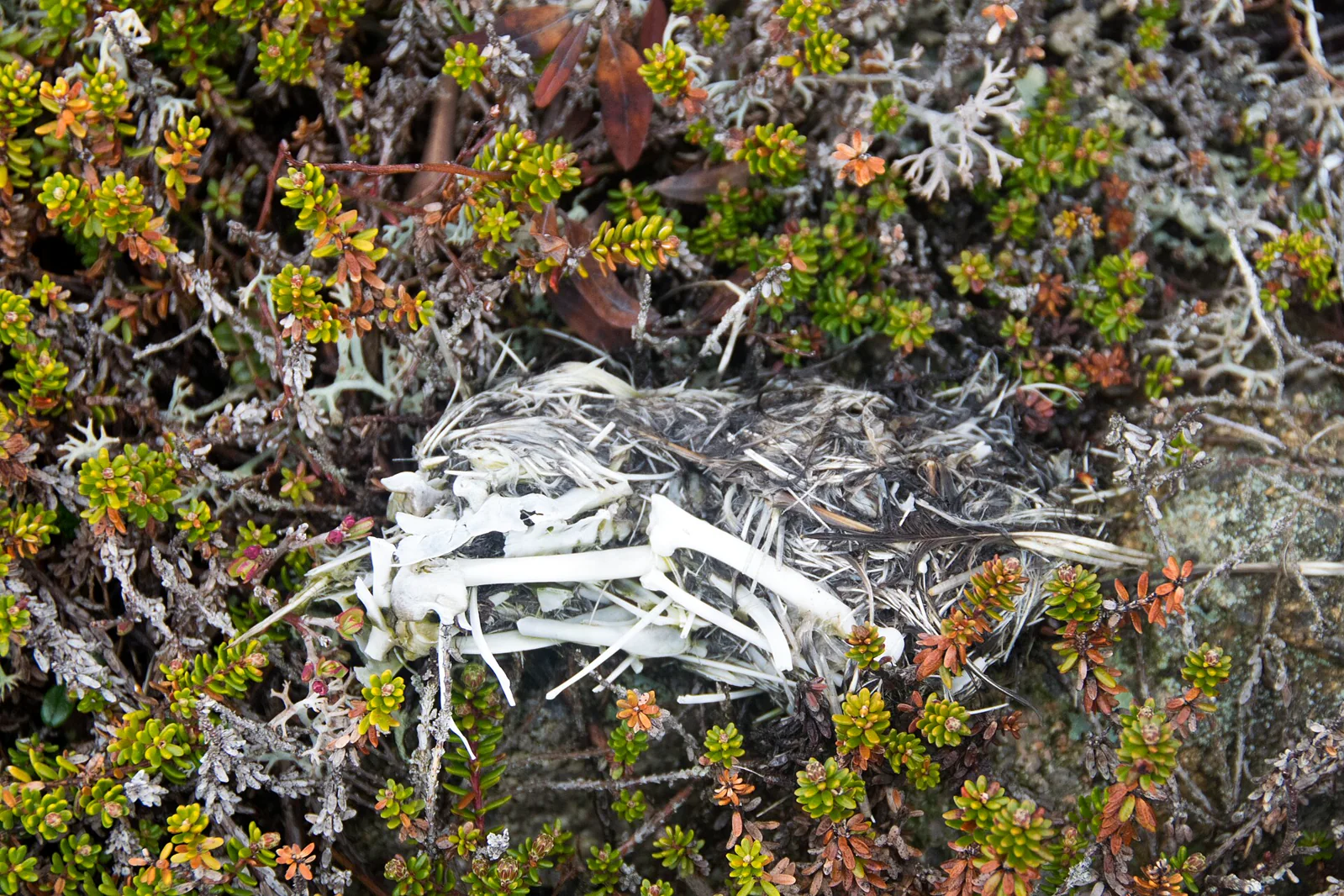
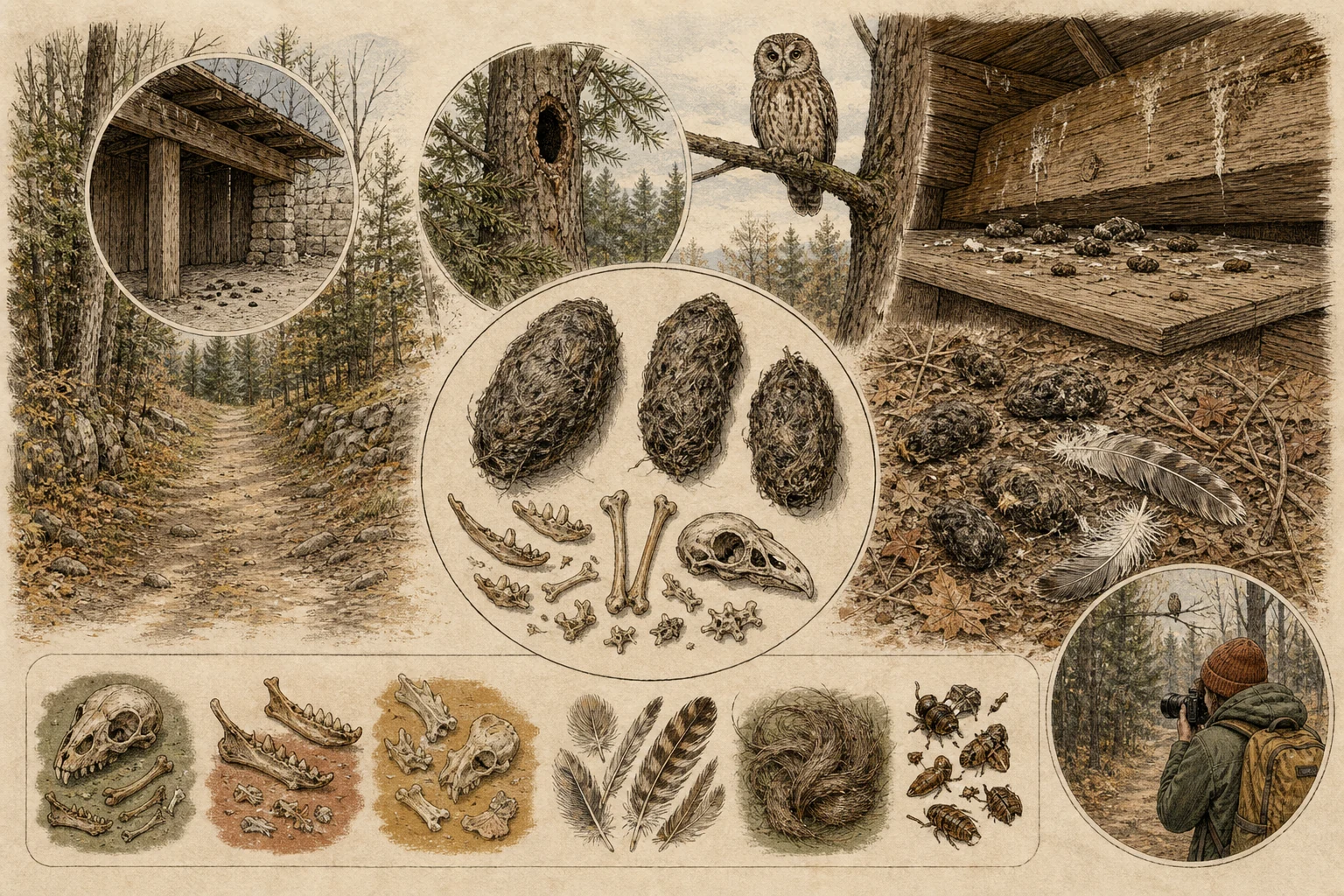
A bird pellet consists of indigestible prey material regurgitated from the muscular gizzard after soft tissues are digested, commonly compacted into a gray or brown oval or cylindrical mass. Because owls have weakly acidic stomach secretions compared with diurnal raptors, their pellets typically hold felted fur wrapped around intact small-mammal skulls, mandibles, and limb bones. However, hawks, falcons, herons, gulls, kingfishers, and corvids also cast pellets of fur, feathers, scales, or chitin, while carnivore scats are excreted droppings—so never classify a dark compact object from outline alone. [1][3][4]
- Photograph the whole object and any naturally exposed contents.
- Record length and width with a scale beside it, without touching it.
- Keep “bird pellet” as the working label until the evidence narrows.
Use the setting as evidence
An accumulation of pellets of varying freshness beneath a sheltered barn beam, dense conifer trunk, cliff ledge, or cavity tree provides far stronger ecological context than a single weathered bolus on an open trail. Pause well back from the trunk and scan upward with binoculars for a likely daytime perch, chalky whitewash splashes on bark and needles, or molted feathers on the ground. Do not enter closed structures, climb toward cavities, or push into dense winter roost cover to confirm an owl; flushing a daytime roosting bird exposes it to stress and mobbing corvids. [2][4]
- Note whether the pellets appear scattered, accumulated, or displaced by water.
- Record the substrate and exposure to rain or trampling.
- Obey property access, closure, and protected-site rules.
Read visible prey remains with limits
Curved rodent incisors, cheek-tooth rows, shrew mandibles, bird feathers, and beetle exoskeletons can indicate broad prey groups when examined in sterilized educational material or when naturally weathered on the ground. Still, a single wild pellet inspected in place offers only partial clues. Even formal scientific pellet analyses carry taphonomic biases: a U.S. Geological Survey study of a Great Horned Owl pellet documented avian prey represented by feathers that would have been missed or undercounted from skeletal elements alone, demonstrating why one material type never captures a complete diet. [1][3][5]
- Do not pull apart a wild pellet to expose its contents.
- Distinguish “material visible” from a verified prey identification.
- Avoid converting one pellet's contents into a percentage of the bird's diet.
Leave natural pellets and roosts undisturbed
Careful field natural history does not require collecting specimens or dissecting wild pellets barehanded. Photograph the sign in place, record general habitat notes without publishing exact coordinates of sensitive owl roosts, and step away quietly if a perched bird sleeks its feathers, swivels its head to stare, or vocalizes repeatedly. Classroom dissection guides rely on commercially heat-sterilized pellets and laboratory hygiene controls; wild pellets can harbor Salmonella and other pathogens and may contain protected avian feathers, making hands-off visual documentation the safest standard outdoors. [1][2][3]
- Never use playback or bait to confirm the bird at a pellet site.
- Do not remove pellets, bones, feathers, or other parts from the site.
- Check local land-manager guidance if a roost or mortality event seems unusual.
Related guides
Get Fauna and identify it in the field.
Where this guide comes from
Source-checked editorial guide. Last updated . This guide teaches identification and field skills; it is not a substitute for expert verification when it matters.