Feathers as field sign
A feather can narrow a bird group through size, shape, vane symmetry, pattern, and location, but a single worn feather often cannot support a species identification. Photograph it where it lies and leave it there.
Last updated
Document before you compare
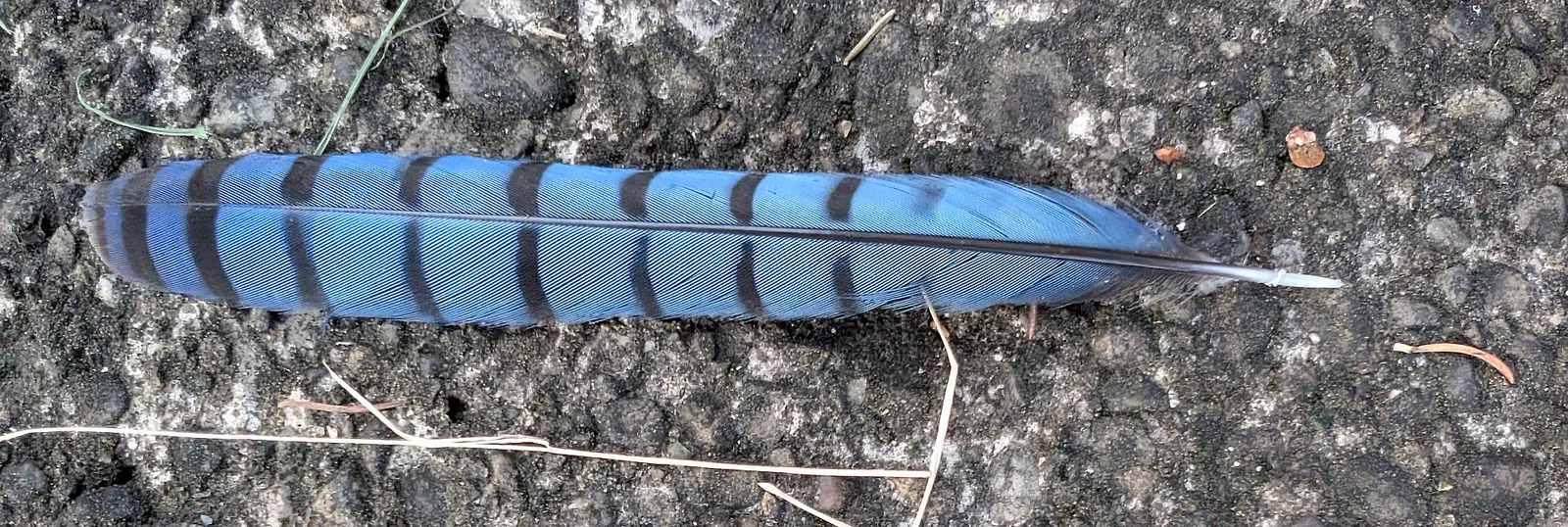
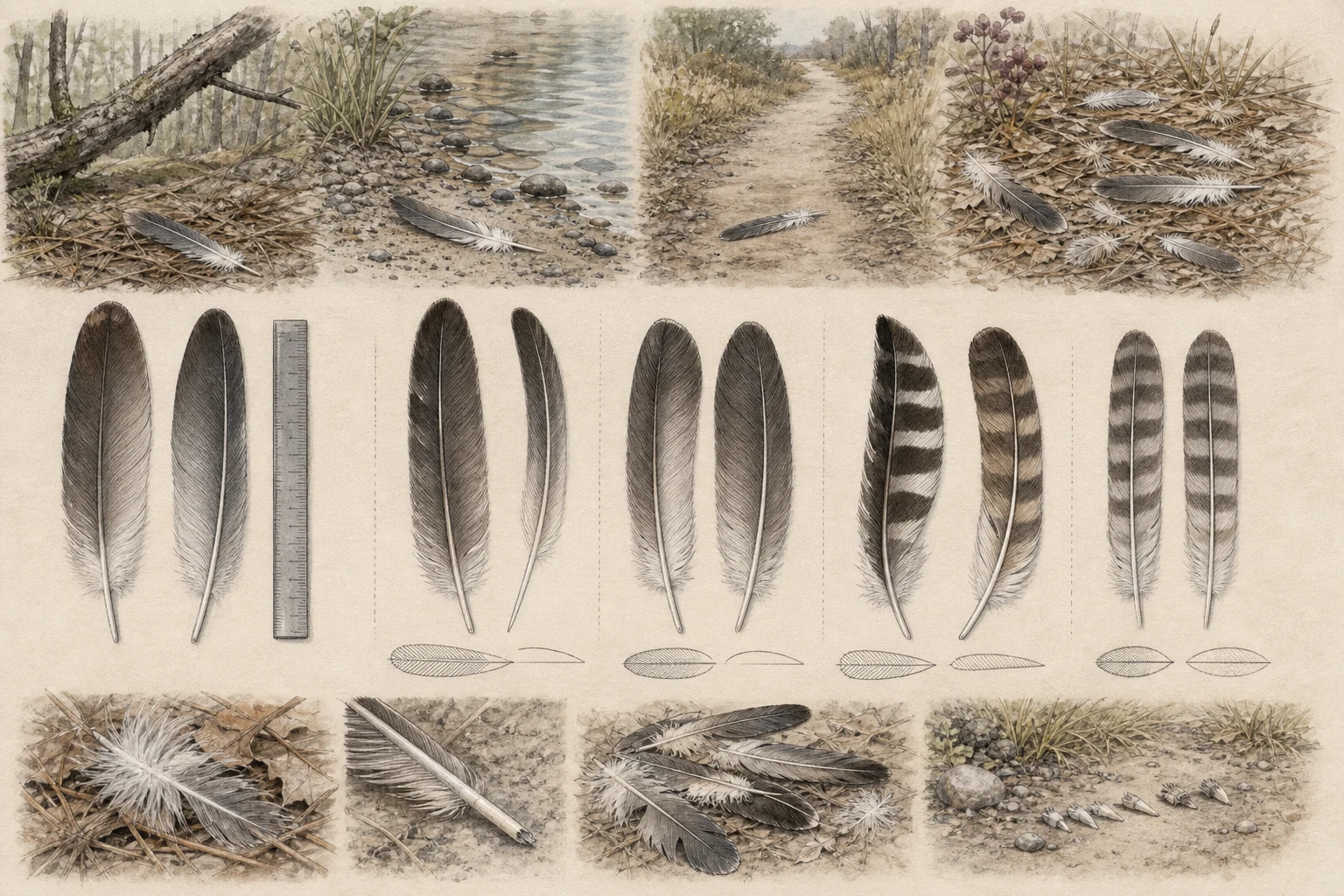
Take an overall context photograph first showing whether the feather lies below a snag perch, beside a wetland margin, across a woodland path, or scattered among a plucking cluster of other feathers. Next, photograph its upper and lower surfaces straight on from directly overhead with a ruler or millimeter scale placed beside—not pressed onto—the vane. Structural blues on jays and iridescent greens on dabbling ducks shift dramatically with viewing angle and camera white balance, while a missing tip or worn edge can alter the apparent outline and length, so retain your original files and field notes. [1][2][5]
- Record total length without straightening or lifting the feather.
- Include date, location, habitat, and the number of nearby feathers.
- Do not assume nearby feathers all came from one bird or one event.
Decide what kind of feather it resembles
Primary wing feathers are built as stiff, curved airfoils and usually have pointed tips, long quills, and strongly unequal vanes with a narrow leading edge and wider trailing edge; secondaries along the forearm have rounder tips and slightly unequal vanes. Outer tail rectrices can also be strongly asymmetrical, whereas central tail feathers are nearly symmetrical around a straight shaft. Small body contour feathers and fluffy down feathers lack the diagnostic geometry of wing and tail feathers and are far less completely represented in the Feather Atlas, so an inconclusive search never proves a species is absent. [1][3][4]
- Compare the shaft's curve and the relative width of each vane.
- Treat a very fluffy feather as a different search problem from a stiff flight feather.
- Choose “unknown position” when wear or breakage hides the useful shape.
Match several features at once
Combine measured millimeter length, dominant color, barring or spotting geometry, pale tip edging, feather position, and the local seasonal bird list rather than relying on a single striking hue. The U.S. Fish and Wildlife Service Feather Atlas search returns visually similar curated flight-feather scans, not a guaranteed species identification. Age, sex, molt stage, mud staining, mechanical abrasion, and harsh midday light can all complicate a match across hawks, owls, grouse, and woodpeckers, so compare multiple reference scans side by side and keep a shortlist whenever diagnostic features conflict. [1][2][3][5]
- Begin with shape and pattern before relying on a memorable color.
- Check whether candidate species occur in that place and season.
- Label an identification tentative unless the diagnostic features agree.
Interpret the scene conservatively
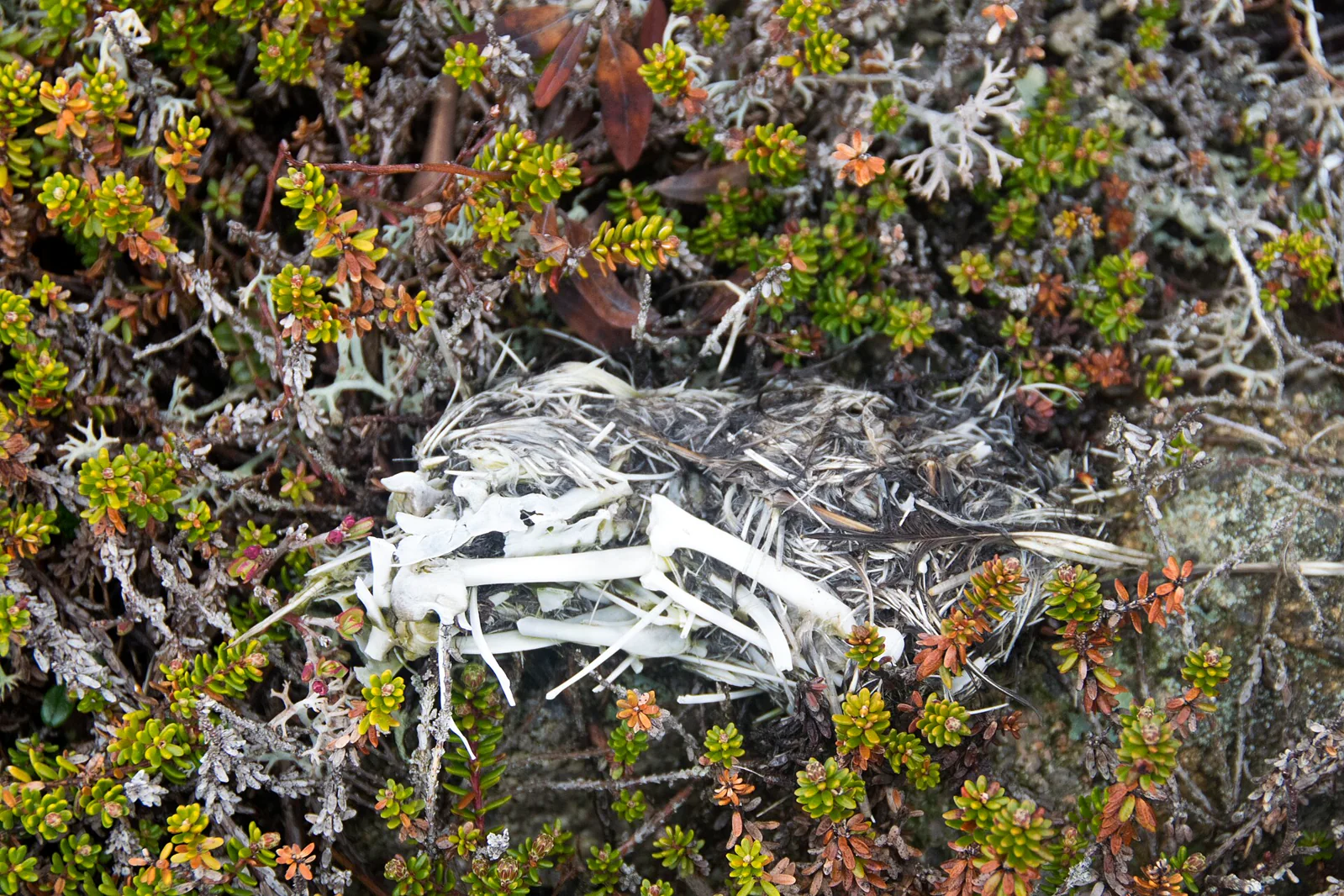
A single loose feather on a forest trail may have been dropped during normal symmetrical molt, blown from a canopy preening perch by wind, or carried away by a scavenging mammal or nesting songbird. While a compact plucking scatter or sheared shafts can raise questions about a predator encounter, feather arrangement alone rarely reconstructs whether an animal was killed or scavenged. In the United States, the Migratory Bird Treaty Act also governs field practice: leave native-bird feathers and parts in place unless a current federal and state permit or specific statutory exception applies. [1][4][5]
- Do not move feathers into a more photogenic arrangement.
- Check current federal, state, tribal, and site rules rather than assuming collection is allowed.
- Report unusual mortality clusters to the appropriate land or wildlife authority.
Related guides
Get Fauna and identify it in the field.
Where this guide comes from
Source-checked editorial guide. Last updated . This guide teaches identification and field skills; it is not a substitute for expert verification when it matters.
- U.S. Fish & Wildlife Service Forensics Laboratory — The Feather Atlas ↗
- U.S. Fish & Wildlife Service — Feather Atlas identification tool ↗
- U.S. Fish & Wildlife Service — Identifying feather position ↗
- U.S. Fish & Wildlife Service — Feathers and the law ↗
- Cornell Lab Bird Academy — Everything You Need to Know About Feathers ↗