Mimicry in the field
Mimicry is more than two organisms looking alike to people. A useful explanation identifies a model, a mimic, and a receiver whose behavior is changed by the resemblance, then asks whether the signal is deceptive, shared, or serving another function.
Last updated
Name the three roles
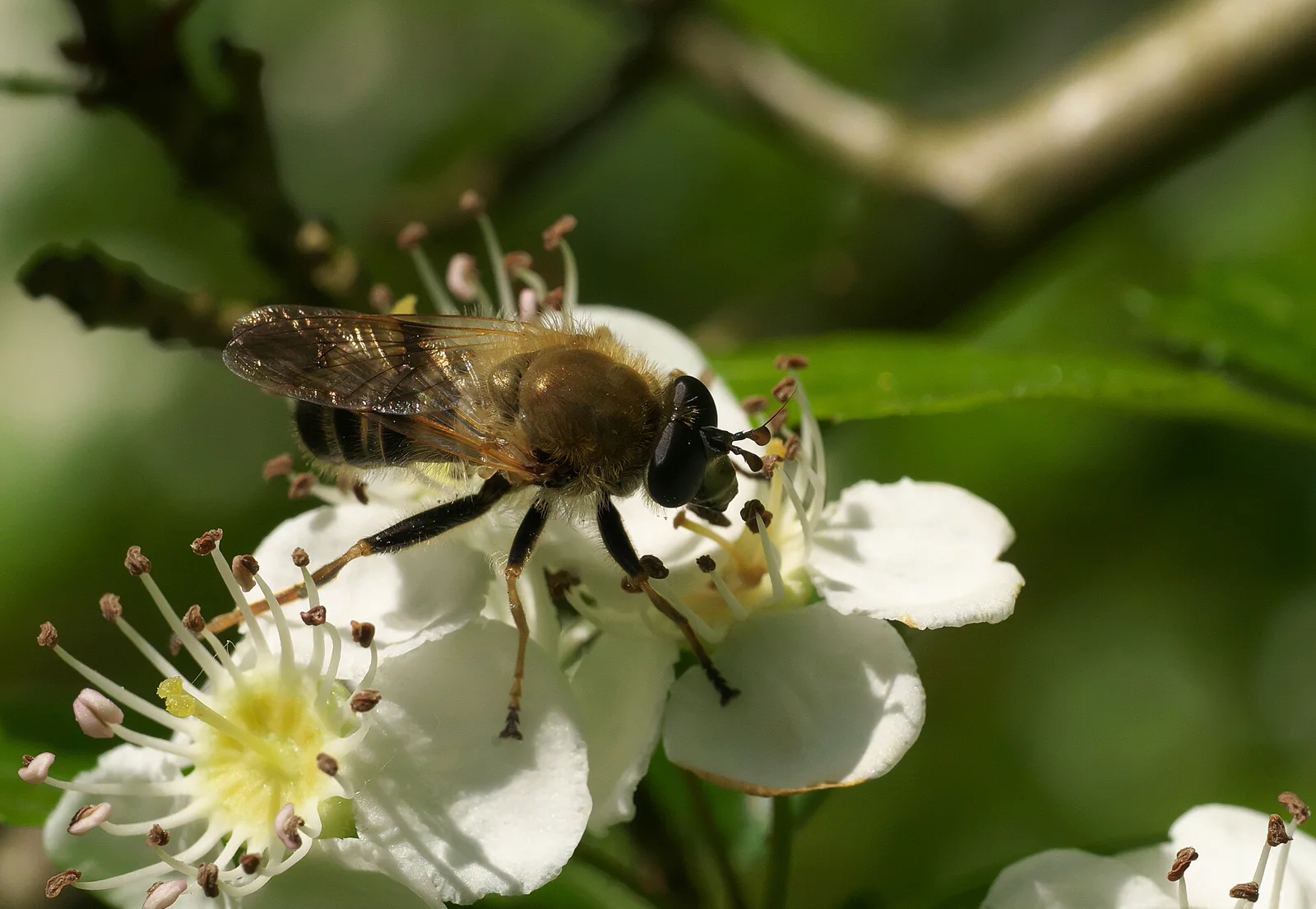
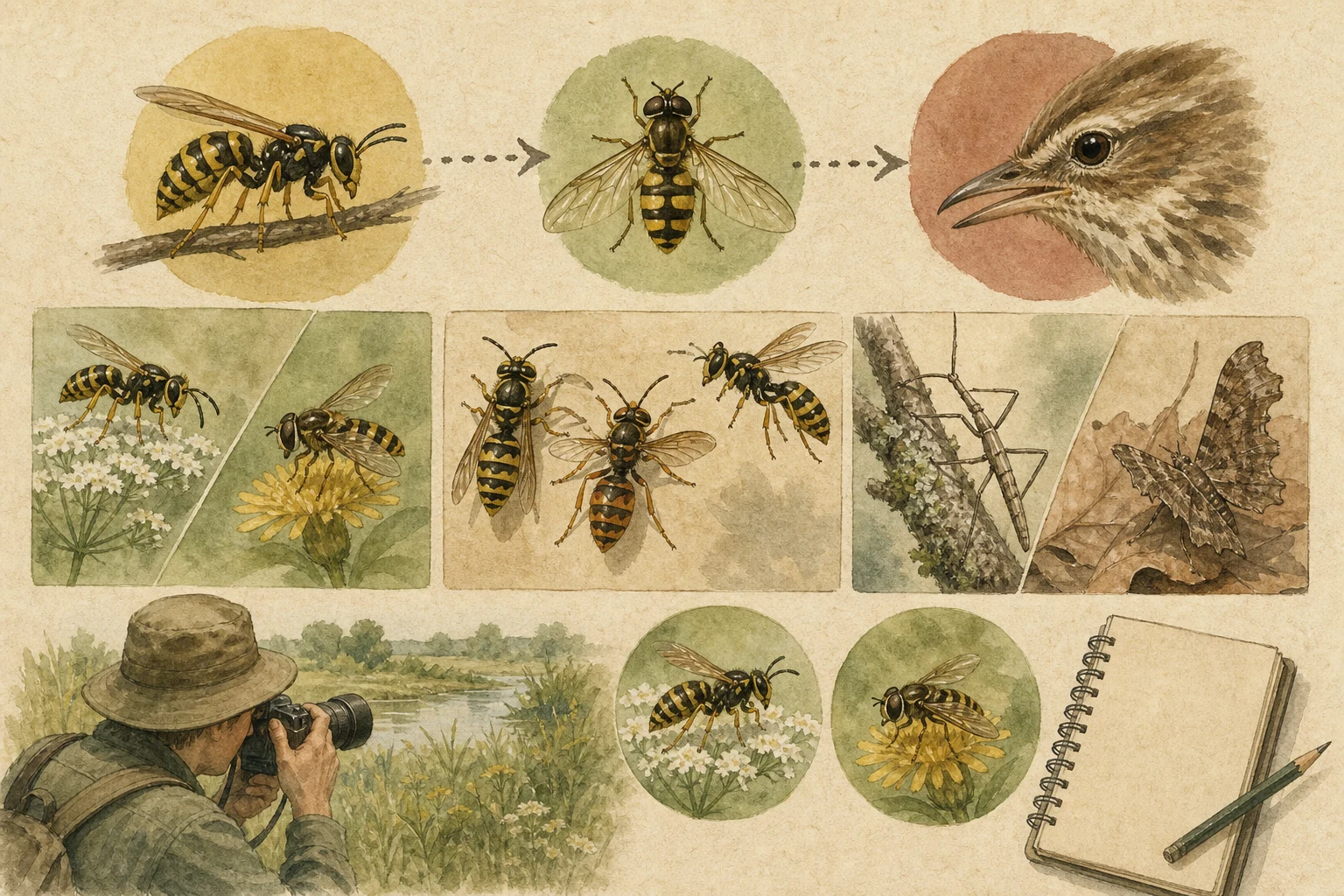
Evolutionary mimicry is not simply two species that look similar in a field guide; it is a three-party ecological interaction involving a model, a mimic, and a signal receiver. The model displays a trait—such as a warning pattern, flight style, sound, or chemical cue—that influences the receiver's behavior, and the mimic gains a selective advantage because the receiver mistakes it for, or groups it with, the model. Because natural selection acts through the sensory system of the receiver (often a hunting bird, spider, or lizard), a mimic only needs to match the features that the receiver actually attends to during a brief field encounter. [1][3]
- Every mimicry hypothesis specifies three actors: the model, the mimic, and the receiver whose behavior is altered.
- Behavioral mimicry—such as a hoverfly holding dark front legs forward like wasp antennae—often reinforces a rough color match.
- Common trap: assuming imperfect mimics are 'poor adaptations' when their resemblance is already sufficient to deter a fast-moving predator.
Separate deceptive and shared warnings
Protective mimicry falls along a spectrum anchored by two classic forms. In Batesian mimicry, a palatable or harmless mimic—such as a flower-visiting syrphid hoverfly or clearwing moth—copies the warning signal of a stinging bee or wasp, parasitizing the predator avoidance that the defended model maintains. In Müllerian mimicry, two or more genuinely unpalatable or venomous species—such as distasteful Heliconius butterflies or co-occurring bumble bee species—converge on a shared warning pattern, splitting the mortality cost of educating local predators. Because palatability varies with diet and predator species, wild pairs like monarchs and viceroys can sit along a continuum between these two poles. [1][2][4][5]
- Batesian mimicry is deceptive: an undefended organism borrows the warning signal of a defended model.
- Müllerian mimicry is mutually beneficial: multiple defended species share one warning badge so predators learn it faster.
- Field check: look at wing venation, antennae, and eye shape to separate harmless bee-mimic flies (two wings, stubby antennae) from true bees.
Do not confuse resemblance functions
Not every striking look-alike in nature is an example of protective Batesian or Müllerian mimicry. When a caterpillar, katydid, or stick insect resembles an inanimate twig, thorn, or bird dropping that sends no signal of its own, biologists classify the strategy as masquerade (a form of camouflage) rather than true mimicry. Elsewhere, aggressive mimics—such as certain anglerfishes, bolas spiders, or predatory fireflies—imitate a harmless model or a mate lure to draw prey within striking reach. Shared ancestry and convergent adaptation to the same microhabitat can also produce look-alike species without any deceptive signaling at all. [1][3][5]
- Resembling an inanimate object (a twig, stone, or dead leaf) is masquerade, whereas mimicry copies another signaling organism.
- Aggressive mimicry turns resemblance into a hunting tool, luring prey or hosts closer instead of deterring predators.
- Closely related species often look alike simply through shared ancestry rather than selection for mimicry.
Build a field case carefully
When you spot an apparent mimic and model visiting the same goldenrod patch or woodland edge, document both organisms hands-off so their natural posture and behavior stay intact. Photograph dorsal and lateral views that capture diagnostic taxonomic characters—such as Diptera haltere knobs versus Hymenoptera hindwings—and record the date, location, habitat, relative abundance of each species, and any behavioral traits like wing-flicking or abdomen-curling. Afterward, use regional keys to confirm both species' identities and check published literature before claiming whether the pair represents Batesian mimicry, Müllerian co-mimicry, or incidental similarity. [1][2][4]
- Field check: log whether the putative model and mimic actually overlap at the same site, season, and microhabitat.
- Capture clear anatomical photos (antennae, eyes, wing count, leg shape) alongside notes on how the animal moved in life.
- Never handle a suspected mimic to test whether it stings—treat every wasp-, bee-, or coral-snake-patterned animal with hands-off caution.
Related guides
Get Fauna and identify it in the field.
Where this guide comes from
Source-checked editorial guide. Last updated . This guide teaches identification and field skills; it is not a substitute for expert verification when it matters.
- Proceedings. Biological sciences — Signals, cues and the nature of mimicry ↗
- Nature Education — Predation, herbivory, and parasitism ↗
- Natural History Museum — Can you spot the hidden animals that use cunning camouflage? ↗
- Nature — Selection overrides gene flow in mimicry ↗
- Die Naturwissenschaften — The evolution of Müllerian mimicry ↗