How sea turtles navigate
Sea turtles extract directional and positional information from geographic patterns in Earth's magnetic field, then combine those cues with experience and other senses to travel between widely separated habitats.
Last updated
Treat Earth's field as a compass
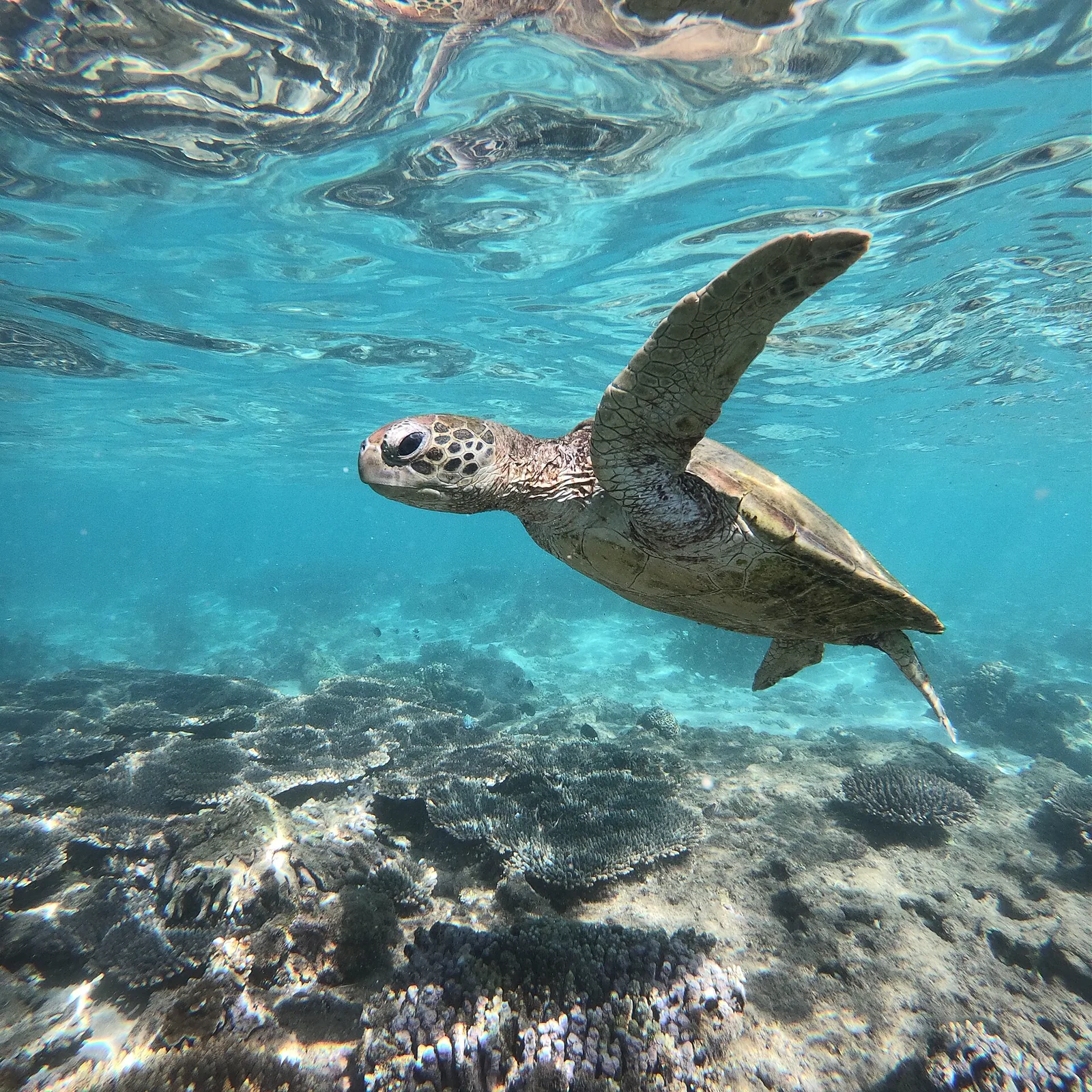
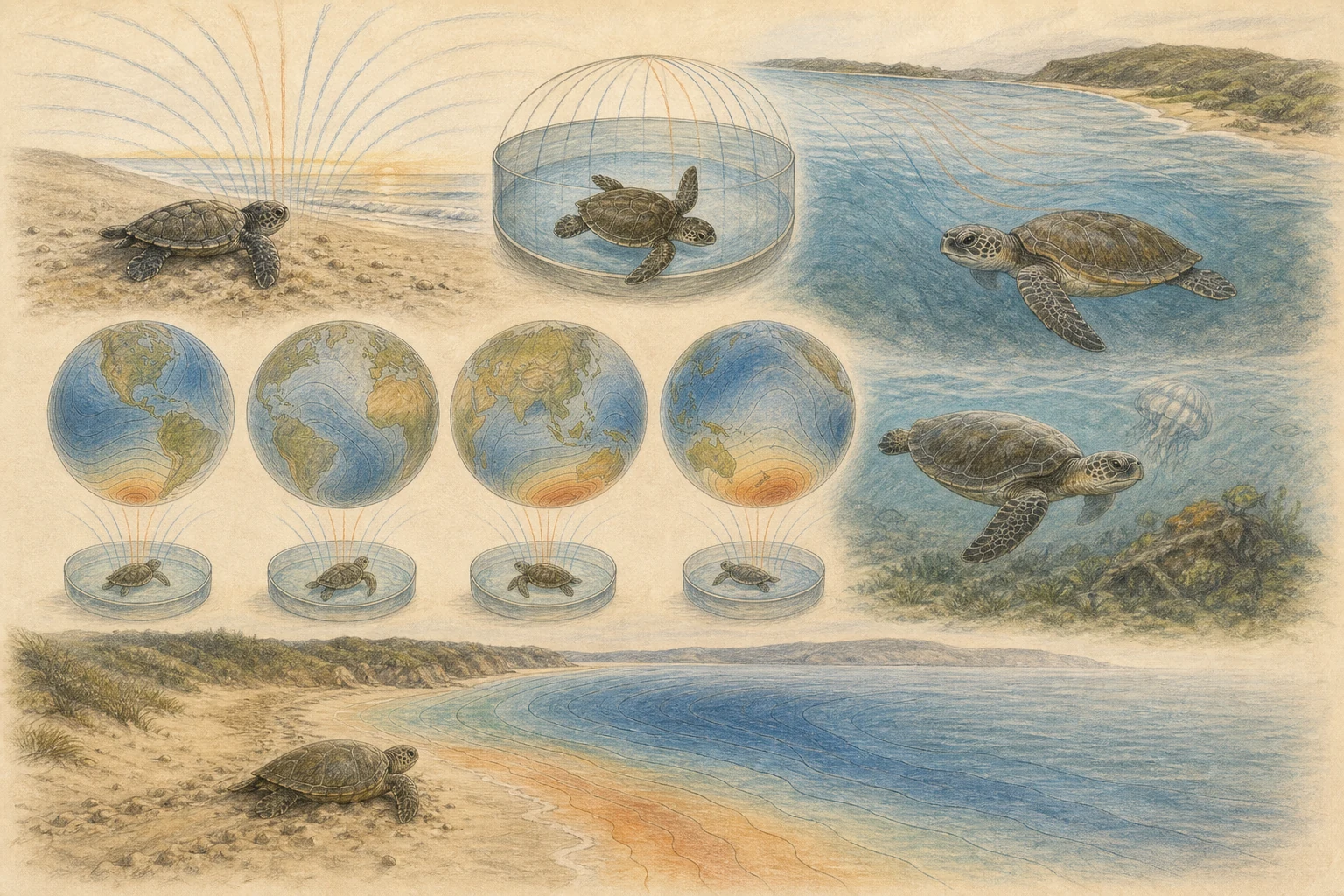
A compass tells a swimmer which way to head without revealing where it is on the globe, and newly emerged sea turtles rely on a sequential hierarchy of directional cues from their first minutes on land. On a dark nesting beach, loggerhead (Caretta caretta) and green turtle (Chelonia mydas) hatchlings crawl toward the lower, brighter marine horizon, then orient into oncoming surface waves as they enter the surf zone. As they swim into deeper offshore water beyond coastal wave refraction, their magnetic inclination compass takes over to maintain a steady bearing through open water lacking visual landmarks. [2][3]
- Beach crawls rely on horizon brightness and slope before wave surge guides hatchlings through the surf zone
- A geomagnetic inclination compass maintains directional headings once hatchlings reach deep water
- Artificial beachfront lighting disrupts the initial visual step before magnetic orientation begins
Read a coarse magnetic map
Beyond a simple directional compass, Earth's magnetic field varies predictably across ocean basins in two measurable properties: total field intensity (overall strength) and inclination angle (how steeply magnetic field lines dip toward the planet's surface). In coil-enclosed laboratory arenas that reproduce the exact magnetic signatures of distant Atlantic sites, hatchling loggerheads adopt the specific swimming headings needed to stay inside the warm North Atlantic Subtropical Gyre and avoid fatal cold currents. Brief magnetic-pulse experiments disrupt this positional map response while leaving directional compass orientation intact, indicating that map and compass rely on distinct sensory processes. [2][3][4]
- Magnetic intensity and inclination angle form a two-variable geographic gradient across many ocean regions
- Simulated regional fields cause naive loggerhead hatchlings to steer headings that keep them within warm gyre currents
- Strong magnetic pulses impair positional map orientation without abolishing basic compass headings
Combine inheritance with learning
Whereas hatchlings enter the ocean with an inherited magnetic program tuned to broad current boundaries, juvenile and adult sea turtles refine their oceanic navigation through direct experience. Conditioning experiments with young loggerheads show that turtles can learn to recognize the magnetic signature of a specific geographic region where food was provided, responding with anticipatory foraging behavior—their characteristic 'turtle dance' of surface tilting, head lifting, and flipper paddling—when exposed to that field months later. Even in those learned-map trials, strong magnetic pulses did not erase the conditioned response, pointing to two separate magnetoreceptive mechanisms for map and compass senses. [1][3]
- Hatchlings rely on inherited responses to regional fields during their first transoceanic circuit
- Juvenile loggerheads can learn and remember the magnetic signatures of productive foraging grounds
- Experimental evidence indicates separate physiological pathways for the magnetic map and magnetic compass
Return with more than one cue
Adult females returning after decades at sea often nest along the same coastal region where they hatched, a pattern explained by geomagnetic imprinting on the natal coast's inclination and intensity contours. Because Earth's magnetic field shifts slowly over decades through secular variation, natal-beach coastlines trace predictable magnetic isolines that guide a returning migrant into the right general area rather than to a single meter of sand. Once near shore, waterborne chemical odors, wind-driven plumes, coastal currents, and seabed topography help the turtle complete its final approach, even as the exact cellular magnetoreceptor remains under investigation. [1][2][4]
- Geomagnetic imprinting guides adults back to the magnetic isolines intersecting their natal coastline
- Slow secular drift in Earth's magnetic field can shift nesting distributions slightly along a coast over decades
- Waterborne odors, wave direction, and local bathymetry refine navigation during the final coastal approach
Related guides
Get Fauna and identify it in the field.
Where this guide comes from
Source-checked editorial guide. Last updated . This guide teaches identification and field skills; it is not a substitute for expert verification when it matters.
- Nature — Learned magnetic map cues and two mechanisms of magnetoreception in turtles ↗
- Proceedings of the National Academy of Sciences of the United States of America — Geomagnetic imprinting: A unifying hypothesis of long-distance natal homing in salmon and sea turtles ↗
- Journal of comparative physiology. A, Neuroethology, sensory, neural, and behavioral physiology — Magnetic maps in animal navigation ↗
- The Journal of experimental biology — Disruption of the sea turtle magnetic map sense by a magnetic pulse ↗