Why salamanders regrow limbs
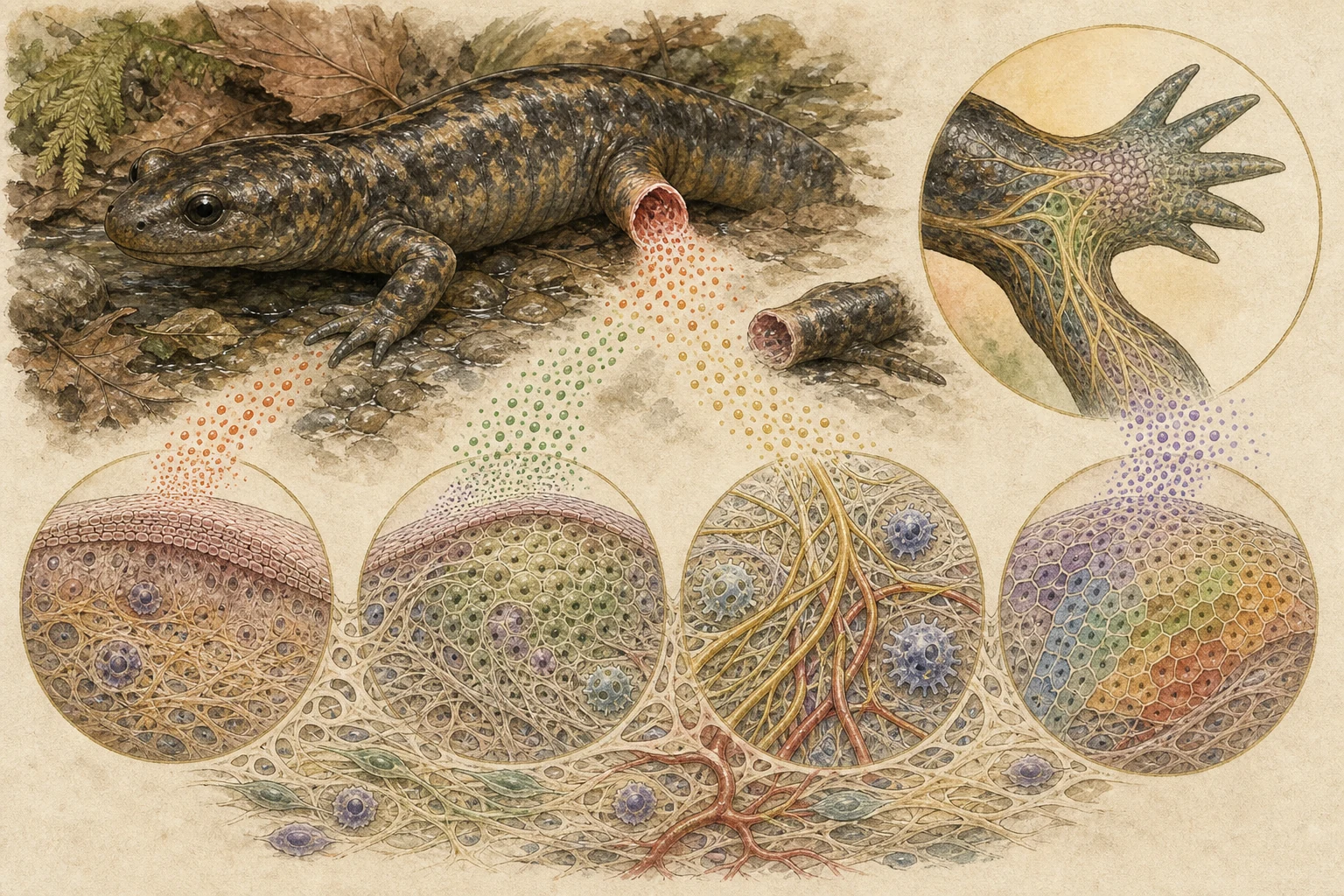
Regenerating salamanders do more than heal a stump. They create a specialized wound environment where surviving cells supply progenitors, nerves support growth, and positional signals guide a replacement with the right structures in the right places.
Last updated
Close the wound without locking it in scar
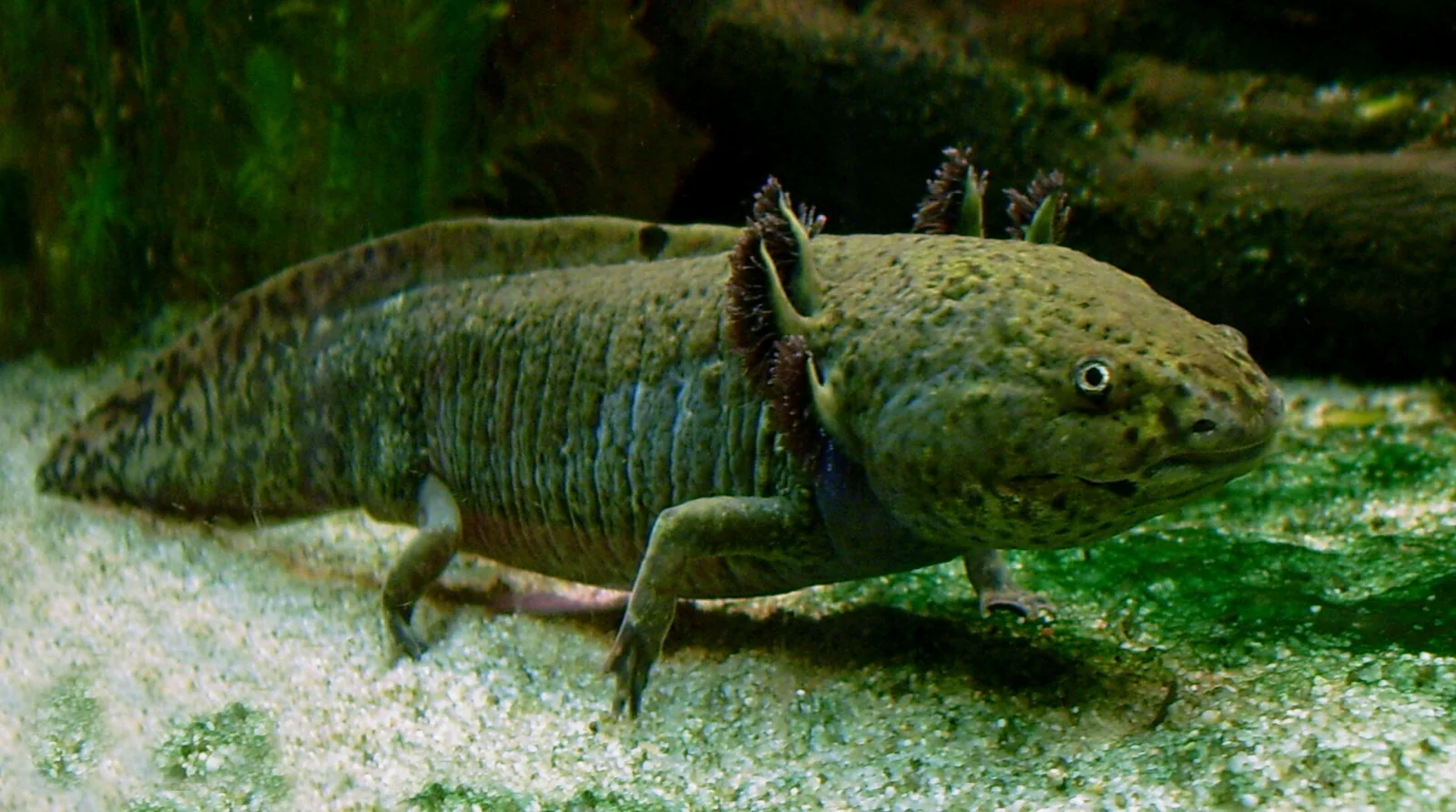
Within hours of a limb injury in an axolotl (Ambystoma mexicanum) or newt, surrounding epidermal cells migrate across the raw stump and seal it beneath a specialized wound epidermis rather than forming a dry scab. Unlike adult mammalian wounds, which rapidly deposit dense, cross-linked collagen scar tissue that blocks further outgrowth, the salamander wound epithelium thickens into an apical signaling cap that communicates directly with underlying stump tissues. Macrophages and other immune cells still infiltrate the site to clear cellular debris and bacteria, but their cytokine profile and extracellular enzymes remodel the matrix to permit cell migration and regeneration instead of permanent fibrosis. [2][3][4]
- Migrating epidermal cells seal the raw amputation surface within hours to form a specialized wound epithelium
- Macrophages clear debris and remodel matrix proteins without triggering a permanent collagen scar cap
- Depleting macrophages early after injury blocks blastema formation and shifts healing toward scarring
Assemble a blastema from surviving tissues
Beneath the thickened wound epidermis, mature cells near the injury plane re-enter the cell cycle, shed their differentiated features, and accumulate into a cone-shaped mass of proliferating progenitors called a blastema. Rather than reverting into a single pluripotent embryonic pool that can make anything, lineage-tracing experiments in axolotls show that most blastema cells keep strict memories of their tissue class: dermal fibroblasts and cartilage cells make new skeleton and dermis, muscle satellite or dedifferentiated muscle cells rebuild muscle, and Schwann cells regrow nerve sheaths. Regeneration succeeds by coordinating these lineage-restricted streams as the bud elongates. [2][3][4]
- Surviving cells near the stump dedifferentiate or activate stem-like progenitors to build the blastema cone
- Lineage-tracing in axolotls shows that cartilage, dermis, and muscle progenitors remain tissue-restricted
- A translucent, dome-shaped blastema bud is the first visible external sign that limb outgrowth is underway
Require nerves and growth signals
A salamander blastema will not grow into a limb if the major peripheral nerves supplying the stump are severed before the bud matures. Axons and accompanying Schwann cells release mitogenic proteins—including neuregulins, fibroblast growth factors, and anterior gradient proteins—that stimulate blastema cells to divide while blood vessels and the apical epidermal cap supply complementary signals. Once the blastema reaches a critical cell mass, it becomes less dependent on nerve-derived factors for basic differentiation, illustrating how regeneration emerges from a timed, reciprocal dialogue among nerves, epithelium, immune cells, and mesenchyme rather than a single master hormone. [2][3][4]
- Severing the nerve supply to a newly amputated salamander stump halts blastema proliferation
- Axons, Schwann cells, and the apical wound epithelium exchange growth factors that sustain cell division
- Blood vessels and remodeled extracellular matrix grow into the bud alongside regenerating nerve fibers
Remember where the cut occurred
When a salamander loses a limb at the wrist, the blastema replaces only the missing wrist and digits; when the loss occurs near the shoulder, the animal rebuilds humerus, radius, ulna, carpals, and digits in proper anatomical order. Classic grafting experiments and modern molecular studies show that connective-tissue fibroblasts carry stable positional identity along the proximal-distal, anterior-posterior, and dorsal-ventral axes, maintained through Hox, Meis, and sonic hedgehog signaling pathways. Bringing cells from opposite sides of the limb circumference into contact at the wound site stimulates intercalary growth until all missing intermediate coordinates are filled in. [1][2][3]
- Connective-tissue fibroblasts retain molecular positional memory of their location along all three limb axes
- Outgrowth replaces only the structures distal to the injury plane, proceeding from stump to digit tips
- Mismatched positional identities across the wound margin help drive proliferation until normal pattern is restored
Recognizing a regenerating limb
An early regenerate in a stream-side newt or pond salamander reads as a smooth, pale, rounded bud on the stump rather than a miniature hand, because the blastema forms and elongates before internal skeletal pattern resolves into digits. Later stages condense cartilage from the amputation plane outward, so limb proportion tells you roughly where the injury occurred: a limb carrying a short forearm and tiny hand was lost near the elbow, whereas one missing only two toes suffered a localized bite. Photograph both left and right limbs from directly above in a shallow dish of pond water before releasing the animal at its exact cover object. [1][2][3]
- Early regeneration appears as a smooth, unscarred cone or paddle before individual digits separate
- Comparing left and right limb lengths shows how far along the proximal-distal axis the original loss occurred
- Subadult and larval salamanders typically regenerate faster and with fewer digit anomalies than old adults
Related guides
Get Fauna and identify it in the field.
Where this guide comes from
Source-checked editorial guide. Last updated . This guide teaches identification and field skills; it is not a substitute for expert verification when it matters.
- Cold Spring Harbor perspectives in biology — Positional Memory in Vertebrate Regeneration: A Century's Insights from the Salamander Limb ↗
- Development (Cambridge, England) — Model systems for regeneration: salamanders ↗
- Regeneration (Oxford, England) — Mechanisms of urodele limb regeneration ↗
- Current topics in developmental biology — Salamanders: The molecular basis of tissue regeneration and its relevance to human disease ↗