How crabs molt and grow
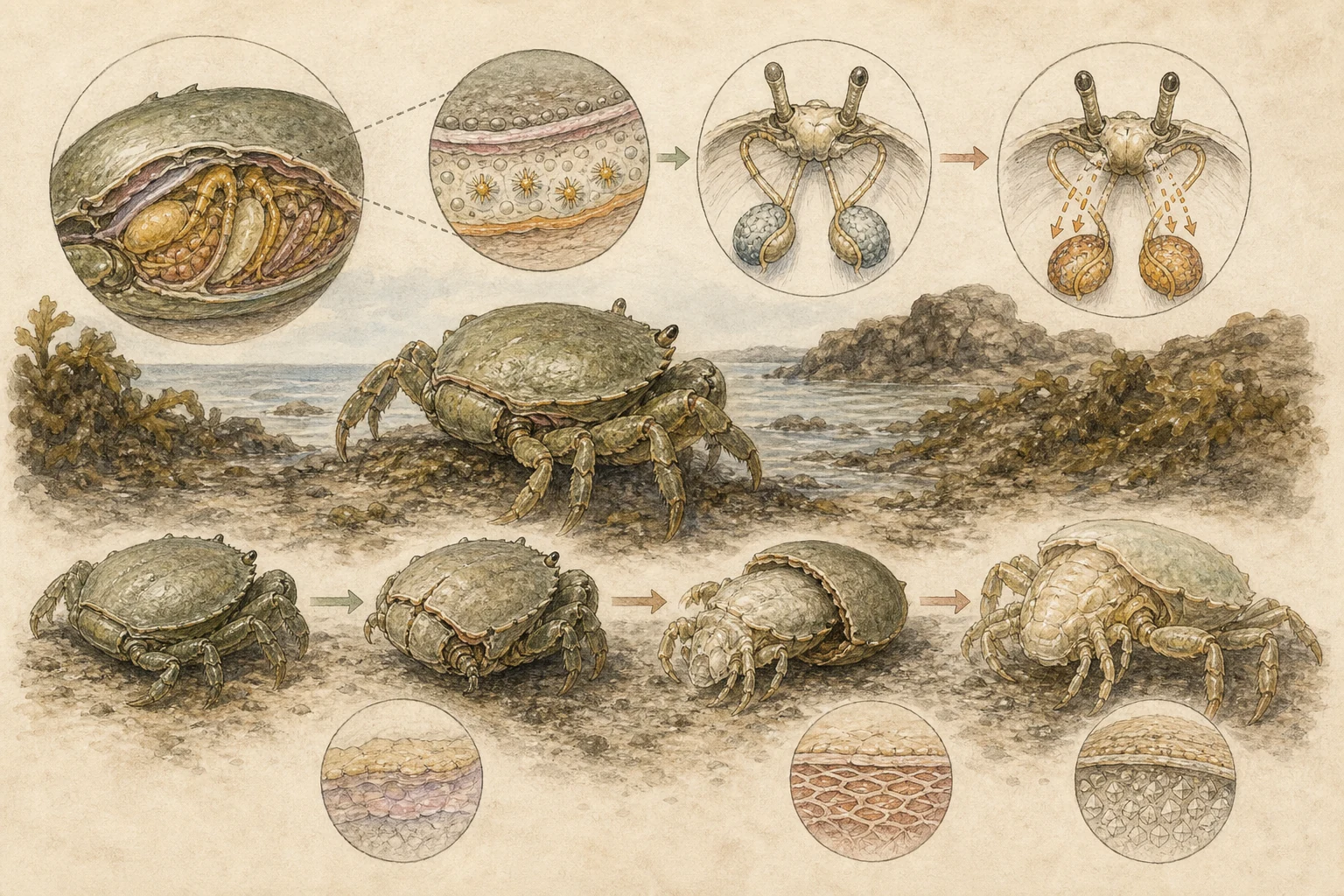
Because a hardened crab shell cannot stretch, growth comes in steps. The crab prepares a larger cuticle underneath, leaves the old shell, expands while the new one is soft, and then mineralizes and strengthens it.
Last updated
Prepare below the old shell
Because a crab's calcified exoskeleton is an external armor box of chitin-protein fibers impregnated with calcium carbonate, the animal's external dimensions stay locked during the long intermolt feeding period while muscle and hepatopancreas reserves accumulate inside. Weeks before shedding, the crab enters premolt (proecdysis): the underlying epidermis detaches from the old shell (apolysis) and secretes molting fluid rich in chitinases and proteases that digest the uncalcified inner layers of the old cuticle. Reclaimed amino acids, sugars, and calcium are resorbed into the body or stored, while the epidermis secretes a wrinkled, larger new epicuticle and exocuticle underneath. [1][4]
- During premolt, the epidermis detaches from the old armor and digests its inner layers to recycle minerals and chitin
- A new, larger, uncalcified cuticle is secreted in soft folds directly beneath the rigid outer shell
- Missing legs or claws that were autotomized earlier develop inside folded limb buds ready to expand at the molt
Coordinate the cycle with hormones
A crab's decision to enter premolt is governed by a two-part neuroendocrine switch linking its eyestalks to a pair of thoracic molting glands called the Y-organs. Throughout the intermolt period, neurosecretory cells in the eyestalk X-organ/sinus gland complex release molt-inhibiting hormone (MIH), a neuropeptide that acts through cyclic-nucleotide and mTOR signaling pathways to keep the Y-organs quiescent. When adequate energy reserves, limb-regeneration cues, water temperature, and seasonal photoperiod align, MIH release drops and the Y-organs ramp up synthesis of steroid molting hormones (ecdysteroids), committing the crab to the irreversible physiological cascade of premolt and ecdysis. [2][3]
- Molt-inhibiting hormone (MIH) from the eyestalk sinus gland normally suppresses the thoracic Y-organs during intermolt
- Rising ecdysteroid levels from activated Y-organs orchestrate cuticle resorption, new shell secretion, and limb-bud growth
- Multiple lost limbs can accelerate molting by reducing inhibitory signaling and stimulating Y-organ activity
Back out and expand
When ecdysis begins, the crab seeks a sheltered rock crevice, kelp holdfast, or seagrass bed and actively drinks and absorbs water across its gut and gills, swelling its internal hydrostatic pressure until the old shell cracks open along decalcified suture lines (ecdysial sutures) around the rear and sides of the carapace. Lifting the old dorsal shield like a hinged lid, the crab slowly backs out—pulling its broad claw muscles through narrow basal leg joints that temporarily soften—and leaves behind a complete, hollow ghost of its former self, including clear eye lenses, gill coverings, and stomach lining. Continued water uptake inflates the soft 'buster' crab to its new, larger size within hours. [1][2]
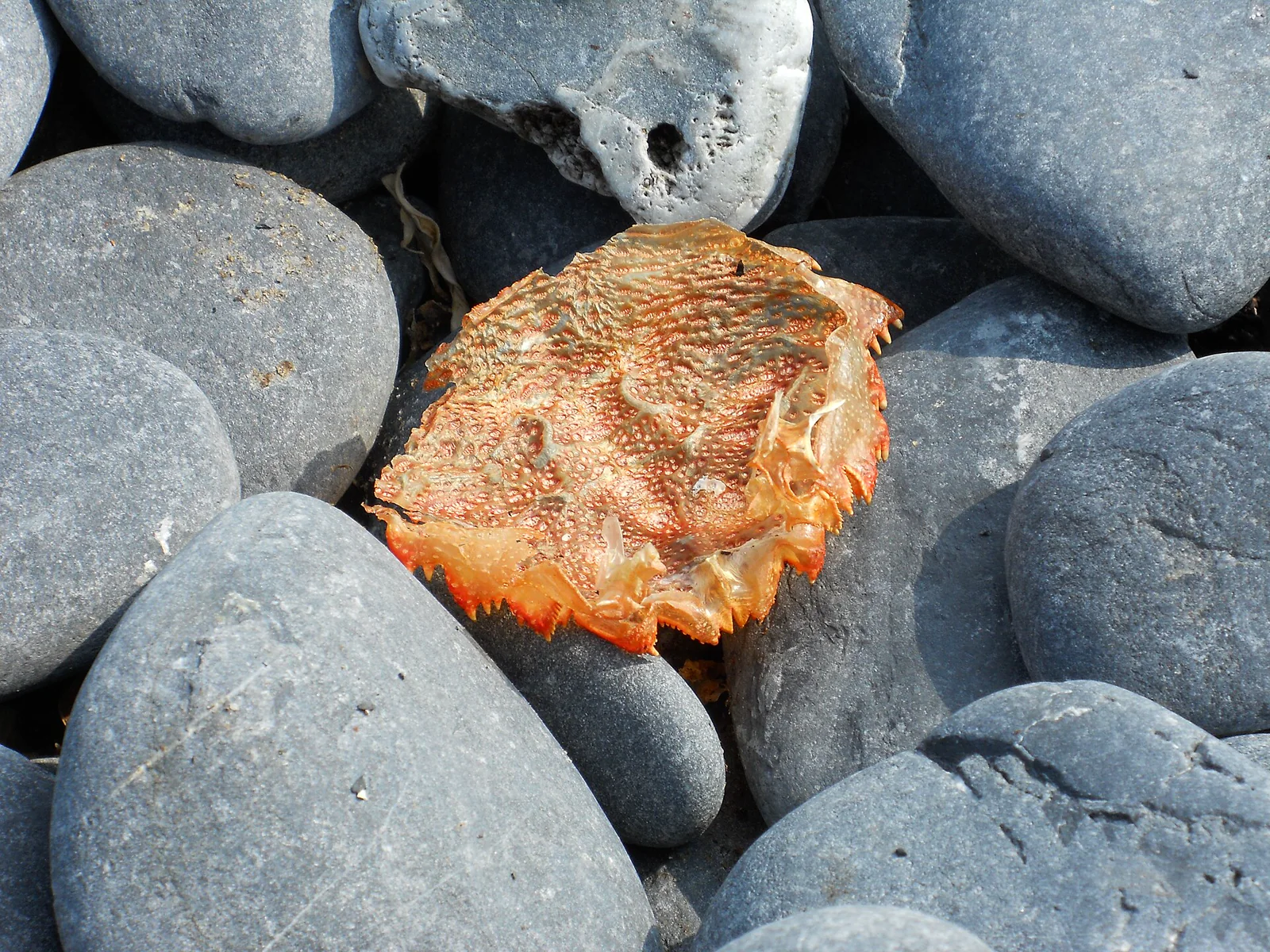
- An empty molt cast (exuvia) on the beach has clear eye lenses and a hinged rear seam, distinguishing it from a dead crab
- Localized decalcification at the base of the chelipeds lets large claw muscles slip through narrow leg joints intact
- Rapid water uptake during and right after ecdysis inflates the wrinkled new cuticle before mineralization begins
Harden a larger exoskeleton
Freshly emerged in the 'soft-shell' postmolt stage, a shore crab (Carcinus maenas) or blue crab (Callinectes sapidus) has papery cuticle that cannot yet anchor powerful claw contractions or deflect a predator's bite. Over the following days to weeks, epidermal cells upregulate structural cuticle proteins, carbonic anhydrase, and ion transporters: quinone tanning cross-links proteins in the outer layers (sclerotization) while calcium and bicarbonate ions pumped from seawater—or mobilized from internal storage deposits in freshwater and land crabs—precipitate as calcite and amorphous calcium carbonate. Only during the subsequent intermolt does actual muscle tissue gradually replace the water space gained at ecdysis. [1][2][4]
- Postmolt hardening combines protein cross-linking (sclerotization) with heavy calcium-carbonate biomineralization
- Marine crabs draw most of their calcium for shell hardening directly from seawater across the gills
- Some families, such as spider and snow crabs (Majidae, Oregoniidae), stop molting altogether after a final puberty molt
Related guides
Get Fauna and identify it in the field.
Where this guide comes from
Source-checked editorial guide. Last updated . This guide teaches identification and field skills; it is not a substitute for expert verification when it matters.
- MarLIN — Marine Life Information Network (UK) ↗
- Frontiers in endocrinology — A Crab Is Not a Fish: Unique Aspects of the Crustacean Endocrine System and Considerations for Endocrine Toxicology ↗
- Frontiers in endocrinology — Signaling Pathways That Regulate the Crustacean Molting Gland ↗
- BMC genomics — Differential expression profiling of components associated with exoskeletal hardening in crustaceans ↗