How spiders build orb webs
An orb web emerges from repeated local decisions rather than a view of a finished blueprint. The spider feels existing threads, measures with its legs, and changes movement patterns as the frame, spokes, and capture spiral take shape.
Last updated
Anchor a bridge and outer frame
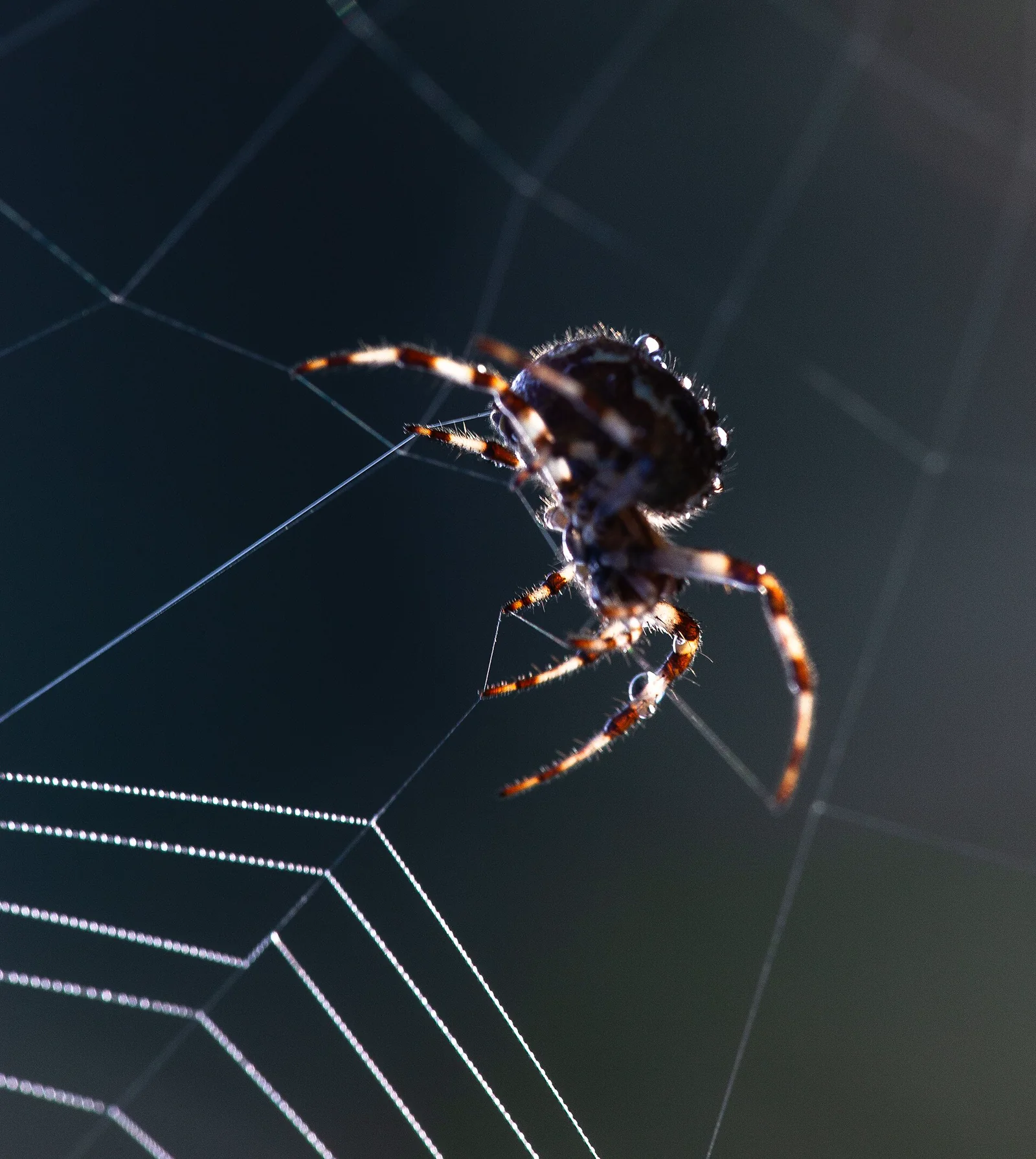
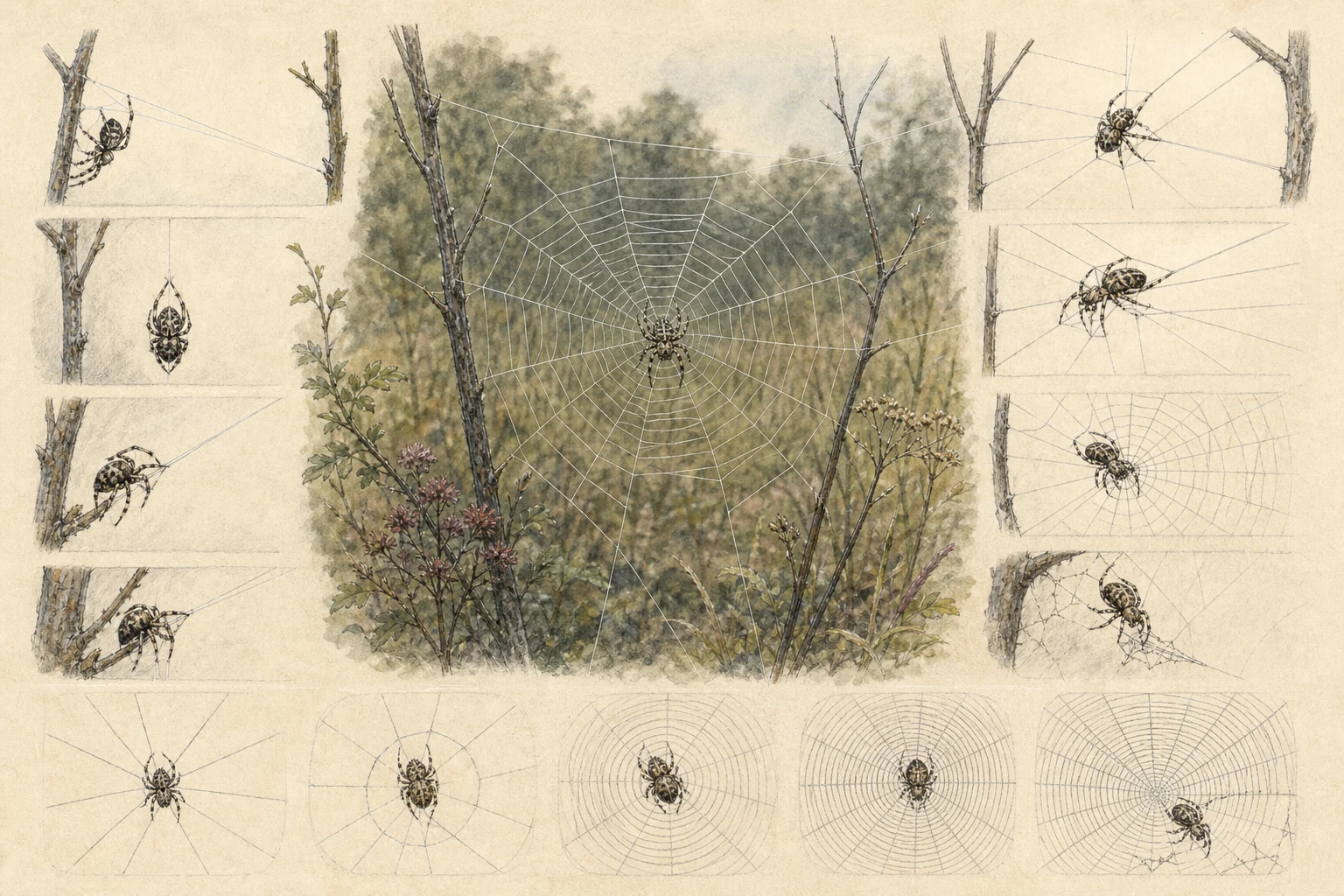
Before an orb weaver such as the European garden spider (Araneus diadematus) or hackled orb weaver (Uloborus diversus) can spin a single radial spoke, it has to span an open gap between stems, twigs, or porch posts. Commonly at dusk or before dawn, the spider raises its abdomen and releases a fine, buoyant silk filament into a breeze until the drifting tip snags on rough bark across the void, or it walks around the gap dragging a safety line behind it. Crossing and doubling that initial bridge thread creates a taut top cable, from which the spider drops on a vertical line and pulls out triangular frame threads that adapt the web's border to whatever crooked geometry the gap allows. [2][4]
- Airborne bridging silk or walked draglines establish the first horizontal span across an open gap
- Repeated crossings reinforce the top bridge line before outer frame threads define the web's perimeter
- Preliminary exploration bouts test anchor stiffness and adjust frame angles to fit irregular branches
Connect a hub with radii
Once the outer frame holds tension, the spider establishes a provisional hub near the center and begins stringing dry, stiff major-ampullate silk spokes between the hub and the surrounding frame. Rather than spinning spokes in simple clockwise order like wheel rims on an assembly line, the builder walks out along a finished radius while trailing a new silk line, steps a measured distance along the frame, pulls the new thread taut with its legs, and anchors it with a tiny silk cement disk (piriform attachment). By alternating sectors across the web and testing radial tension through its tarsal claws, the spider keeps hub stress balanced even when the frame is lopsided. [1][3]
- Dry major-ampullate silk forms the stiff radial spokes that carry load and transmit prey vibrations to the hub
- Spiders alternate radial placements across different sectors to keep tension balanced around the center
- In asymmetric gaps among twigs or rocks, radial angles are spaced closer on the shorter side of the frame
Use one spiral to place another
With the radii in place, the spider turns at the hub and walks outward in a wide, open spiral of dry auxiliary silk that braces the spokes and serves as a temporary handrail where the gap between radii has grown too wide to step across directly. Reaching the outer edge of the frame, the builder reverses course and works slowly inward from periphery to hub, spinning the closely spaced, stretchy capture spiral—coated with microscopic glue droplets in araneids or combed into dry nanofiber cribellar puffs in uloborids. As it attaches each new capture segment, the spider uses an inner front leg to touch the previous loop for spacing while biting out the temporary scaffold spiral behind itself. [1][2][3]
- A widely spaced, non-sticky auxiliary spiral is spun from the hub outward to brace the radii during construction
- Sticky or cribellar capture silk is laid from the outer frame inward while the temporary scaffold is removed
- Tarsal contact with the preceding capture loop sets the regular spacing between sticky turns
Follow rules that remain flexible
Automated computer-vision tracking of complete web-building bouts in Uloborus diversus showed that each construction stage—exploration, radial building, auxiliary spiral, and capture spiral—has a distinct leg-coordination signature that allows observers to tell which phase the spider is in from a few seconds of motion alone. Yet these inherited action rules respond continuously to local feedback: a spider with depleted silk glands widens its capture spiral spacing, a web torn on one side by a beetle is patched by sector, and many orb weavers eat their old silk at dawn to recycle its amino acids into a fresh orb the next evening. [1][2][3][4]
- High-resolution posture tracking shows that each web-building stage uses a distinct stereotypic leg rhythm
- Gravity shifts hub placement slightly above center in many vertical orbs so the spider can drop faster to lower sectors
- Many orb weavers ingest damaged capture silk daily and recycle its proteins into the next night's web
Related guides
Get Fauna and identify it in the field.
Where this guide comes from
Source-checked editorial guide. Last updated . This guide teaches identification and field skills; it is not a substitute for expert verification when it matters.